
“That would be it!”, says Nikos Markou, my companion from Limassol, as we see the 39 Qvevri winery. Bitsmendi lies around 35 kilometres from Tbilisi, near Mtskheta, the ancient capital of historic Iberia – once a historic kingdom in the Caucasus. It is quiet here. There is little agriculture in the valley, along with a few elegant country houses belonging to Tbilisi’s upper class. On the distant mountain ridges, the silhouettes of stone monasteries stand out. Blue September sky, strong sunshine, a little haze after what was probably a cool night. The winery dominates the landscape. A castle-like new building, inspired by historical models but by no means kitsch. Clear architecture, surrounded by its own vineyards. They continue to grow every year, with additional areas being cultivated for viticulture.
A start-up rather than a family history
39 Qvevri is not the further development of one of those classic family businesses so frequently found in Georgia. Quite the opposite: it is a start-up. A comparatively young wine project: founded in 2019, professionally established and staffed with specialists from the outset. In the car park we are met by Ekaterine “Eka” Khmiadashvili, the managing director, together with winemaker Vazha Tchabukiani and several other young specialists from the team. And I think to myself: My God, how young are they all?
Eka Khmiadashvili is in her thirties, but has long been no unknown quantity in the Georgian wine world. She has been working professionally in the industry for around 15 years: teaching assignments, export management, consultancy and academic work have all formed part of her path through Georgian wine before she eventually came to 39 Qvevri. Vazha Tchabukiani is the winery’s winemaker and shows us around the estate that day together with Eka and the others. Behind the young team, however, there is also one of the most experienced minds in Georgian winemaking acting as an adviser: David Chichua. A biochemist, winemaker and winegrower, he has been involved with wine for more than two decades, served as chief winemaker at several Georgian wineries, taught wine technology and wine chemistry, and researched ancient Georgian grape varieties.
Why 39, exactly?
Let us remember: the qvevri is a large earthenware vessel sunk into the ground, in which wine is fermented and matured – a type of vessel that also took hold in Europe around 25 years ago. Above all in Italy. The tradition of this winemaking method goes back thousands of years in Georgia. Naturally, we are not talking about small vases here. A qvevri can hold 1,500, 2,000 litres or more. At 39 Qvevri winery, there are – unsurprisingly – 39.
The concept is followed through consistently. Qvevri are not decoration here. They form the foundation of the winery. The 39 vessels are housed in a huge hall with a wooden dome, whose construction helps regulate light and ventilation. Technically, intervention is limited to what is necessary. Aluminium panels can be inserted into the qvevri and filled with warm or cold water to regulate the temperature. That is all. Not much more happens. Caring for the underground vessels remains manual work. Cleaning and renewing the wax layer, together with firing them out, are part of the annual and not entirely risk-free procedure. Someone has to climb down into the qvevri’s throat to do it.
A wine range that explains qvevri
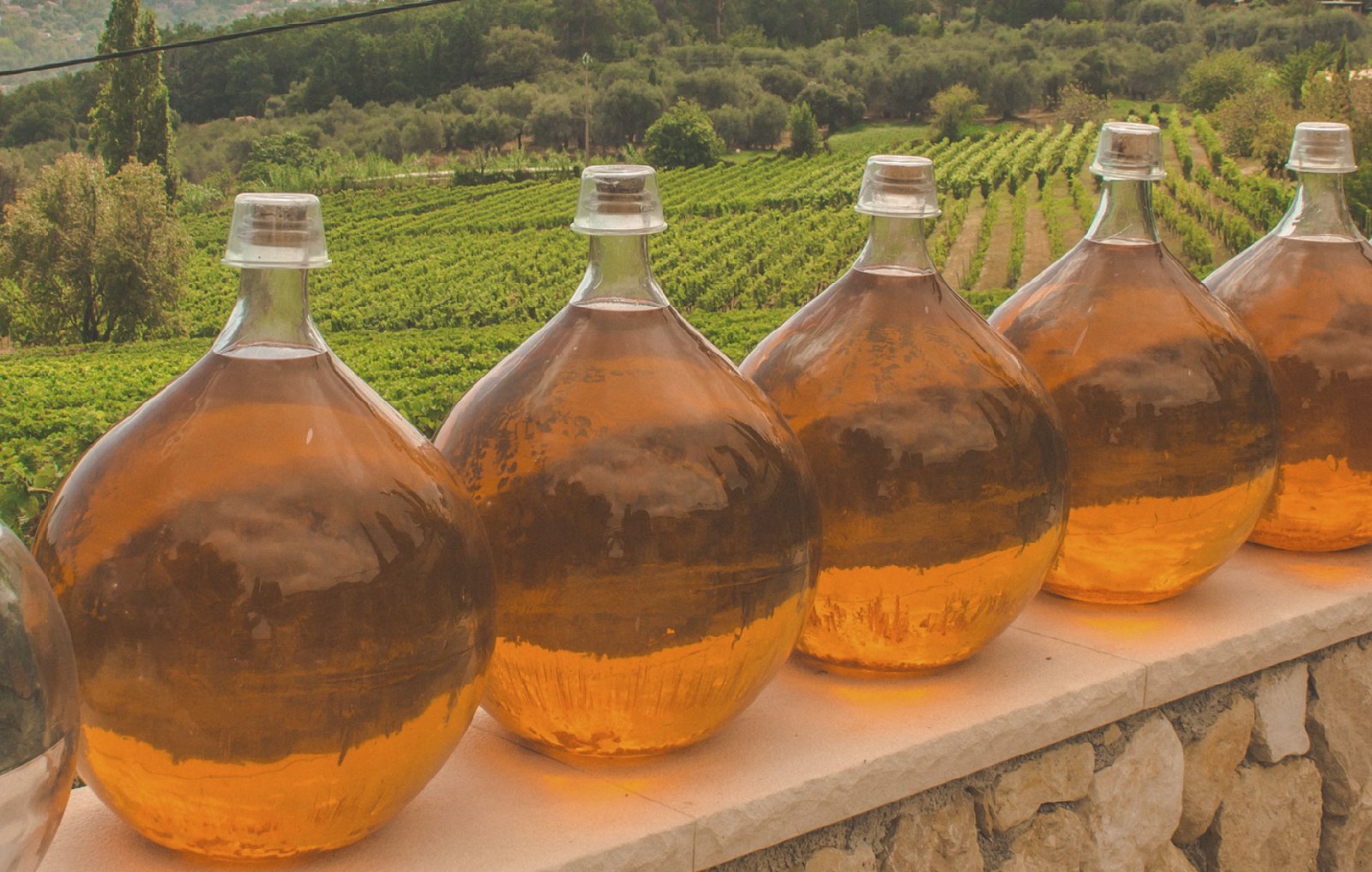
The range comprises around eight to ten wines and is remarkably clearly structured. Anyone wanting to get to know qvevri wines does not have to plunge straight into an extremely tannic wine here. We can drink our way through the range and learn to understand what actually happens in the qvevri. With white grape varieties, in any case, we are not really talking about “white wine” in the classical Central European sense. These are amber wines – the Georgian version of what is usually called orange wine here. In combination with the qvevri, this produces wines that are simply lovely to drink on the one hand, while also being excellent food companions on the other. They can quite easily replace a red wine, especially with the well-seasoned Georgian grilled dishes. But also with steak. Or Serbian bean soup. Or heavily spiced khinkali.
The Chinuri comes first. Here, only around 30 per cent of the must remains with the wine. The result is an exceptionally approachable amber: bright, floral, with a little white peach and nut, a light grip of tannin but no weightiness. With Goruli Mtsvane, things become denser, more structured and more aromatic: more fruit, more body, more of that phenolic character that makes these wines such good food companions. Rkatsiteli then leads decisively into the classic Georgian amber world: yellow fruit, quince, nutty and slightly tea-like notes, together with considerably more structure. Khikhvi shifts the picture towards herbs and spice. Not a linear progression, but rather an expansion of the spectrum. By this point, we have already cleared the cheese board. And then comes Kisi: broad, powerful, complex. Yellow and dried fruit, plenty of structure, pronounced tannin and a long finish. With this wine at the latest, one understands why the usual division into white and red wine does not get one very far with traditional Georgian wines.
And yet: the reds
I chiefly remember Tavkveri as a spicy, lighter red. Not the powerful, concentrated red one might perhaps instinctively expect from Georgia, but a wine with spice, fruit and an invigorating lightness. Shavkapito seems cooler and tauter, perhaps also somewhat more “European”: darker fruit, spice, less warmth and heaviness. And finally Saperavi: dark, powerful, concentrated. Plum, black cherry, acidity, tannin – in the wine we tasted, wood also exceptionally came into play.
What is impressive about 39 Qvevri is the consistency of the entire range and how naturally it conveys an understanding of the different wines and how they are made. You are not presented with seven variations of the same wine. You can genuinely follow what grape variety, proportion of must and maturation do to the style. Anyone who visited VieVinum 2026 in Vienna in May will probably already have encountered 39 Qvevri. Georgia was the guest country, and 39 Qvevri was also present at the Hofburg. In a few months, the winery plans to expand its offering to include agrotourism and to offer tastings and a restaurant on a larger scale. A reason to travel to this Caucasian endpoint of ancient civilisation.
In Germany, GeoWeinhaus in Berlin carries several wines from 39 Qvevri, including Saperavi, Chinuri, Kisi, Khikhvi, Tavkveri and Shavkapito. Also in Berlin, the wines can be found at 8000 Vintages; Goruli Mtsvane, among others, is listed there. In the United Kingdom, Saperavi Social in London carries 39 Qvevri, and in Cyprus, Wine Case in Limassol does so. In the USA, the winery is part of Van Horn Imports’ portfolio; at retail, the wines can be found, for example, at The Meteor in Austin, Texas. Information about the wines, the winery and contact details is, of course, also available directly from 39 Qvevri.