
by Manfred Klimek
People had already grown accustomed to the wine world groaning. Too few guests, too many bills, too little hope. The narrative was saturated with frustration – and within it lay that weariness which settles in over the years like yeast that no one stirs.
And then, on a Saturday in Großlangheim, during the oyster event at the Grebner family’s Patrizierhof, suddenly everything was turned upside down.
It was, in parts, delightfully loud; there was laughter, singing, drinking from glasses that were never empty. Beats somewhere. It smelled of salt, shell and sparkling wine. The wine flowed as it once had, when people still thought that intoxication was a right – and not a luxury. As though the Patrizierhof lay above a wine volcano, and now, at this very moment, a fissure had opened from which something rose that had been thought lost.
A publican, half euphoric, half astonished, said that his guests had started drinking again about three months ago. Not merely tasting, not merely sipping, not merely asking, but drinking. By the bottle. With hunger, with pleasure, with seriousness. He could not explain it. But nor did he want to ask for long. Because it was happening. Now.
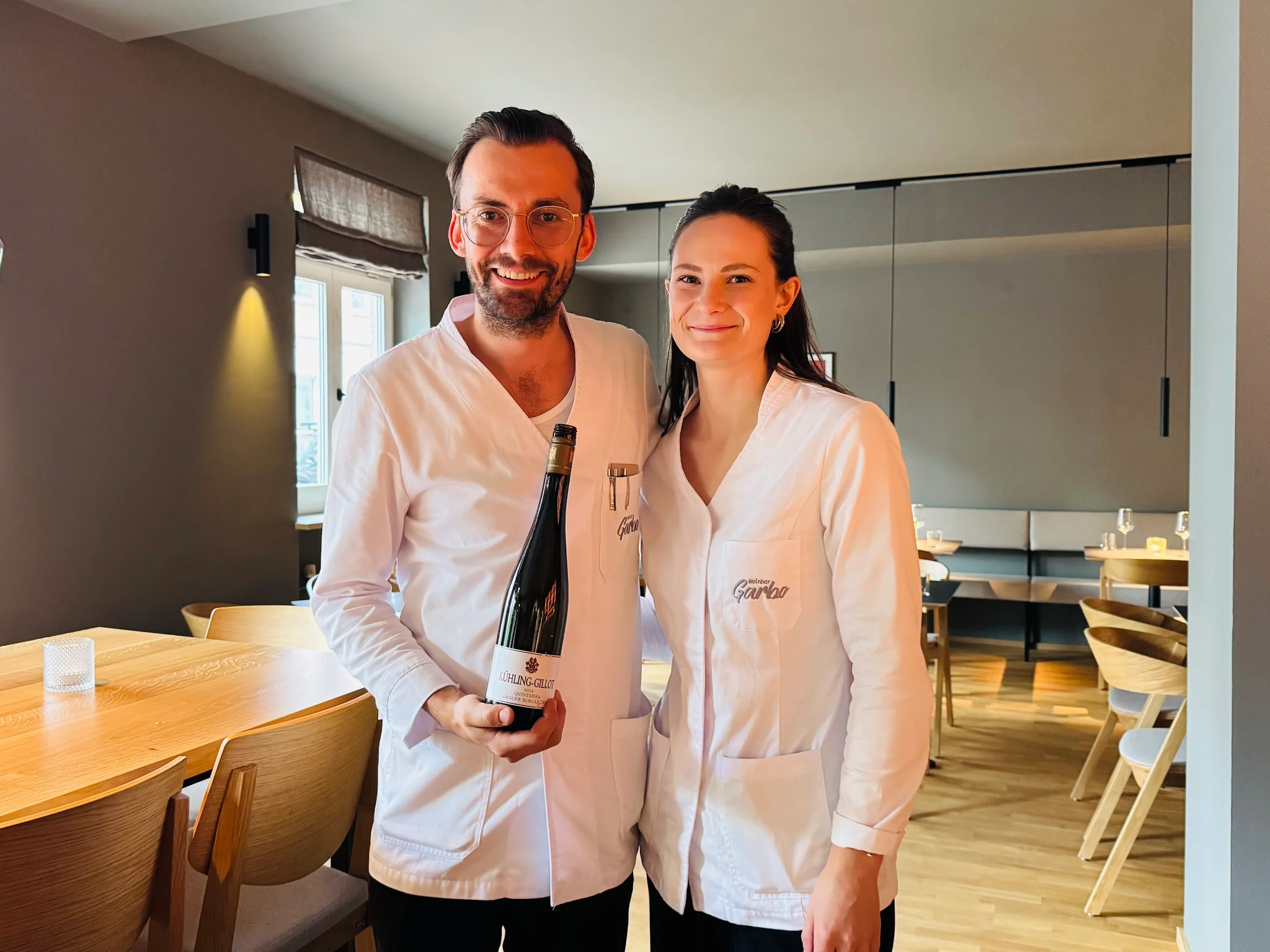
And then the name was mentioned: Garbo.
A new wine bar in Munich, run by Stefan Grabler and Markus Hirschler. Not even two months old. And already they are saying: it is like back then, at Cordobar. At that feverish, vibrant, legendary Cordobar, where Willi Schlögl and Stefan Grabler once set the night alight with Riesling. And indeed: it is burning here too. At Garbo. The guests stand, crowd in, drink. The regulars’ table, where no seat can be reserved, is like a gate into another era. The takings recall pre-Covid nights, Berlin at four in the morning, the feeling that anything is still possible – if only there is enough wine.
It is not the only island. Freundschaft, Willi Schlögl’s bar, has long since established itself as a new epicentre. Not just another counter, but a place with attitude and humour. The wine list is wild and recognises no genre boundaries. Chardonnay alongside sake, aged Gamay alongside Lambrusco. Whoever drinks there becomes part of a game that knows no rules except: openness.
The Garbo, so I heard, is even more nervous, even closer to the street, closer to pleasure. But then it is Munich, so more stylish and a touch more self-absorbed: poured and intervened. In the atmosphere, in the taste, in the self-understanding of a scene that waited for events for too long. Now it is putting them on itself again.
And what does that mean?
That the wine world is not shrinking exclusively, but surviving on islands. And there, in these bright, feverish zones, gathering new strength. Zones of resistance are emerging everywhere. Against stagnation. Against paralysis. Against the idea that wine is something that has to be analysed to death.
This new scene is not large. It will not feed all winegrowers. It will only marginally enliven the trade. It is not “the solution”. But it is life. And that place from which one sets out for new shores – that is enough. Because something emanates from these places. Not merely turnover, not merely attention – but conviction. A sense of what wine can be when one regards it not as a product, but as a promise. As movement, not as a brand. As escalation, not as calculation.
The dance on the wine volcano is not naïve. It knows that the industry is wavering. But it dances all the same. Precisely because of that. And if the embers are sufficient, others will follow. Not because it is a trend, but because it is defiance.
A glass in hand. Music in the veins. And the feeling: it matters again now.