
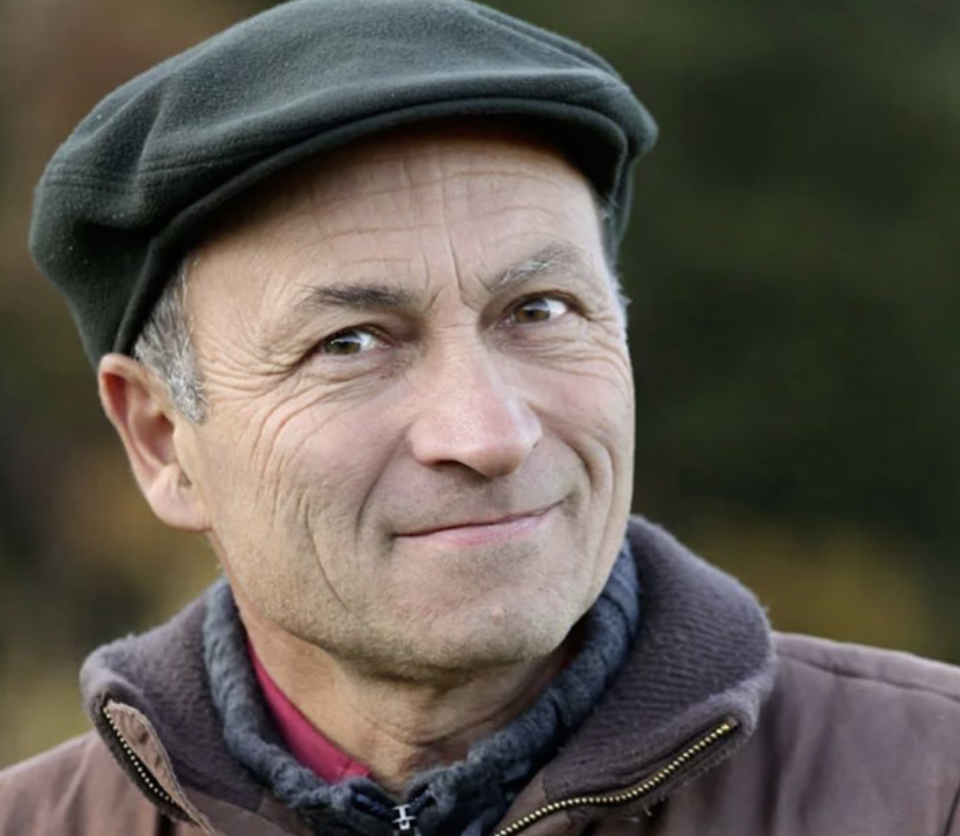
(Claude Auguste / Manfred Klimek)
Emmanuel Reynaud has died. Aged 61. Not old at all. He was the winemaker who did not modernise the Rhône, as so many others did, but restored its memory – and who was revered for it as a hermit-prophet. With his death, it is not just a winemaker who has passed away, but a style, a way of seeing the world, a chapter in viticulture that was already on its way out. The wines, all of them expensive rarities, saw their secondary market prices rise by around ten per cent following his death. One senses: this will never happen again.
Rayas and Reynaud – that was Grenache, but as no one else understood it. No muscle-flexing, no alcohol-fuelled heaviness, no barrique hammering. Reynaud demonstrated that Grenache need not be broad, but rather translucent, light, fragrant, almost ethereal – yet with power and staying power. Long-lasting staying power. That elegance does not come from the barrel, but from the courage to allow the wine to mature and the determination to leave out everything superfluous.
It’s now forgotten just what a scandal this once was. A Châteauneuf that abandoned the old, traditional cuvée blending – the commune’s versatile blend of grape varieties – and instead bottled pure Grenache – as Châteauneuf-du-Pape. For decades, Châteauneuf was the bastion of full-bodied wines, high alcohol content, and proud, dark, opulent wines, which in recent years were even decanted – despite their 15 per cent alcohol content – as if they were logs for the fire. And then came this quiet man from Sarrians, who received almost no one, but who silenced everyone who was allowed to visit: with a Châteauneuf made solely from Grenache, which smelled of wild strawberries rather than jam, of dry woodland, of sand, of herbs growing on barren, very barren soil. Grenache as a poem, not as a machine gun.
Reynaud was one of the last who dared to view Châteauneuf not as a brand, but as an intimate experience. A man who was never tempted to update his style, because he knew he possessed only this one, perfect formula – his instinct for winemaking. He worked with old foudres that, at the outset, had more history than he did. He was a latecomer – a very late one. He fought, sometimes defiantly, against modernity, because he knew that modernity is all too readily traded for truth and reality – when modernity becomes a fad.
Over the last twenty years, he increasingly became the anchor of a region that had to reinvent itself – something it did not always succeed in doing. International trends shifted; alcohol-laden wines were suddenly no longer cool, but embarrassing. Emmanuel Reynaud was proof that this transformation does not mean capitulation, but liberation. But now that he is gone, a part of this return to our roots is also lost.
For with him dies one of the last who still understood Châteauneuf-du-Pape as an intellectual and spiritual place: as a landscape of sand, stone, light and early summer air. As a being.
His life story fits perfectly with this outlook: The boy who tended vines at Château des Tours just as other French country children tended their rabbits, who later took on the legacy of a Château Rayas in a state of disrepair, who replanted plots that no one really wanted to save any more, and who, in the end, was the one who restored the estate’s dignity.
Reynaud was a revolutionary through gentleness. Yet gentleness has the short end of the stick these days.
With his death, it is not Rayas, the estate, that dies. But an era in which Grenache was allowed to be poetic.