
(Manfred Klimek)
Even before the first bottle is opened here, the Rieger winery reveals virtually everything about itself. How so? The people. We are in the Markgräflerland, in the deepest south-west of Germany.
In the winery tavern, Josepha and Bernhard Rieger serve their guests. They do not seem like the senior owners they are, but like winegrowers who are genuinely delighted by every visitor; and visitors come here in no small numbers from neighbouring Switzerland, where they would pay at least a third more for the same quality of wine and tarte flambée.
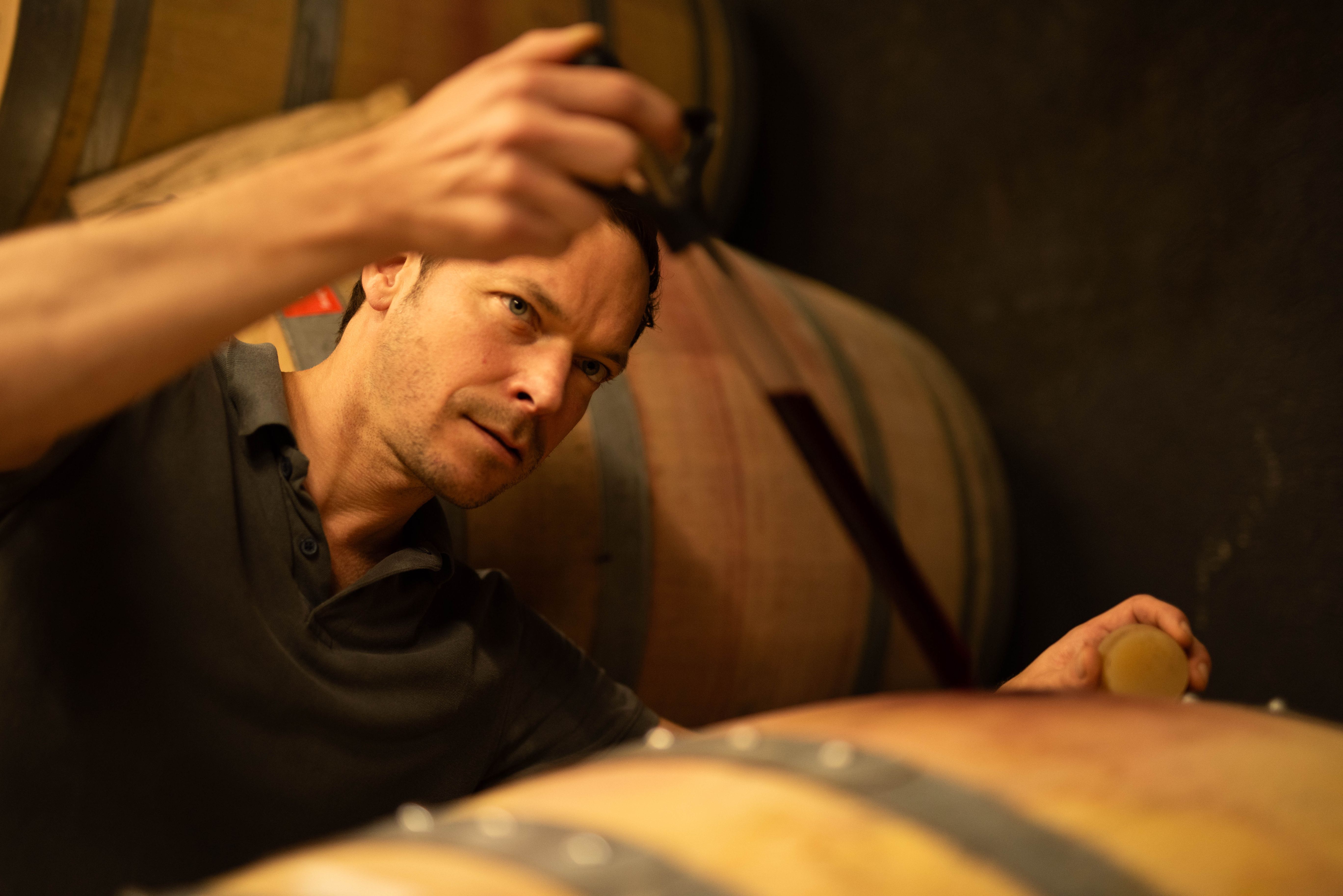
Their son Philipp runs the winery today. He possesses that pleasant melancholy which develops in people whose lives had to endure fractures early and unexpectedly. Fractures rarely make biographies simpler, but almost always more interesting. Perhaps that is why he approaches his wines entirely without pathos. In an industry in which some winegrowers want to explain their greatness in their very first sentence, this is a refreshing quality.
Then there is Markus Brauchle, cellar master and responsible for international distribution. In the midst of barrels and tanks, a conversation about literature suddenly develops. Completely unexpectedly, he pulls Harald Irnberger’s cult Viennese book “Geil” out of a bag, talks about it with the same enthusiasm as he does about wine and presses it into my hand to read as I leave. That too is part of a good winery: it entertains people whose interests extend far beyond grape varieties and fermentation temperatures.
And finally, sitting beside me in the delivery van is Nina, a young member of the Riegers’ team, who drives me through the vineyards (I never got a driving licence), fetches good music from her Spotify account and turns out to be a kind of intellectual wine groupie: one of those people who do not merely take wine as a given, but are curious about what lies behind it. As the vines pass by outside, we talk about God and the world – and rather little about wine. Conversations like these cannot be planned. They simply happen.
Only afterwards do I begin to take an interest in the winery itself. They have worked organically since 2005 and according to Demeter guidelines since 2010 – without any great eco-fuss. Today, the family farms more than 25 hectares of vines, ranks among the largest biodynamic wineries in Baden-Württemberg and, as I see it, combines consistently accessible winemaking with a remarkably calm modernity – serenely good.
Now to two wines that the Rieger-Brauchle team sets before me. First, the most interesting Rieger wine for me, which is not one of their internationally acclaimed top wines, but the still-classified-as-simple Pinot Noir vom Löss (2023 vintage, €12.00). At a time when red wines are selling increasingly poorly (why, actually?), this red wine is what the British call a “burner” – a product for consumption that we immediately understand and like. This Pinot is worth far more than it costs: heart cherry, not insignificantly ripe, also slightly bitter rosehip, hardly any plum, but a hint of blueberry and some cassis, as in great village wines from Burgundy, around 200 km away. Brutally drinkable on the palate. And the best thing: we can easily forget this wine in the cellar for another ten years. Thanks to its acid structure, it will then be one of the region’s finest mature red wines. And genuine value for money.
After that, the Gewürztraminer Hitzbuck from 2022 (€22.00): one of the most interesting and finest Gewürztraminers in Germany. On the nose, some marzipan, yellow flowers, cherry, nashi pear, a little cypress, then sea breeze, rose and raisin, wax. On the sip, a little fresh sweetness, honeydew melon, yet extremely much drier than on the nose. The slight Campari bitterness on the final finish turns this Gewürztraminer, actually a banal aromatic variety, into an experience. World-class winemaking.