
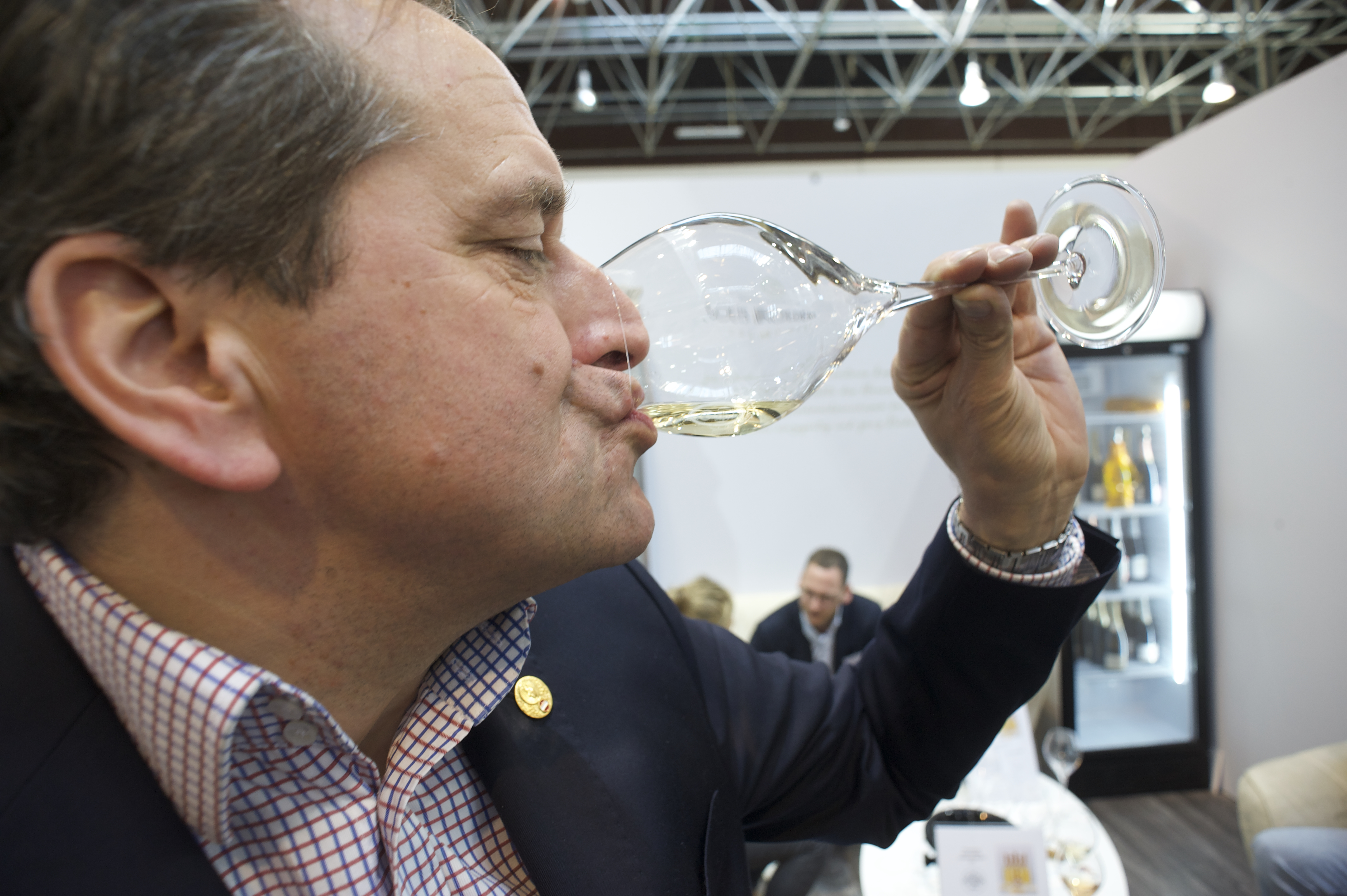
(Gerhard Retter / Editorial team / Photo: Manfred Klimek)
South Tyrol is small. At least on the map. Just under 5,800 hectares of vineyard area between the Alps, the Dolomites, apple orchards, steep slopes and terraces. A wine country that can be described in just a few figures – and yet eludes every simple description. For South Tyrol is not a wine-growing region that can be understood through hectares, litres or grape varieties. South Tyrol thrives on contrasts. Alpine and Mediterranean. German-speaking and Italian. Farming country and design region. Cooperative country and small-scale winemaker laboratory. Conscious of tradition and, at the same time, remarkably agile. South Tyrol is so “much much”.
South Tyrol’s true jewel-like quality has little to do with the age of its often very young winemakers. It reveals itself in their thinking. In their approach to provenance. In their approach to tradition. In their approach to change. This is how wines with freshness, precision and a sense of provenance are created here. Wines that rarely seem immediately pleasing and yet possess great drinkability. Wines that reflect their surroundings: cool and clear in structure, yet shaped by the warmth that characterises life south of the Brenner Pass.
South Tyrol is by no means sustained solely by romantic small-scale producers. The cooperatives of Alto Adige are among the most efficient and quality-oriented in Europe. They have made a significant contribution to South Tyrol now being perceived internationally not merely as a beautiful landscape, but as a reliable wine origin. That is precisely where the region’s special quality lies. Large, highly professional wineries exist alongside tiny family businesses. Historic monastic wineries alongside young low-intervention projects. Cooperative logic alongside radical parcel-by-parcel work. The vines grow between 200 and 1,000 metres above sea level, on limestone, porphyry, moraine, dolomite, gravel, clay, quartz and volcanic rock. The temperature differences between day and night are often greater than those separating entire seasons elsewhere.
The result is wines with tension. Pinot Bianco with remarkable architecture. Sauvignon Blanc with Alpine freshness rather than exotic excess. Chardonnay that does not have to copy Burgundy. Kerner that allows its altitude to be tasted. Pinot Noir with more nerve than muscle. Lagrein, which is becoming ever more precise. And Vernatsch, perhaps South Tyrol’s most culturally important grape variety, which is finally once again being understood as what it can be: identity in a glass.
South Tyrol too is grappling with climate change, hail, late frost, rising costs and changing consumer behaviour. The region is, however, starting from an unusually strong position. Provenance, craftsmanship and premiumisation are not subsequent marketing ideas here, but have been part of reality for decades. High-altitude sites are not a romantic backdrop, but a strategic advantage. At the same time, a generation of female and male winemakers is growing up that no longer has to prove that South Tyrol can produce great wines. They are more interested in precision than in effects. In provenance rather than stylistic expression. In individuality rather than the recognisability of international role models. Here are two producers and two wines that I would like to introduce
Haderburg – South Tyrol’s great sparkling-wine tradition
Let us begin with Haderburg in Salurn: the Ochsenreiter family works at the Hausmannhof in Buchholz above Salurn, at altitudes between 350 and 550 metres. Haderburg is one of those producers that should be mentioned far more often in international discussions about sparkling wine. The conditions are ideal: cool nights, calcareous and sandy weathered soils, traditional bottle fermentation and lengthy lees ageing. Above all, patience. Haderburg does not produce sparkling wines for quick effects, but for development and depth.
The 2019 Pas Dosé is exemplary of this style. Chardonnay and Pinot Noir meet precision, freshness and structure. The absence of dosage does not seem ascetic here, but self-evident. Nothing is concealed. And nothing needs to be hidden. The result is not a sparkling wine for the reception before the meal. It is a wine that can accompany a meal. Oysters, crudo, shellfish, poultry, mushrooms or truffles find here a sparkling wine (made using the Champagne method) on an equal footing.
Neustift Abbey / Abbazia di Novacella – History as a real advantage
Old, but young in its thinking: the Augustinian Canons’ monastery was founded as early as 1142. Neustift Abbey’s winery is one of the oldest active wineries in the world. History is not managed as a museum piece here, but used productively. It provides experience, knowledge and continuity. And many old cellar books that tell many stories about winemaking. The Isarco Valley has its own language within South Tyrol. The high-altitude sites provide freshness and tension from acidity; the wines are precise, linear and aromatically clear. Few grape varieties benefit from this more than Kerner.
The 2024 Kerner Praepositus shows why this variety has found perhaps its most convincing home in the Isarco Valley. Kerner can quickly become too much: too aromatic, too exotic, too immediately pleasing. Here, the opposite happens. The fruit remains present, but is supported by minerality, dryness and structure. The vineyards lie between 650 and 750 metres above sea level. Moraine soils, mica schist, paragneiss and quartzite shape the character. The cool nights preserve freshness and tension.
The Praepositus therefore seems not fashionable, but timeless. It goes with terrines, Asian-influenced dishes, poultry, spicy vegetable cuisine or mature mountain cheese. With wines such as these, it becomes clear that aromatics are never the problem. The problem begins where they no longer possess any structure.