
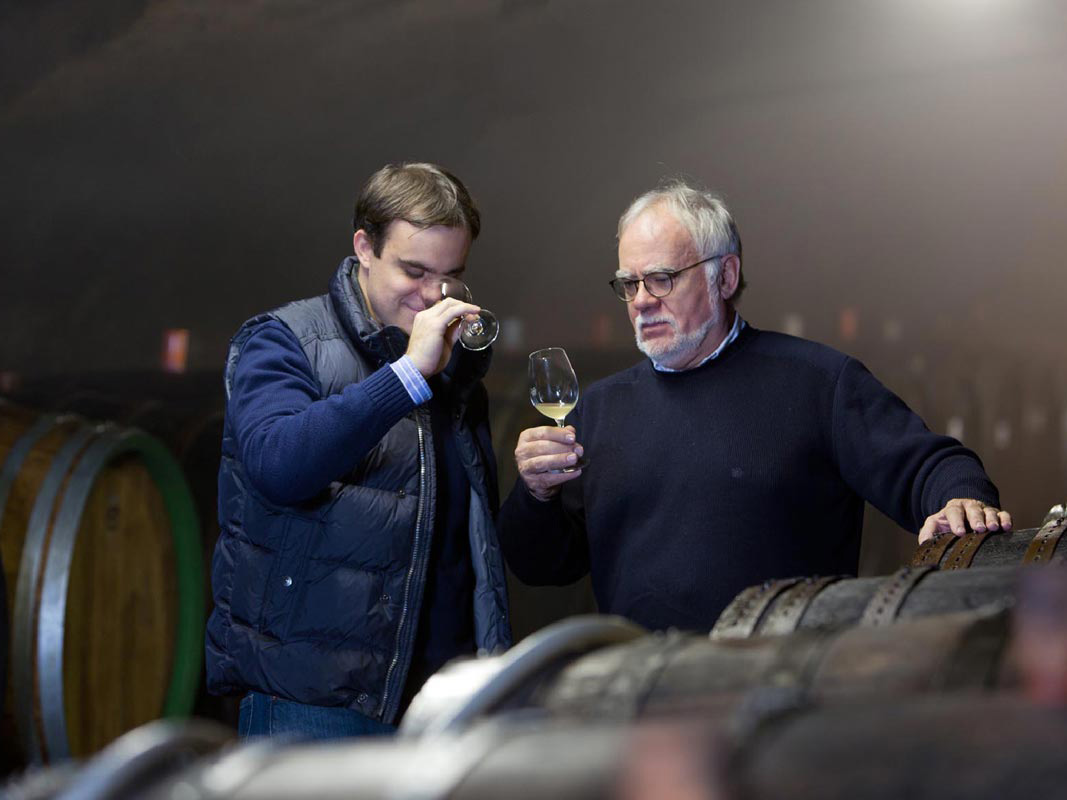
(Manfred Klimek)
There are also wineries that do not need a revolution in the current crisis, because their stability is in itself an expression of revolutionary intelligence. Max Ferdinand Richter in Mülheim an der Mosel is one of these rare, exceptional estates. An estate that has known what it is doing for centuries – and which therefore stands astonishingly unshaken even in times of global wine crisis. Not because they chase the market, but because they have built trust through prudence, conservative liberalism and a reliable style. 200,000 bottles a year, of which around 80 per cent are exported, and of those, approximately 30 per cent go to the USA – and even there, where Trump’s punitive tariffs have hit a number of Moselle winegrowers hard, the decline has been minimal. Cleverly negotiated partnerships, stable relationships, no scaremongering: it works.
The blend of grape varieties remains classic: 95 per cent Riesling, plus Pinot Blanc, a little Pinot Noir and the old ‘Gemischter Satz’, newly planted here. A foundation built not on nostalgia, but on experience.
Alter Satz 2024
Riesling, Heunisch, Orleans, Traminer, Adelfränkischer, Grünfränkischer and Kleinberger – a wine like a window into the past. Macerated directly in the vineyard, aged for a year in a 1,000-litre Fuder. The Traminer’s aroma comes through clearly, even though it makes up only five per cent. Floral spice, a delicate grip, steeped in history yet light on its feet. 2,000 bottles – a wine of the present can scarcely carry more of the past.
Riesling Gutsriesling 2024 (dry)
9.90 euros is actually too little for a genuine steep-slope Riesling. Stone fruit, subtle slate, 11.5 per cent alcohol. An honest, unpretentious wine that shows what ‘normality’ can taste like when craftsmanship is taken seriously.
Riesling Gutsriesling semi-dry 2024
20 grams of residual sugar, 9 acidity – the semi-dry Mosel style that the younger generation would love, if only the trade associations could finally market it better. ‘Low Alk, big fruit’ is practically written on the glass here. An underrated style, 9.90 euros, 60,000 bottles – and each one perhaps represents a market that remains largely untapped simply because it was swept aside by the current trend for dry wines.
Riesling Graacher Domprobst, Old Vines, dry 2024
: 90-year-old vines. 3,000 bottles: peach, stone fruit, juicy, powerful with 12 per cent alcohol, just 2 grams of sugar – a bone-dry classic that has a firm place, particularly in the hospitality sector. A Riesling without any harshness.
Riesling Brauneberger Juffer-Sonnenuhr, Großes Gewächs 2024
Dark berries, ripe stone fruit, a hint of slate spice, spontaneously fermented, like all the wines here, delicate, satisfying. 11.5 per cent alcohol, 32 euros, a wine with a deep calm and a subtle pulse. Mosel elegance in a delicious, intellectual style.
Riesling Mülheimer Sonnenlay, Kabinett, off-dry 2024
9.5 per cent alcohol, 20 grams of sugar – the light sweetness dances on the palate. Rowan, raspberry, lots of raspberry, herbs, mineral coolness. A wine that demonstrates why moderate sweetness on the Moselle is not a ‘leftovers’ category, but a cultural technique.
Riesling Kabinett Elisenberg(er) Monopol 2024
, 7.5 per cent alcohol, a Napoleonic endowment, peach, apricot, quartzite slate – and yes, ‘lemonade for adults’ (an ironic quote from the winemaker). A wine with pedigree, wit and a historical aura. €15.90.
Riesling Sonnenuhr Kabinett 2024
Pure blue slate. Apple, mirabelle plum, apricot, Nashi pear. 7.5 per cent alcohol. A textbook Mosel Kabinett: distinctly fruity, yet without the cloying sentimentality that has put us off residual-sweet wines for years.
Riesling Sonnenuhr Spätlese 2024
70 grams of sugar, 7.5 per cent alcohol. Fig skin, vineyard peach, cassis, herbs, old wood. The full spectrum of Mosel sweet wines, delivered with precision and an extraordinary sense of style. 23 euros.
Riesling Himmelreich Auslese 2024
7 per cent alcohol, 90 grams residual sugar, 20 per cent botrytis. Honey, apricot, greengage, slate. A wine that puts Sauternes firmly in its place – and quite thoroughly at that.
Max Ferdinand Richter, known as ‘Ferl’, embodies a Mosel aesthetic that neither seeks to be trendy nor can be considered old-fashioned. Instead: supreme confidence. This is precisely why this winery is weathering the current crisis almost unscathed.
And because red wine – specifically Pinot Noir – is also part of the estate’s identity, a closer look at the two excellent Pinots will follow – in one of the forthcoming issues of *WELT am SONNTAG*.