
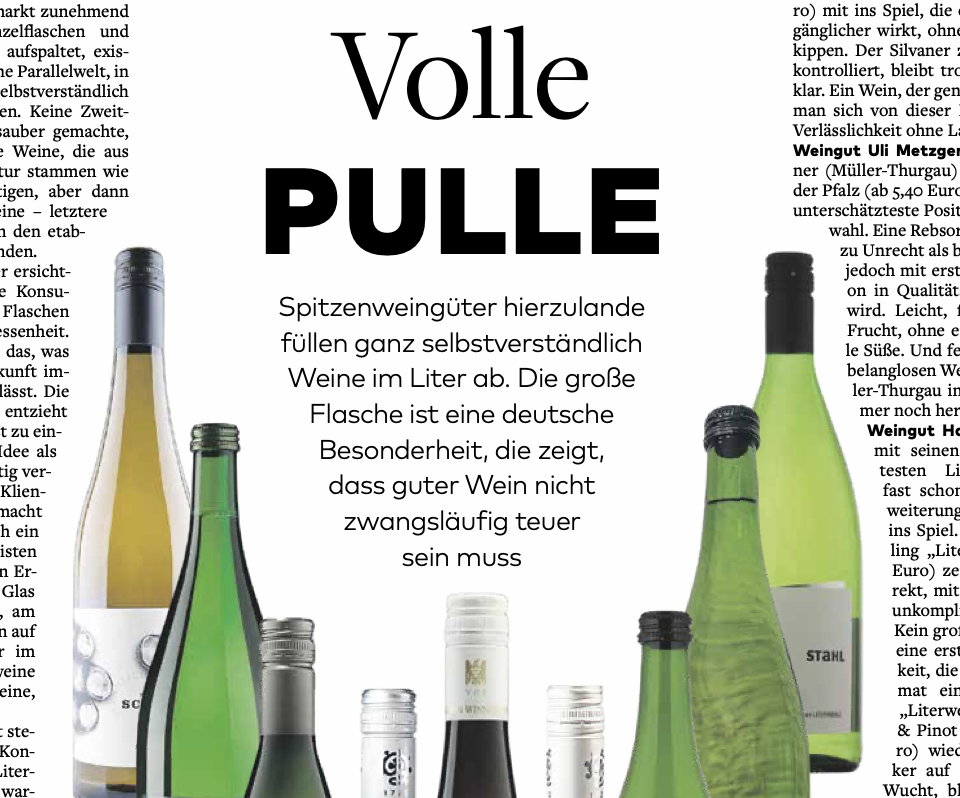
(Manfred Klimek / WELT am SONNTAG)
It is the all-rounder for wine consumers – specifically those who do not want to go without their daily good glass of wine: the litre bottle of decent wine, containing very respectable German wines for comparatively little money. Made by quite prominent, successful winemakers who could dispense with this format without suffering major financial losses. But they do not want to. Not yet.
A bottle format, moreover, that by international standards seems almost out of its time, yet preserves something that disappeared elsewhere long ago: the idea that good wine does not necessarily have to be expensive. While the global wine market is increasingly splitting into prestige sites, individual bottles and narrative inflation, Germany has a parallel world in which top estates quite naturally bottle wines by the litre. Not second-tier products, but cleanly made, often remarkably precise wines that come from the same winegrowing culture as the equally affordable but ultimately more expensive estate wines – almost always bottled in the established 0.75-litre format.
And yet, despite all the obvious advantages for consumers, these bottles are increasingly being forgotten. The trade loves what can be narrated, what can be upgraded; it loves what can be made ever more exclusive in terms of price and provenance. The litre bottle, by contrast, eludes this logic. It is too simple, too clear in its identity as a table wine, too unspectacular. At the same time, the clientele for whom it was originally made is also disappearing: people who want to be able to afford a good glass of wine without turning it into an event. A glass with a meal, in everyday life, in the evening to relax on the balcony, terrace or in the garden – because litre wines are above all white wines, summer wines.
The wineries themselves face a conflict that is not communicated externally. Every good litre wine raises the question of why the same winery’s estate wine should cost more. As a result, the litre bottle is often underpromoted – a product that exists but rarely takes centre stage.
Objectively speaking, it is a German singularity. In France, for example, the idea of “vin de soif”, a simple, easy-drinking wine, does exist, and major houses such as Domaines Barons de Rothschild certainly produce accessible qualities at modest prices. Yet the litre format – this deliberate choice to offer more wine at the same quality – is rarely found there.
In Germany, by contrast, the litre bottle has its roots in the restaurant trade, in table wine and wine served by the glass. It is not a statement, but a permanent cultural fixture. A litre of wine meant to be shared, aimed not at the moment of tasting but simply at the pleasure of drinking. The declining enthusiasm for drinking among younger generations after 2000 is its problem – and at the same time its opportunity. For it stands for something that wine is increasingly losing, and that the younger generation is no longer even secretly looking for: an unselfconscious normality.
There is no doubt that the grapes for these wines come from the first harvest, the early picking, during which all grapes that the winery no longer wants to let mature are sorted out. Nor is there any doubt that part of the grape material also comes from qualified purchases from trustworthy grape suppliers. Despite these levellings, perceived as qualitative limitations, no reputable winegrowing estate can afford to allow even a single bottle of wine to leave the property without also embodying the quality criteria of the winery’s most expensive wine. For an merely average wine from a winery known for quality would be a catastrophe – especially in the age of social media.
So it is time to take these bottles seriously. Not as a curiosity, but as what they are: one of the last genuinely democratic forms of wine offering.
The Silvaner in a litre bottle from the winery also represented in Michelin-starred gastronomy Winzerhof Stahl (from €6.50; the somewhat higher-quality bottled version called “Kilo” for €9.50) from Simmershofen in Franconia shows how clear and fresh this category can be when it is taken entirely seriously. No decorative superstructure, but a precise, straightforward wine that reduces the grape variety to its robust essence. Freshness, a cool streak, plus that typical, slightly bitter herbal character that keeps the palate alert.
The Juliusspital in Würzburg interprets its litre Silvaner (from €8.50) somewhat more classically. There is more roundness here, more Franconian oenological self-assurance. The fruit seems riper, the wine softer overall, without losing its definition. A Silvaner that relies less on tension than Stahl’s, and more on balance – and finds its strength precisely there.
At Zehnthof Luckert in Sulzfeld am Main, a truly great Franconian winemaker with wines of international standing, the litre Silvaner (from €11.50) becomes an understated expression of great ability. The wine is austere, precise, almost severe in its structure. Less fruit, more structure, more of the soils’ saline character, a clear signature that does not ingratiate itself. The fact that such a style appears in a litre bottle is almost a statement in itself.
The Weingut Schenk in Randersacker, finally, brings a Silvaner litre version (from €8.50) into play that seems somewhat more open and accessible, without ever becoming banal. The Silvaner shows fruit, but in a controlled way; it remains dry, clean and clear. A wine that delivers exactly what one hopes for from this category: reliability without boredom.
The litre Rivaner (Müller-Thurgau) from the winery Uli Metzger from Grünstadt in the Palatinate (from €5.40) is perhaps the most underrated entry in this selection. A grape variety that was long, and not without justification, regarded as inconsequential, but here is transformed into Qualitätswein with astonishing precision. Light, fresh, with clear fruit and none of the obtrusively banal sweetness. And far removed from the many forgettable wines that Müller-Thurgau in Germany still has to stand for.
The Palatinate Weingut Hammel adds an almost playful extension of the idea with its two most prominent litre bottles. The “Literweise” Riesling (from €6.36) is juicy and direct, with clear acidity and uncomplicated fruit. No great depth, but remarkably easy to drink, which is exactly what the format calls for. The “Literweise” rosé (Dornfelder & Pinot Noir, from €5.79), meanwhile, places greater emphasis on fruit and also power, but always remains fresh and invigorating – almost casually good.
The Riesling from the Deidesheim winery Von Winning in litre format (from €7.10) seems like a controlled balancing act. The estate, known for ambitious, often oak-influenced wines, shows here that reduction is possible even in the simplest category. Clear, precise, with clean acidity and fruit that never dominates, leaving room for the soils’ saline character. A litre wine with a sense of place, without putting it on display.
David Spies, a winemaker in Rheinhessen and cellar master of the best-known Riesling served in DB dining cars, delivers a litre Riesling that perhaps comes closest to this category’s ideal. A Riesling that wants nothing except to be good. Fresh, straightforward, with exactly the right balance of fruit and acidity. No statement, no concept – simply a wine that is there when you need it.