
(Text: Manfred Klimek & Claude Auguste, who knows the wines better)
One of the peculiarities of the current wine crisis is that, alongside declining consumption worldwide, demand for the wines of a small number of producers, often very small ones, has by no means diminished. Nor are these producers necessarily based in the classic centres of the international wine trade. Twenty years ago, the wines of the French Jura were still regarded, even among reasonably knowledgeable wine drinkers, as specialities requiring explanation. Today, the region has developed into one of the most interesting phenomena in recent wine history. Around 2,000 hectares of vines, a manageable number of winegrowers and an international level of attention that many considerably more important wine-growing regions might well envy the Jura for.
The American Wine Enthusiast recently devoted attention to one of the region's most extraordinary appellations. In his article, Aleks Zecevic asks whether Château-Chalon is France's last great wine secret. A perfectly reasonable question, although secrets written about in internationally influential wine media have the unpleasant tendency to stop being secrets before long.
Zecevic had already looked in detail at the rise of the Jura the previous year. Towards the end of the noughties, American importers began introducing the then comparatively inexpensive wines to an interested gastronomic public. In New York, wines from Overnoy-Houillon were being poured by the glass; today, they are among the most sought-after collector's items from the Jura internationally. The names Ganevat, Labet, Tissot, Bornard and Overnoy became a kind of international code of recognition among wine enthusiasts. Knowing them signalled that one engaged with wine beyond the established hierarchies. This was, incidentally, a not entirely insignificant social aspect of the wine hype: for a time, possession of knowledge could replace possession of money as a status marker. Until the knowledge itself became so popular that one once again needed a great deal of money to keep up.
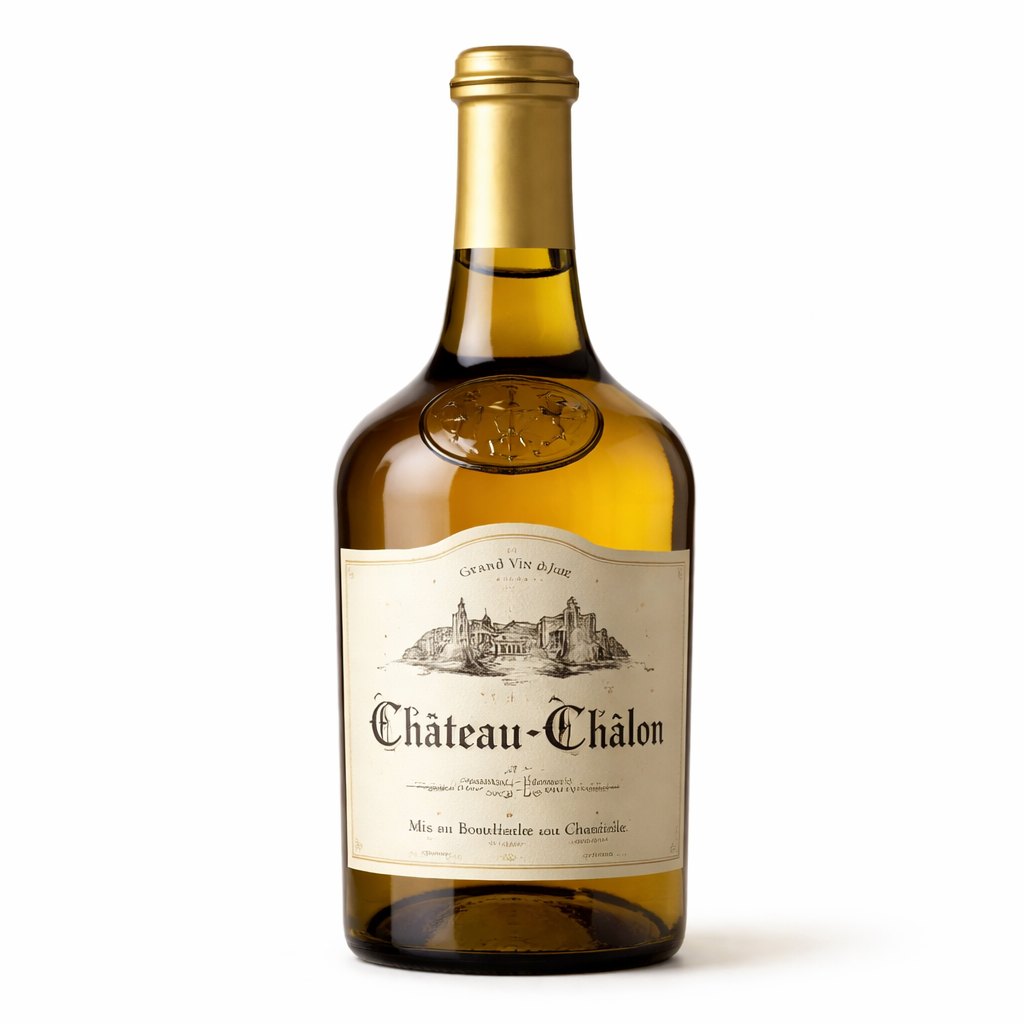
Château-Chalon occupies a special position within this development. The appellation, independent since 1936, is devoted exclusively to one type of wine: Vin Jaune made from the Savagnin grape variety. The wine spends more than six years in a wooden barrel that is not completely full. Beneath a naturally forming layer of yeast, it develops the peculiar aromatics that make it one of Europe's most unmistakable white wines. Walnuts, hazelnuts, dried orange peel, curry, fenugreek and, occasionally, a spice reminiscent of mushrooms, along with often astonishing freshness and almost obstinate acidity. The wine is dry, its flavour extraordinarily persistent and its life expectancy considerable. Even after several decades, such wines can still be remarkably vibrant.
The slightly squat 620-millilitre bottle specifically intended for Vin Jaune, the Clavelin, is just as much part of the wine's identity as its unusual production method. A statement by the geologist Michel Campy, whom Zecevic quotes in Wine Enthusiast, is interesting. Campy puts Château-Chalon's geological uniqueness into perspective. The famous blue-grey marl soils are also found elsewhere in the Jura. What determines the wine's standing, he says, is the work carried out by the winegrowers over centuries. This is a noteworthy expansion of the term terroir, which is used so inflationarily today. For terroir would therefore also be the sum of the experiences of those people who have cultivated, studied and interpreted a landscape over generations. People would be an integral part of the terroir, rather than merely its more or less gifted translators.
One of the most important addresses in Château-Chalon is Domaine Macle, whose wines should be remembered as a reference for the appellation's classic style. Despite all their nutty, oxidative spice, a Château-Chalon from Macle can possess enormous precision, salty minerality and an almost austere structure. It is also worth exploring the Vin Jaunes of Stéphane Tissot and the exceptionally long-lived Savagnins of Jean-François Ganevat. In general, it would be a mistake to get to know the Jura exclusively through its oxidatively matured wines. The Chardonnays and Savagnins matured with the barrels topped up regularly, the so-called Vins ouillés, can, in terms of tension, extract and mineral differentiation, certainly approach the finest white wines of Burgundy without having to taste Burgundian as a result. Then there are the often pale-coloured, fine-boned red wines made from Poulsard and the spicier, more substantial ones made from Trousseau. The Jura is an astonishingly broadly based wine-growing region for its small size.
The fact that there are economic and climatic problems here too should not be overlooked amid the enthusiasm. In Wine Enthusiast, Carmen Macle describes how rising alcohol levels and falling acidity make it more difficult for the natural layer of yeast to form, which is crucial to the maturation of Château-Chalon. A wine region whose reputation is based on the perseverance of its producers is, of all places, being challenged in that perseverance by climatic changes. What is to be done when nature increasingly makes it difficult to continue a centuries-old tradition?
And what does the Jura's success tell us about the future of the wine hype? There is much to suggest that in future we will have to view this hype in a more differentiated way. The great years, when enthusiasm for wine was almost inevitably accompanied by rising prices, new prestige products and ever more elaborate staging, are likely to be over for the time being. But this by no means means that part of the wine public's desire to discover, understand and bring attention to extraordinary winegrowers and their wines has died out.
The Jura also shows that appreciation for a wine region can build up over a very long period. The work of some importers, sommeliers, wine merchants and wine journalists who were engaging with these wines fifteen or twenty years ago continues to bear fruit today. The fact that speculators have now also entered the scene and that four-figure sums are being paid for individual bottles is the less welcome side-effect of this development. But it should not tempt us to ridicule in retrospect the original enthusiasm for these wines.
It would be fatal, incidentally, if wine journalism were to lose its curiosity in the face of the current crisis and henceforth focus primarily on sales statistics, grubbing-up premiums, health studies and the industry's economic hardships. Highlighting extraordinary winegrowers and their wines is not a journalistic activity that we should allow ourselves only during the economically good years for wine.