
His death came as a surprise and was also a slap in the face for the Kremstal wine scene – back in 2018, when Walter Buchegger died. At fifty. After breakfast. In the middle of his work. He, the storming force, the one who kept moving things forward, who drew the consequence from the region’s stagnation in the late 1990s: to make modern wines, thereby alienating old customers and binding new wine drinkers, younger wine drinkers, to his wines with a completely revamped range – above all in the then rapidly growing bars and restaurants scene.
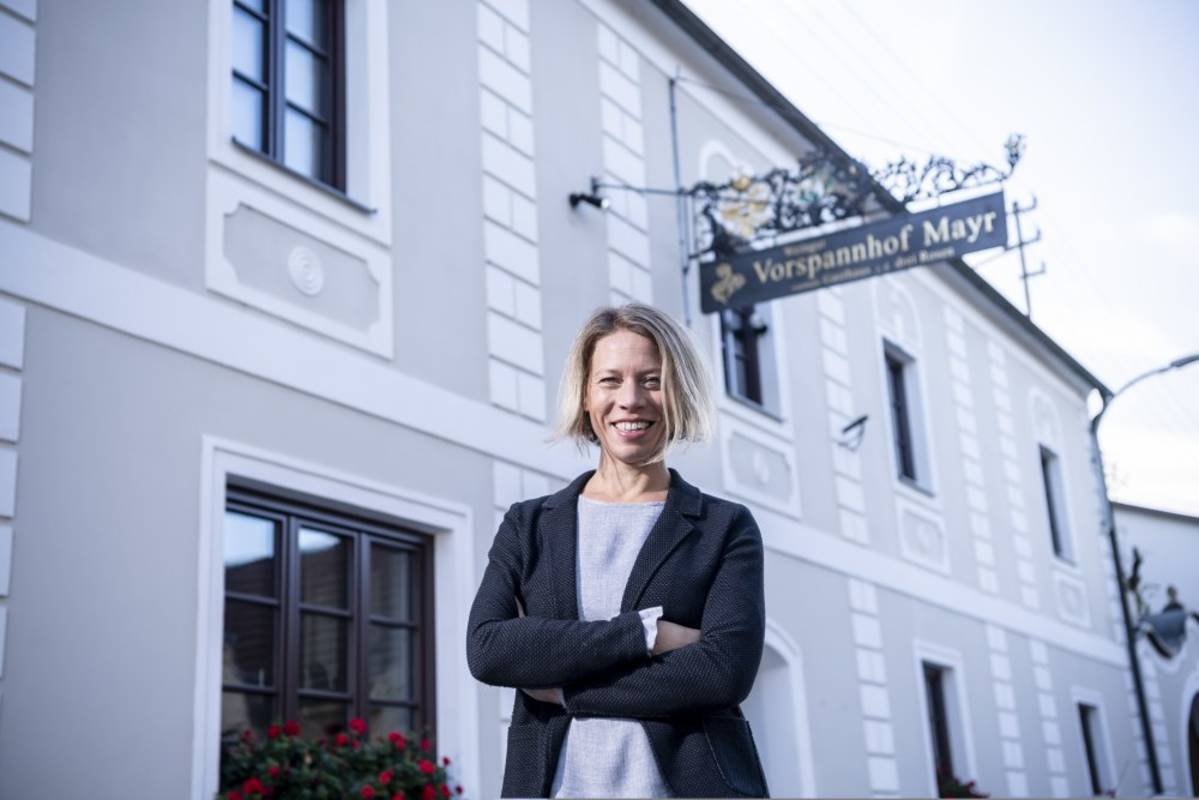
After Walter Buchegger’s death, his partner Silke Mayr was left alone – winegrower, mother of their children and now also responsible for two wineries. Her own winery, Vorspannhof Mayr and the Weingut Buchegger, which Walter had built up. It could have meant the end – for one of the estates, perhaps for both. But for Mayr, an intellectual and strong woman, resigned thinking was not an option. She did not merely stand firm. She rose to the challenge. Today, the names Mayr and Buchegger stand for continuity and an unmistakable, quaffable modernity: for wines that assert the future.
Anyone opening bottles from either of her estates today senses seriousness and precision, clarity and, yes, conviction too. Nothing merely pleasing, willing to cater to the desire to please, nothing arbitrary, as ideological winemaking prescribed for so long. Instead, wines that reflect the local terroir to perfection, distinguishing this small wine region, if only slightly, from its larger neighbours, Wachau and Kamptal. One of these differences is the location of vineyards on the edge of the area, where the forests of the cool Waldviertel begin – the region where the so-called Bohemian Massif, the Czech upland, begins.
The Grüner Veltliner Ried Wolfsgraben (Vorspannhof Mayr) 2024 (€9.50) shows how much a basic wine can contain in terms of provenance: loamy loess soils, as is often the case here, vines aged 40–50 years, stainless steel, barely any time on the skins – and yet substance, saltiness and a delicate tension. Not a rustic, simple Veltliner, but a wine that pinpoints the much-praised, autochthonous delicacy of the grape variety – a point that can simply be described as drinking pleasure.
The Riesling Gedersdorf Ortswein (Weingut Buchegger, €9.90) follows immediately: no copy of German Rieslings, which would not be possible here anyway, no sweet echo of a Kabinett wine idea, but taut, stony and individual. A wine that shows how the newly revived trend for enjoyable wines translates from the farm into the trade, a trend that at both estates, especially at Vorspannhof, is still very strongly shaped by direct sales from the winery – that old, personally run farmers’ market of the winegrowers, which is worth its weight in gold in these times.
Then the Rieling Kremsleiten 2024 (Vorspannhof Mayr, €15.50): terraces, barren, the old vines inherited from his grandfather. Stone fruit, peach, firn. Massive in structure, fresh in expression. A wine with weight, without ever seeming heavy.
In between, the Rote Veltliner Ried Tiefenthal 2023 (Weingut Buchegger, €16.50): smoke, walnut, hazelnut, gooseberry, raspberry. Morbid, but never rustic. Wet clay, dark, sensual. A Buchegger through and through – for the large glass, not the small one. Roter Veltliner, incidentally, has little or nothing to do with Grüner Veltliner and was already being grown here when robber barons still ruled the Danube region.
With the Riesling Erste Lage Ried Marthal 2024 (€22) provides Silke Mayr with a counterpoint: nut, apricot, peach, together with a tannic note from seven hours of skin contact that lends power and flavour. Stainless steel, clarity, density. And thrilling tension.
The Grüner Veltliner Ried Vordernberg 2023 (Weingut Buchegger, €26.50): smoke, a touch of rusticity without any peasant character, vines from the 1960s – including those from a sub-parcel with the off-putting name ‘Ungut’. What carries weight here is the elegance that this Veltliner, above all in a generously rounded Burgundy glass, plays as its ace.
And as the crowning glory: the Grüner Veltliner 3 Rosen (Vorspannhof Mayr, €37). The oldest vineyards, a Burgundy bottle – and Burgundy-like depth too. Massive, serious, grand. A wine that never wants to be ornament, but always a statement.
Buchegger was a progressive. He threw open the windows and brought fresh air into the Kremstal. His death was a rupture. But Silke Mayr has fashioned from this rupture a trajectory that once again emphasises the differences between the two estates more than before: two stories, two signatures. In doing so, she creates wines that tell us nothing of loss, but of the present and the future.
That is perhaps the greatest achievement: not to turn catastrophe into a monument, but into a range that lives.