
(Editorial, Manfred Klimek)
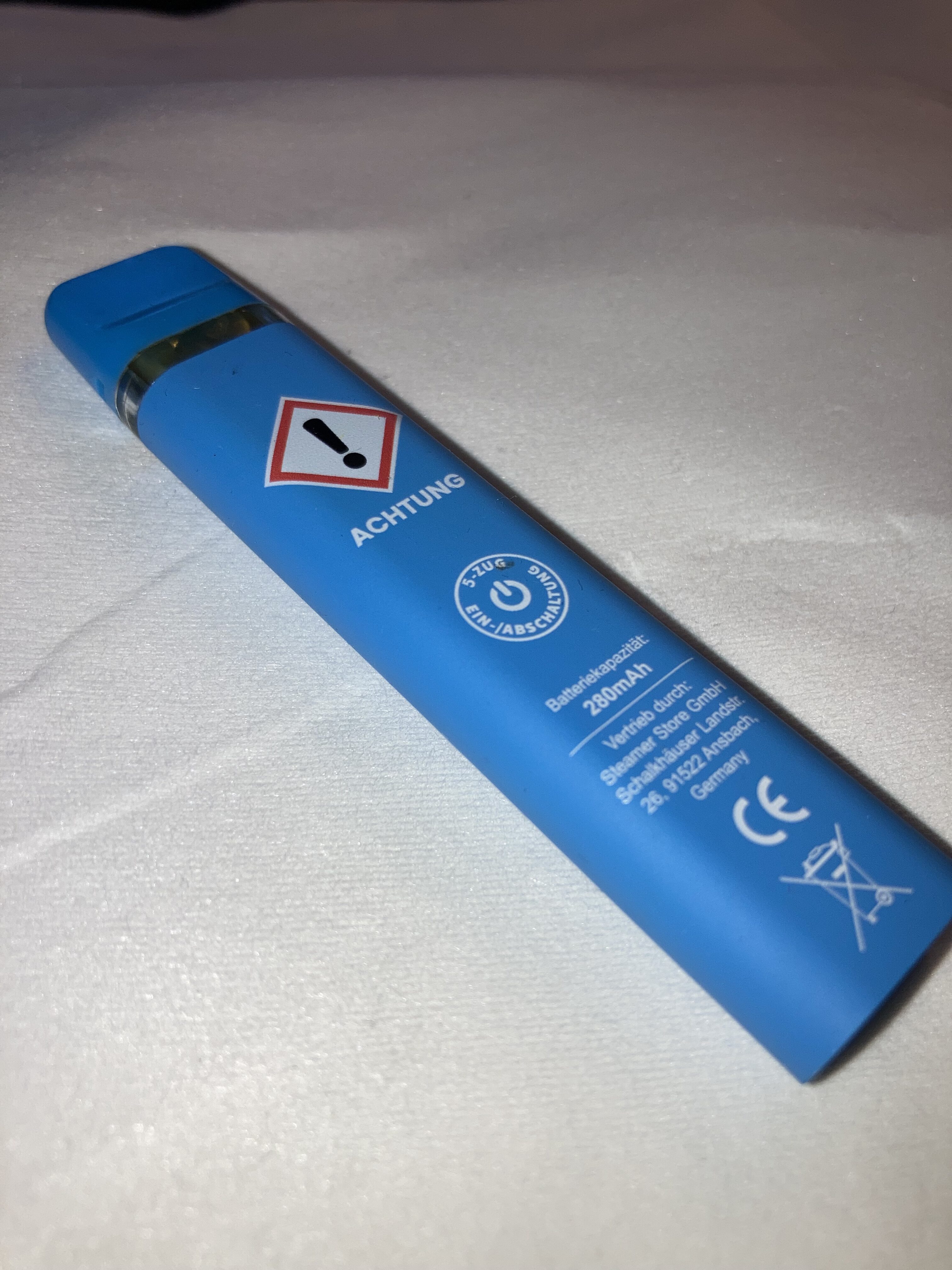
It lies there harmlessly, this cool blue stick that rejects every notion of the romance of enjoyment: technically sleek, slightly futuristic, a small device without pathos. Nothing about it betrays the fact that, for an entire generation, it has become what red wine was for us: the opener to the evening, the decelerator, the small private transition from day to night. And, I confess openly here: for me too. Not always, but increasingly often. Because contained in this stick, which can legally be purchased in Germany (but not in Austria or Switzerland), is a very gentle vaper blend, a hint of HHC, no THC whatsoever, and an effect that I would once have attributed only to wine. A soft growing tiredness, a calm drifting away, a fine, almost literary haze. As mild as a light Bordeaux, as clear as a Riesling, as reliable as a Quantum Comfort.
This is not about displacing wine. It is about the body renegotiating its own contracts over the years. Red wine, even in moderate quantities, now exacts a greater toll than it used to. I notice it clearly: a few glasses too many, and the next day becomes a repair operation. The stick, by contrast—as inconspicuous as it looks—seems more efficient, more controllable, physically lighter. A kind of peace in a hand-sized format. For many people between 20 and 40, it has long been a matter of course.
Naturally, a question arises that would have sounded absurd only a few years ago: Why is there no red wine vape? One that conveys not only the flavour, but the ritual, the effect, the mild drunkenness. We inhale mint, mango, menthol, cherry, energy, even something called “Galaxy Ice”—but not a single product dares to tackle Europe’s oldest evening culture.
Can alcohol be sensibly vaporised at all? Does it make you drunk? The few people I asked say yes—but presumably only a little, and differently, and not with the same warmth in the heart as a glass of wine. It is a dubious science, a grey area between aromatherapy and substance culture. The authorities have tools for cannabis, and for alcohol anyway. But for these new blends? More difficult. And that is precisely what makes them so attractive: they elude the classic regulatory pigeonholes. A red wine vape would not merely close a gap; it would be an experiment in cultural history.
Perhaps that is where an opportunity lies, strange as it sounds. The wine world is at a stage where it is struggling to maintain its connection with younger generations. Young people vape, they drink less, they want control. And they have no patience for 800 years of tradition if that tradition does not touch their way of life. A red wine vape could seem grotesque—or brilliant. It would be a product capable of fostering fellowship between worlds, a gateway for those who have so far known wine only as their parents’ problem area. Why not enter through the haze rather than through the glass?
Naturally, there would be many who saw this as blasphemy. Wine is sacred, they say; wine is culture; wine must not be forced into a cartridge. Yet those same people forget that wine was originally a product of chance, a technological experiment of antiquity. And that any culture which does not move ends up mummifying itself.
I am not arguing for replacing the bottle with the stick. I am arguing for acknowledging reality: the world has changed faster than winegrowing is accustomed to. Perhaps it is time for winemakers who are already thinking about natural wine, zero-dosage sparkling wine or alcohol-free options to go one step further. Pool their money, conduct research together, develop a red wine vape concentrate that is not ridiculous but serious. A wine that is not drunk, but breathed.
This will probably never happen. But the blue stick on my table tells me that it could happen. And that—as so often—not tradition is what decides, but the needs of the evening. And those are changing faster than any appellation.