
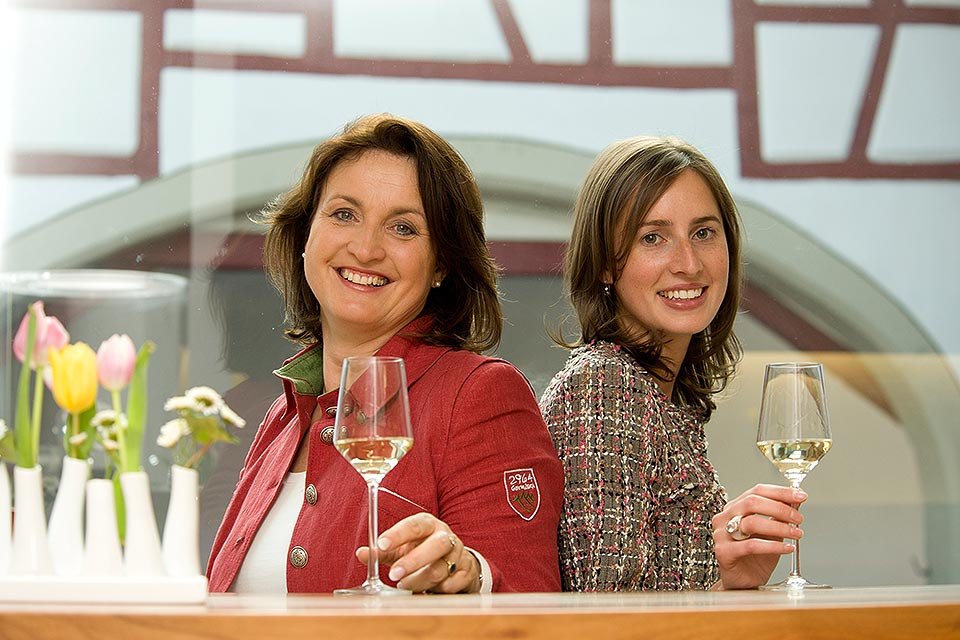
At 62, successful people do not normally go through job interviews any more. Least of all when they are called Andrea Wirsching and have run one of Germany’s best-known family wineries. The Hans Wirsching winery in Iphofen is one of Franconia’s great names; its history stretches back to 1630. Andrea Wirsching had been managing director since 2016. Now her 24-years-younger half-sister Lena von Gemmingen is taking over. And Andrea Wirsching is moving out. “I have already cleared out my flat at the winery. The new winery manager is going to live there.”
On 1 October, she took over the management of the Karthäuserhof on the Ruwer: 28 hectares, almost exclusively Riesling, around 120,000 bottles a year. Founded by Carthusian monks in 1335, the estate is one of the historic monuments of German viticulture. It has been family-owned since 1811 and today belongs to Albert Behler. Quite a substantial new workplace for a woman who, at an age when others are thinking about retirement, was sending out job applications.
The area is not entirely new to Wirsching. Sixteen years ago, after separating from her then husband, she returned from Schloss Saarstein on the Saar to Iphofen. She had raised three children there. In Franconia, she was met by a family business with clear hierarchies. “There were an insane number of bosses. My father was the patriarch, 77 at the time, and he is 93 today. He said to me: You do PR and marketing. And we’ll send Lena to Geisenheim to study.”
The half-sisters decided early on not to turn it into a family war. In 2011, they founded their joint wine project Sister.Act. “We wanted to show that the old and the new family belong together.” Andrea took on more and more responsibility, became president of the Vinissima network and gained an international understanding of a wine world in which women had long since stopped carrying out merely administrative work. “At some point I was in New York with some wonderful female winemakers and thought: Wow, now I’ve arrived. Now I can also stop caring about the prejudices of the male world.”
She was not much of a feminist at the time. “But probably in practice.” The old order nevertheless remained visible for a long time: “Until his 90th birthday, my father signed important decisions. That was not always easy to communicate.” Now she is moving back to a winery with a male owner. Another patriarch? “Perhaps. But this time I am coming from outside, emancipated. They consider me capable. I am not the daughter managing the family winery, but a completely ordinary employee.”
Above all, Wirsching is returning to a wine culture that shaped her. “At the Saar, I learned to taste soil and region. Whoever the winemaker is – as long as he does not completely mess it up.” And respect: “Suddenly I was no longer the princess from my father’s winery.” Evenings with Egon Müller, international guests, steep vineyards. “You learn pretty quickly that you must not be drunk when climbing around there.”
The Riesling Kabinett in particular is to become her project at Karthäuserhof. Wirsching is already thinking about a “Kabi connection” involving several estates. “Kabinett fits the times perfectly. Seven to ten per cent alcohol, fruit and acidity, this immense fizz – you find nothing like it anywhere else in the world. It is unique.” Millennials and Generation Z were looking for lighter wines with less alcohol. Her programme for this can be summed up remarkably briefly: “Party is Kabi.”
Behind this lies a more serious criticism of German wine history. For Wirsching, the major mistake began with the 1970s wine law, new-bred varieties and a wine industry that focused on quantity for a long time. “That damaged the German style. We had something unique internationally and lost sight of it ourselves.”