
Klimek: "What on earth are you doing on the Ionian Islands? You said you’d finally finish the new, secret function in the editorial system. We wanted to test it. Remember? Working? Making money? That sort of thing? Mate, what’s got into you?
Ziegler: "Yes, I know. But it was a nice invitation. And I’d already accepted it some time ago."
Klimek: "A nice invitation! Wonderful. Our economic future depends on new editorial-system functions, and His Lordship the publisher goes off to a Greek island because someone invited him nicely. That must have cost money again, too. What is to become of us? Please, what is to become of us?"
Ziegler: "Calm down. It wasn’t expensive at all. Do you even want to know what was going on in Zakynthos?"
Klimek: "I thought the story had been written ages ago. Please don’t tell me you haven’t written anything yet."
Ziegler: "Last time you told me off because my travel report sounded like a school pupil’s essay after project week. So I thought we’d simply talk to each other. Then we can write it up together."
Klimek: "So you’re outsourcing the editorial work to me after already taking the holiday? An interesting business model. All right. Tell me."
Ziegler (as if reading from a sheet of paper): "Zakynthos is one of the Ionian Islands, which were shaped by Venetian influence for centuries. As a result, many old grape varieties have survived there. That sounds very romantic at first. My first impression, however, was that it isn’t at all easy to make good wine from this historic grape material. On the first day we were, more or less unexpectedly ..."
Klimek: "Stop! What grape varieties are there, anyway? The last time I was in the area was in 1989. I was still young then, and Greece had other priorities for me; I was there with my future wife at the time on a sort of pre-honeymoon."
Ziegler: "The most important wine is called Verdea. That isn’t a grape variety, though, but a white-wine cuvée. The name comes from the Italian verde, meaning green. So there we are again with the Venetian influence.
At least 50 per cent must consist of Skiadopoulo. The winemakers can make up the rest from the permitted white varieties, for example Pavlos, which can be rather herbaceous. Basically, every winemaking family has its own recipe."
We unexpectedly ended up at a tasting right at the start, one we could have done without. We'd rather not name the producer. The winery itself already seemed disorganised. Unfortunately, the wines were the same. Verdea, Skiadopoulo, little acidity, hardly any minerality, a few herbs. All rather boring. Hard to drink and even harder to want to spend money on."
Klimek: "So you went to Greece to drink bad wine. I could have given you a few addresses in Berlin for that."
Ziegler: "That was only the beginning. But I did get the impression that this grape material is demanding. You really have to engage with the varieties to make something of them. Some vineyards are at barely 300 metres above sea level. And when grapes are bought in, their quality naturally has to be right as well."
Klimek: "This still doesn’t sound like a successful tourist report. What happened next?"
Ziegler: "That same day we went to Grampsas. They absolutely have to be mentioned. Significantly better wines. Still rather low in acidity, but now with herbs, stone fruit, lemon zest and more structure. We also tasted Goustolidi and Pavlos there.
What was interesting was that the fundamental character of the varieties did not change completely. But suddenly you could tell that someone had taken them seriously. There was work in the glass.
First you go to a producer where things are somewhat chaotic, and drink a boring wine. Then you visit a well-run producer whose people know what they are doing. And suddenly there is more acidity, more minerality, more precision. The care you perceive at the winery is reflected in the wine."
Klimek: "A sensational discovery: good winemakers make better wines than bad winemakers. We urgently need research funding from the European Union for this."
Ziegler: "Go on, make fun. This contrast really did help me. Old grape varieties aren’t automatically marvellous just because they’re old. Sometimes they’re simply old. The history of a grape doesn’t make a good wine."
Klimek: "At least that’s one sentence that makes your trip gradually start to seem worthwhile."
Ziegler: "And at Grampsas there was also the factor of maturity. We drank aged white Verdea. An extra year or two made a noticeable difference. Suddenly some of the wines also had the acidity and balance I’d been missing before.
The only problem is that this involves quite a lot of effort. Compared with other grape varieties and regions, making a good wine here apparently isn't particularly easy or inexpensive. An aged bottle of Verdea can be magnificent. But the winemaker doesn't give you that result for free."
Klimek: "So our editorial system after all: old and expensive."
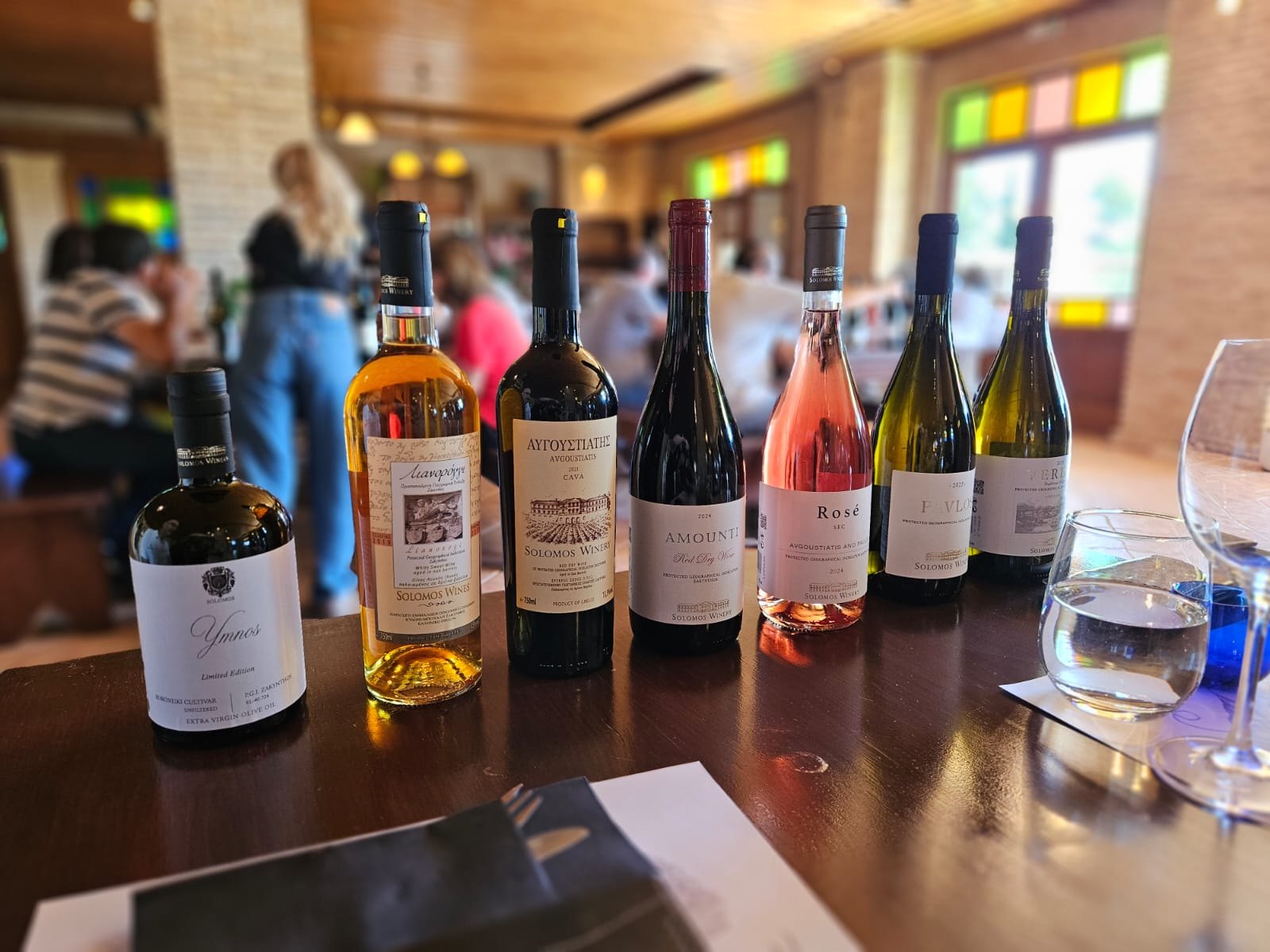
Ziegler: "If you stop interrupting me all the time, I’ll get to the best visit. The next day we went to Solomos Winery. Konstantina Solomou, the daughter of Anastasios Solomos, works there in winemaking. An incredibly smart woman. She explains her wines with such enthusiasm that every tasting becomes a little sensory-analysis seminar. She gestures, looks you straight in the eye, laughs. You have to fall in love with her. And with her wines, too."
Klimek:" I hope we get to the wine in time, before this story turns into My Big Fat Greek Wedding."
Ziegler: "In between, we also tasted olive oil. In small round glasses. We had to warm and rub them between our hands, as if we were jointly summoning the olfactory genie from the bottle."
Klimek: "That sounds like the sort of event where I’d have gone outside after ten minutes to smoke a cigarette. Even though I don’t smoke any more."
Ziegler: "The Verdea there, I think it was the 2025 vintage, had really lovely acidity, at any rate. An excellent wine. We bought a few bottles and opened one on the terrace straight after the tasting."
Klimek: "To believe is to know nothing." But finally, a bottle that doesn’t require an educational explanation. And the reds?"
Ziegler: "The main one is Avgoustiatis. In a way, the island’s red blockbuster. Guess which month the grapes ripen in."
Klimek: "The month of Depp?"
Ziegler: "Ha ha. In fact, the name refers to ripening in August. We drank the probably best Avgoustiatis at Grampsas. A fine red wine that is absolutely competitive internationally. In my view, the variety doesn’t have a particularly pronounced, unmistakably Greek aroma profile. But it can age very well.
We tried different vintages, wines three and five years old, with a very pleasant, fine oxidative development. A mature Avgoustiatis from a 120-year-old ungrafted vineyard was particularly impressive. It still had plenty of potential."
Klimek: "I bet that if the climate continues like this, Avgoustiatis will very soon become Julioustiatis. But vines 120 years old? Now it’s getting interesting. You should have started the story with that instead of telling me about your oral olive-oil massage."
Ziegler: "We even rummaged around in the cellar afterwards. One of my companions was particularly persistent and drank his way back to the 2017 vintage. We paid more than 50 euros per bottle for that on one occasion, too. From the winery, I should stress."
Klimek: "Hang on?! A moment ago you explained to me that the trip hadn’t been expensive. Now you’re buying red wine for more than 50 euros ex-cellar on a Greek island, after drinking your way through half the cellar?"
Ziegler: "We killed the bottle on the spot straight after the meal."
Klimek: "Oh, I see. Then naturally it was an investment in journalistic quality assurance. I take it all back."
Ziegler: "The Avgoustiatis at Solomos was good, too, but we didn’t try any mature vintages there.
I was somewhat disappointed by the rosés. At Solomos we had the Rosé Sec. A few berries, some fruit on the nose, but behind that I was missing the tension. Little acidity, hardly any minerality. Undoubtedly a decent rosé, just a little too well-behaved for my Austrian, acidity-craving palate."
Klimek: "A Viennese palate on a Greek island. That was bound to lead to diplomatic complications eventually."
Ziegler: "Overall, Zakynthos was very interesting. Precisely because not everything was marvellous. The historic grape varieties have potential, but they demand a great deal from the winemakers. And the best producers show what is possible. That’s actually quite a nice story."
Klimek: "Yes, somehow it is. Particularly because it proves that the wine world cannot be saved by old vines, beautiful landscapes and Venetian history alone. In the end, the wine has to taste good. A surprisingly unromantic insight for a trip to a Greek island."
Ziegler: "There you go. Shall I tell you about Kefalonia now as well?"
Klimek: "Oh, please don’t!"
The wineries
Special thanks go to Marinos Demetriou of Novinophobia, an oenologist, cava-shop owner and probably one of Cyprus's most active wine personalities. He organised this trip. We will be talking about him in more detail soon – provided the editorial team has secured its economic future by then.