
(Manfred Klimek, Editorial Team)
The Saar is a place of transition.
Too vast to be tranquil, too rugged to be commercialised, too beautiful to be forgotten. A landscape that marks a break: in the south, its vineyards end at the old steelworks of Völklingen, rusty and defiant, like an industrial epilogue to nature. To the north, it winds its way into barren hills – where Napoleon’s troops once marched through the land and where, today, the fighter jets from Spangdahlem trace their flight paths over the vineyards.
The Saar is the underdog of German wine.
It officially belongs to the greater Moselle region (until 2006 known as the Moselle-Saar-Ruwer), but is overshadowed by it – by the tourist postcard, the boats, the cameras, the endless campsites between Winningen and Trier. Only those who truly know what they are looking for find their way to the Saar: tranquillity, steep slopes, slate. And that subtle tremor that characterises the great Rieslings from the Saar – that crystal-clear, almost brittle quality that does not flatter but emphatically declares its true nature.
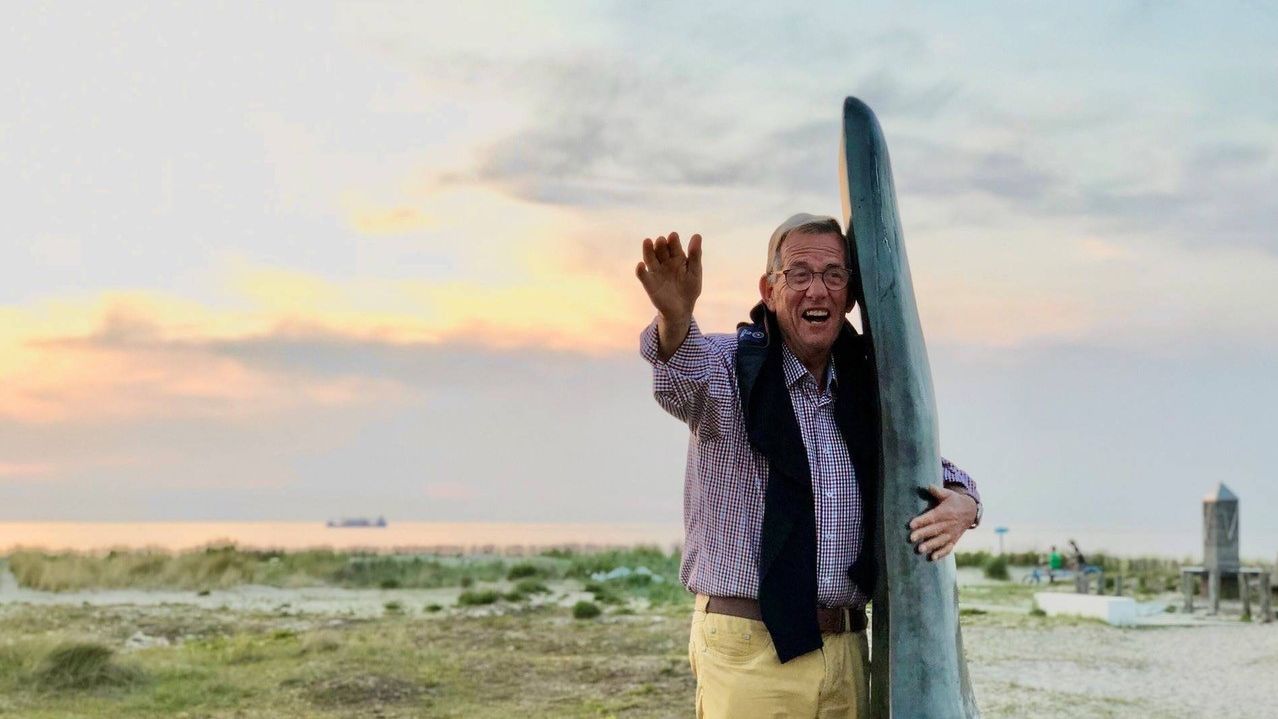
Here, in Konz-Oberemmel, on the border with Luxembourg, lived and worked Eberhard von Kunow, one of those people who made Saar wine what it is today: independent, distinctive, uncompromising.
Von Kunow took over the estate from his father in 1973 and ran it for almost forty years. As a winemaker, he was no loudmouth, but a man of character – straightforward, outspoken, and uncompromising in his vision of quality. He believed in Riesling, but not in passing fads. His wines were clear, deep and unadorned – and they always tasted of their terroir, never merely of cellar work.
The fact that his son, Maximilian von Kunow, is now counted amongst Germany’s finest Riesling producers is no coincidence, but rather the inherited consequence of this attitude.
A small republic of steep slopes and convictions
In Geisenheim, Eberhard von Kunow had learnt how to make wine – but on the Saar he learnt why. His companions: Egon Müller of Scharzhofberg, Hanno Zilliken of Forstmeister Geltz-Zilliken, and Claus Piedmont from Filzen. Men who did not talk about trends, but about vintages – and, not least, about wine-growing policy.
Von Kunow shared with them a spirit that is a tradition on the Saar: discussion, debate, friendship. At the ‘staff meetings’ with colleagues such as Wilhelm Haag, Manfred Prüm, Christoph Tyrell or Willi Schäfer, the talk was not of marketing, but of wine – and of politics, when the wine wasn’t just pushing it aside.
Von Kunow was no theorist, but a hands-on man of principle. Whilst others were talking about sustainability, he had long since been practising it. Whilst others were celebrating cellar technology, he stuck to patience. Taking the initiative, but also listening.
The doer who got involved
Eberhard von Kunow was no loner. He took the term ‘winegrowers’ community’ literally.
He sat on the local council, was actively involved in the carnival society and the Rotary Club – and there, too, he was the same person as in the vineyard: open, direct, without pretence. His way of life was an extension of his way of making wine: honest, unpretentious, with a love of detail.
As an auctioneer at the VDP ‘Großer Ring’ auctions, he was legendary – not because of his volume (or his laughter), but because of his composure. Where others chased numbers, he weighed his words.
The Saar: a landscape of character
It is no coincidence that this very region, in the far west of the country and bordering France, produces such people, for the Saar has always demanded a certain resolve. It does not reward every vintage, nor every idea. It is no marketing playground, but a test of patience involving weather, soil and determination.
Alongside the well-known names – Scharzhof, Zilliken, von Othegraven – von Hövel is also one of the estates that have shaped this region. Von Othegraven, now owned by Günther Jauch, carries on the tradition of classic Saar Rieslings – subtle, precise, serious. It is the sort of wine that does not beguile in a banal way, but makes a dramatic impression.
Eberhard von Kunow was someone who understood the Saar because he was much like it: headstrong, contradictory, reliable. No charlatan, but a man who made things better by taking them seriously.
Von Kunow died on 12 October 2025 in the manor house on his estate – peacefully, surrounded by his family.
A life spent amidst slate, sweat and sharp wit had come to an end – a life that had not only witnessed the golden age of German wine, but had also helped to shape it.
But the Saar remains.