
(Empty bottles? Please hand them in at https:\/\/drink.winearty.wine )
by Claude Auguste
Sometimes, days after the evening I thought was over, I return to the scene of the events. In the kitchen, the glass is still there, unwashed, unpolished, not put away. Beside it, the bottle, empty. Or almost empty. I lift it, tilt it, look through the opening into the neck of the bottle as if into a bygone century. And then, with a turn of the wrist, it happens: One last drop breaks free from the darkness. And a few more. Two, perhaps three millilitres in the glass. Heavy. Red. With a certain tired gleam.
I drink these drops. Slowly, the remainder runs over the papillae. I do not drink these drops out of thirst, nor curiosity, but out of a kind of ritual duty. They are the last witnesses of a vanished night. Sometimes, I admit, this does not happen until the third day. And I know what the pedants will object: The wine is oxidised. Dead. A shadow of its former self. A pathological remnant. But I say: It is precisely in this state that the truth of great wines reveals itself.
For when the last drop still sings – hoarse, broken, but with an inner melody –, then the wine was great. Perhaps it was even very great.
It is like an old singer whose voice has grown fragile, but who still delivers one phrase in such a way that the entire hall falls silent. Because he carries not the strength, but the memory of strength. Because, in his weakness, he reveals the true essence. So it is with the last drop: It carries no more fruit, no freshness, no show. It is naked. And therein lies its dignity.
I have experienced this with old Barolos, with Grenache from Châteauneuf, with Pauillac, with Cornas. But also with German Spätburgunders, when they were not made, but became. When the wine does not merely taste, but speaks. And, in the end, whispers.
On such days I imagine that the wine has transformed into an imprint of itself, a fossilised echo, like a piece of amber with an insect enclosed within it: dead and yet alive for ever. No sommelier can summon this. No decanting, no carafing, no swirling can bring forth this moment. It is the reward of the patient, the reflective, the returning home, who re-enters the scene once everyone else has already left.
I know people who say they have no patience for such afterplays. Life is too short, they say, to watch old wines die. But I believe this: Whoever does not honour the last drop will not understand the first either.
And sometimes, when I drink this drop – eyes closed, alone, the glass held slightly askew in my hand –, images return. Not from the wine, but from the night. The voice of the friend who laughs. The sentence that fell into the silence. The music that imperceptibly mingled with the tannin. All of it returns, like a scent rising from an old book when you open it again after years.
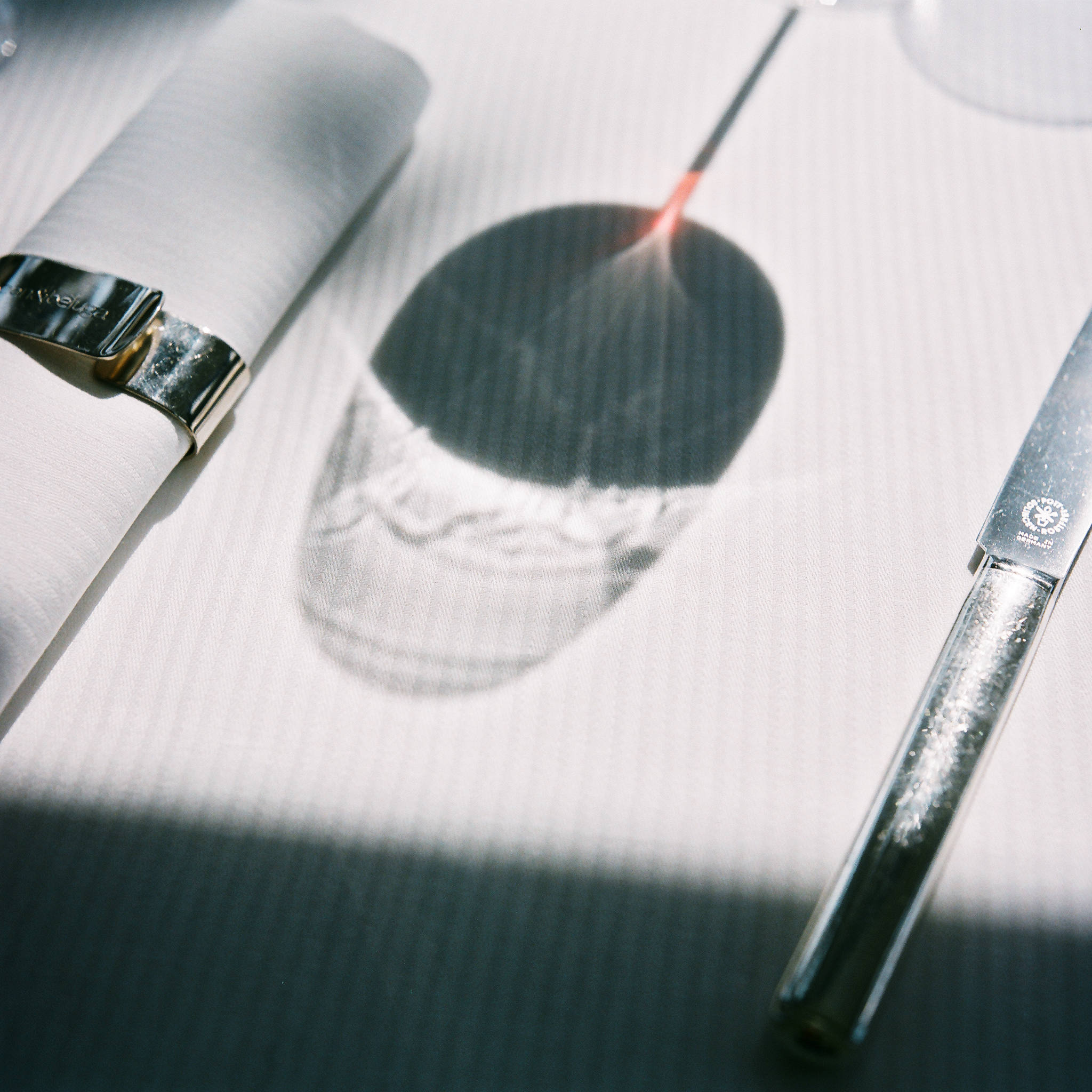
I always drink this drop from the same glass. Or rather: from what remains of it. My glasses come from another time, the early Rodenstock series by Riedel, Burgundy and Bordeaux, drawn, cut, with that degree of unobtrusiveness that was still considered a form of elegance back then. I did not merely buy them. I inherited them, traded them, found them, fought for them. Some came to me by circuitous routes, from abandoned restaurants, from house clearances, from friends who no longer needed them – or could no longer need them.
These glasses are no longer beauties. Their bowls are no longer completely clear; fine streaks from polishing run across the surface like growth rings. They have become a little cloudy, like the eyes of old people, in which a fire nonetheless still glimmers. I do not know whether the wine tastes better from them. But I do know this: It speaks differently in them.
Every glass has its story. Once, I broke one of these Burgundy glasses in the sink, on the morning after one of those nights when the air was still vibrating with conversation. I heard the shattering, I saw the shards, and I stood there as if after a death. Not because of its material value. But because of the time stored in that glass. I can no longer drink the wine we drank from it. I cannot repeat the evening. But the glass had still been there, until just then. Now it is not.
Since then I wash them even more carefully. And sometimes I think: Perhaps that is precisely the point of old glasses. Not their function, but their vulnerability. They teach us to appreciate the moment. They demand respect, like great wines, like old friends. They are not eternal. And that is a good thing.
And whoever holds a glass that has already held many drops knows: Greatness is not measured in perfection, but in the ability to remain – beyond the evening, beyond the taste, across the years. Perhaps even beyond the break.
(Reactions to this article please leave on Insta and Facebook. The forum here is closed)