
(Manfred Klimek)
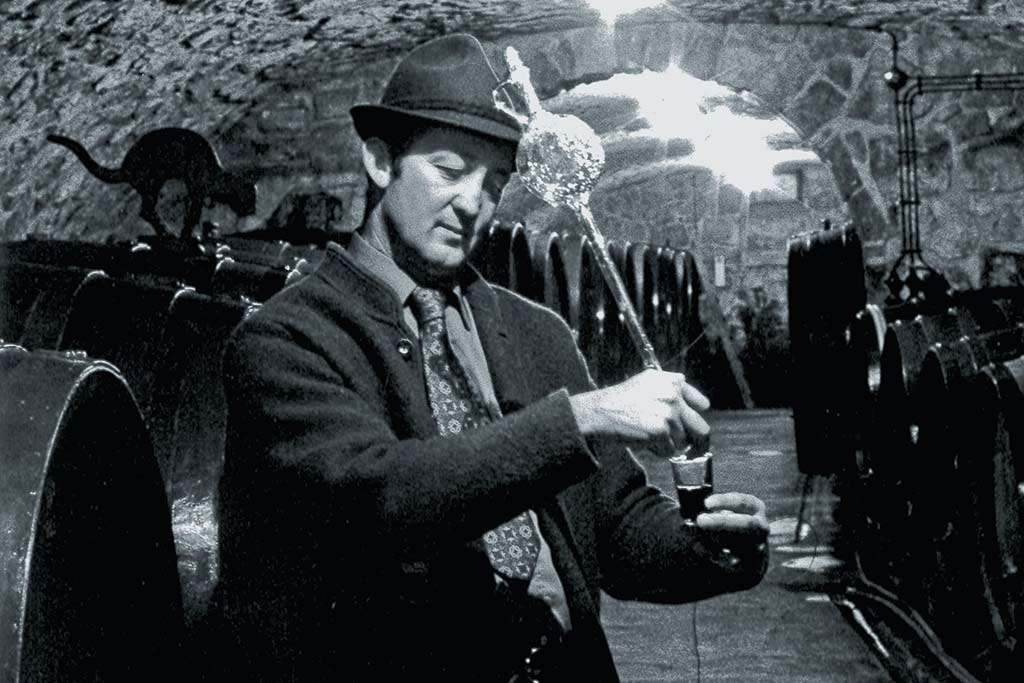
There are usually two things that make great winegrowers. Firstly: their wines. Secondly: their influence on the country's wine industry. Anton Kollwentz, the winegrower with the hat, embodied both. This made not only his wines iconic, but also the man himself: that ever-friendly, approachable, clever old man whom I had known since my youth, from when he was in his prime, and I, following the 1985 wine scandal, had just begun looking for new wines. I mostly found these among very young winegrowers of my generation. But also among those ‘old hands’ like Kollwentz, who understood that everything had to change if Austrian viticulture was to survive.
He survived, mastered the crisis and rose from the ashes. In the 1980s, Austria's winegrowers and associations pulled themselves out of the mire entirely on their own. And one of those winegrowers, by no means the least of them, was Anton Kollwentz.
Anton Kollwentz of Großhöflein on the Leithaberg died on 4 March 2026 at the age of 85. With him, Austrian viticulture loses one of its quiet but decisive pioneers – a man who never needed grand gestures to achieve a great impact; rather, he was someone who spoke about soils, grape varieties and casks with calm self-assurance – always conveying the impression that winemaking was above all a matter of patience and experience. Which, of course, is true.
Born in 1940, experiencing deprivation as a child during the war, Kollwentz took on responsibility for his parents' estate at a very young age. And even early on, he showed a keen sense for developments. In 1958, he planted the first sizeable Zweigelt-producing vineyard in Burgenland; a few years later, he made the first Ausbruch outside Rust. But his true importance to Austrian viticulture lies elsewhere. It lies in his consistent strategic work in the cellar and vineyard. While Austria had to fight for its credibility internationally, a new, impressive seriousness emerged at many estates. Austrian viticulture was ‘in the arse’; Kollwentz was one of those experienced winegrowers who provided direction at that time.
Above all when it came to red wine. Above all, somewhat later, when it came to white wine.
At a time when Austria was associated internationally almost exclusively with white wine, Kollwentz was already working to make Burgenland's potential for great red wines visible. In the early 1980s, he even secured special permission, against the authorities' opposition, to provocatively plant Cabernet Sauvignon – at the time, an almost revolutionary step. At the same time, he remained devoted to Blaufränkisch which he always regarded as one of the region's great grape varieties.
This work produced wines that today rank among the country's icons: Steinzeiler, Point, Setz and Dürr (red), and Tatschler, Neusatz, Katterstein, Gloria and Steinmühle (white); names that became synonymous with great Burgenland wines for generations of wine drinkers – iconic premium cuvées.
A decisive part of this style lay in the handling of wood. Long before ageing in barriques became commonplace in Austrian viticulture, Kollwentz experimented intensively with French oak casks and malolactic fermentation. Over decades, this developed into expertise in oak ageing that has given the winery a particular advantage to this day. At Kollwentz, wood was never fashion – but a tool conceived as modern, used to shape structure, depth and ageing potential.
Anyone who drank Kollwentz's wines quickly understood that here was someone working with great consistency. Power was permitted, but never without balance. Ripeness was important, but never without balance. Balance was and is the estate's great asset.
Kollwentz was also involved in Burgenland viticulture beyond his own estate. In 1995, the association Renowned Wineries Burgenland was founded, and he served as its president for ten years. In this role, he made a substantial contribution to establishing Burgenland internationally as a source of great red wines.
Yet as much as his influence in the industry was recognised, Anton Kollwentz personally remained, true to his nature, a rather reserved man. Someone who preferred speaking about wine rather than about himself. That is precisely where the greatness of his life's work lies.
For much of what seems self-evident today – the international recognition of Burgenland red wines, confidence in provenance and vineyard sites, the precise use of wood in ageing – was prepared and shaped by winegrowers such as Kollwentz. And when we open a bottle of Steinzeiler, Dürr, Tatschler or Steinmühle it tells us not only about a vintage and a vineyard, but also a great deal about that once-young couple in Burgenland who, consciously or unconsciously, were to leave their mark on the country's wine industry.
And that is what makes good and very good winegrowers great winegrowers. Boys to Men: Anton Kollwentz was there early on. I am grateful for many great and happy hours.