(Manfred Klimek)
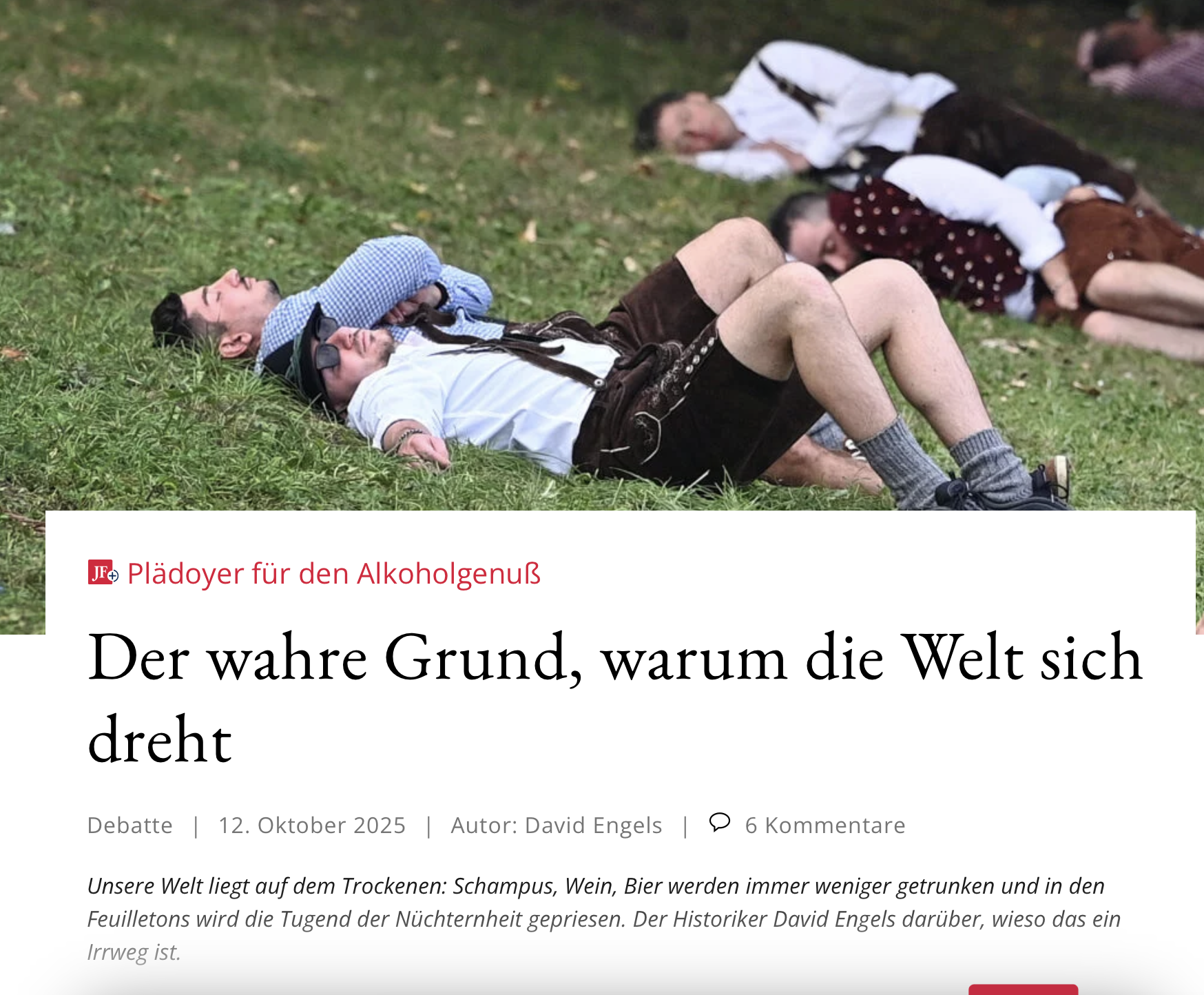
It’s taken a while, but now even the so-called ‘New Right’ seems to have realised that the real culture war of our time is not decided at the ballot box, but also at the dinner table, in the wine shop and even over an evening drink – between those who drink wine, and those who no longer do. In the far-right *Junge Freiheit*, not otherwise known for its literary subtlety, an essay recently appeared celebrating alcohol as ‘humanity’s means of transcendence’. A text that describes wine and intoxication not as vices, but as the ultimate realms of metaphysical experience. What is remarkable is not so much what it says – but the fact that it says it at all.
For the very same circles that once equated wine with liberalism, hedonism or even decadence are now beginning to reclaim it as a symbol of an ‘old world’: as a sign of celebration, community, and of that Western culture in which wine was a sacrament and not a risk. And whilst the WHO, backed by health authorities and sections of the new, morally re-armed Left, declares wine to be a dangerous neurotoxin, it is suddenly being placed at the centre of attention by those who would otherwise have shown little interest in the subtleties of a Pouilly-Fuissé or a biodynamic Riesling.
The irony is complete: of all people, those who once stood for restraint, discipline and self-denial are now defending intoxication as an expression of human depth. The ‘Alt-Right’ – that loose coalition of intellectuals, cultural reactionaries and digital preachers of salvation – has discovered wine as an aesthetic weapon against the new asceticism that calls itself ‘sober’ on Instagram and reinforces the WHO’s flimsy statistics.
Yet this is no longer about alcohol at all, but about worldviews. On the one hand: the ‘art of living’ culture, committed to purity, low-calorie, carbon-neutral, morally hygienic – and, above all, always sober. Its saints are called ‘Dry January’ and ‘Sober October’. On the other hand: those who see in every glass a revolt against the algorithmic body. Wine as the last trace of the Dionysian – as an uncontrollable remnant that eludes digital measurement.
It is no coincidence that right-wing intellectuals, of all people, are reviving this discourse. In the crisis of the West – so their interpretation goes – the loss of wine is the loss of the sacred itself. No intoxication, no mass, no sacrifice. Just a ‘sugar-free zone’ and self-optimisation. The Dionysian spirit, which once fuelled art, music and religion, is being replaced by self-measurement and a sobriety app.
The enemy, then, is not alcohol, but the idea of purification. Modern asceticism, which at first glance appears healthy and enlightened, is in truth the logical continuation of Puritanism – only without God. Its aim is not salvation, but control. Wine, however, has stood for the opposite ever since it came into existence: for trust, devotion, and also for risk.
The fact that the political right has occupied this space is less a provocation than a failure on the part of the other side. For decades, wine was the medium of the enlightened left, of literary figures, of European cosmopolitans. Today, it is health officials who issue warnings, and right-wing authors who raise their glasses. The cultural confusion is complete.
Perhaps it is time to defend wine not ideologically, but on a human level. For intoxication – whether in Rome, Burgundy or on the Rhine – was never merely excess, but also a form of insight: the breaking down of the self, the sharing of the world. Monks, peasants, revolutionaries and winegrowers knew this in equal measure.
What now threatens is not the return of drunkenness, but its disappearance – sobriety as a political ideal. If wine is banned, taxed or outlawed, Europe loses not merely a drink. It loses a language. And whoever attempts to speak it again must not be left in the wrong hands.