
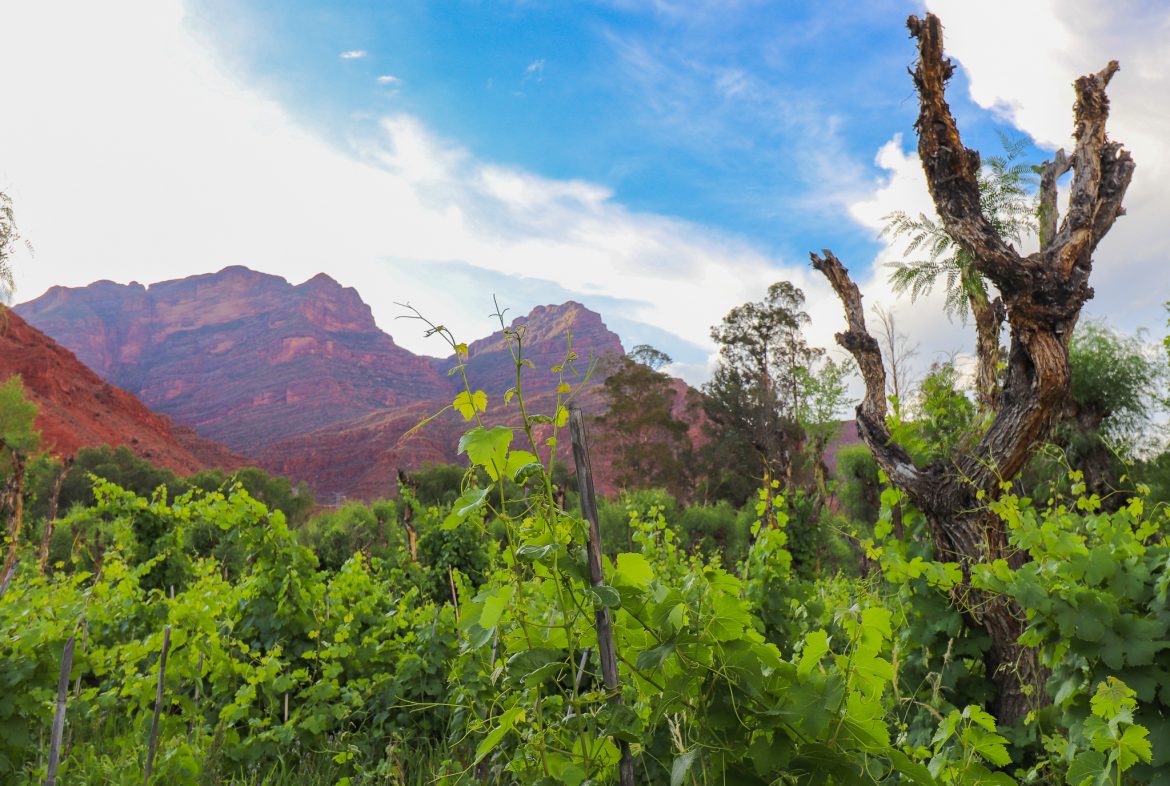
Anyone seriously discussing the future of viticulture today talks about cooler sites, greater altitudes, late-ripening varieties and the question of where the vine can retreat when it becomes ever warmer in its traditional regions. We could travel to England for that. Or to Scandinavia. But we could also travel to Bolivia, to an altitude of 2,400 metres, to a vineyard that already existed there when nobody was yet thinking about climate change. It is called La Encantada, the enchanted vineyard, situated near Villa Abecia in southern Bolivia. And there really is quite a lot that is enchanted here: ancient grape varieties, fruit trees among the vines, a family history with interruptions and a winegrowing tradition whose origins reach back to the Spanish colonial era.
The story begins in Potosí. After the discovery of vast silver deposits at Cerro Rico in the 16th century, the city had become one of the great urban centres of the Spanish colonial world. Many Europeans arrived, and with them came a problem that, from a European perspective, was apparently considered urgent: there was not enough wine. Bringing it in over enormous distances was expensive and arduous. So wine was to be grown where it was needed – following the example of the Roman Empire. Experts in vines and soils were brought in, vineyards were established, and the origins of La Encantada also reach back into this early history of Bolivian viticulture. Some of the vines preserved there have adapted over generations to conditions at an altitude of 2,400 metres. Among them are varieties that even fairly well-informed European wine drinkers are unlikely to have heard of. Vischoqueña, for example, a natural cross between Listán Prieto and Muscat of Alexandria. Alongside it is an old form of Moscatel de Alejandría, which its owner Jorge Daroca Magdalena calls. And finally, that historic vine which has almost more names than berries on the American continent: Mission in California, País in Chile, Criolla Chica in Argentina.
La Encantada’s more recent history begins at the end of the 19th century. Daroca’s great-grandfather took over the land from the Jesuits and produced wine there. His grandfather Tomás Daroca continued the tradition from the 1940s into the 1990s, after which the estate increasingly fell into oblivion. Nobody wanted to carry on. Until Jorge Daroca rediscovered the place and, with it, his family’s history. At first he did something entirely sensible: he hired oenologists to make wine for him. At some point he realised that, although their ideas resulted in respectable wines, they did not necessarily result in La Encantada. So he began to think backwards. He studied the old methods, but above all the vineyard. Because it functions in a fundamentally different way from those clinically clean vineyard plots we know from many European regions. La Encantada is not a monoculture. Apple, quince, olive and pear trees grow among the vines, along with flowers and other fruit. The trees provide food; sometimes their fruit is left to lie and becomes compost. Above all, though, they help the vines. Some of the vines climb up them, the tree canopies provide protection from brutal sunshine and hail, and the fruit attracts pests that might otherwise feed on the grapes. Biodiversity here is not a pretty certificate on the farm gate, but a centuries-old form of agricultural pragmatism.
In the cellar, things are correspondingly unspectacular. Daroca describes his wines as “makeup free”. No oak intended to give them an additional personality, spontaneous fermentation with the indigenous yeasts and as little intervention as possible. This now sounds like the usual vocabulary of the natural wine scene, but here it takes on a different meaning. Anyone who owns such a vineyard does not need to impose an oenological signature on it by force. Magdalena, the old Moscatel de Alejandría, shows this particularly well: floral, peach, apricot, pineapple, a little honey, yet a long way from the perfumed heaviness that can sometimes make Muscat tiring. Vischoqueña Cabra Roja is the exotic of the small collection, with wild berries, cherry, eucalyptus, quince and a spicy, hard-to-classify aromatic character. And then there is Negra Criolla Cabra Roja, made from Criolla Chica. The quietest of the three wines, less aromatic but with red fruit, black pepper and remarkably unobtrusive complexity. Three wines that do not try to imitate Bordeaux, Burgundy or any other European reference. That is probably their greatest advantage.
La Encantada is therefore more than a charming story about natural wine from an exotic country. This vineyard reminds us how closely our image of wine remains tied to Europe and its climatic coordinates. For a long time, the zone between the 30th and 50th parallels was regarded as the natural home of quality winegrowing. Bolivia does not adhere particularly reliably to such textbook rules. The enormous altitude changes temperature, solar radiation and day–night variations, creating conditions in which vines thrive in places where, according to classical European thinking, they would have little business being. Added to this are old genetic adaptations, traditional varieties and an agricultural system that did not need to be invented because it had never completely disappeared. Perhaps, then, part of wine’s future lies precisely in its past. And perhaps we will have to get used to the fact that the world’s most interesting new wine regions are sometimes very old ones.