
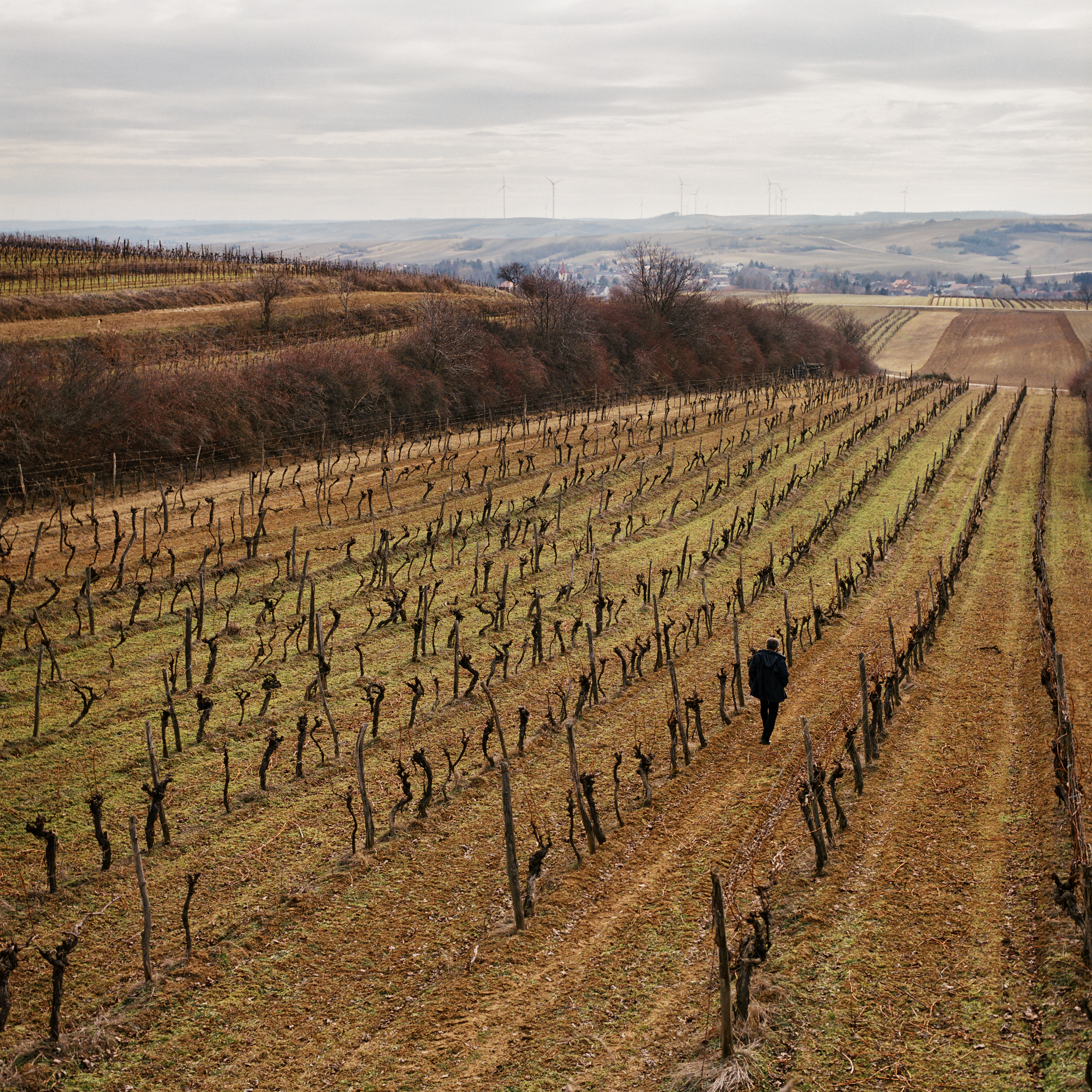
(Dr Maximilian Schüttky / Manfred Klimek / Editorial / Pic: Manfred Klimek)
The wine world has now understood that it is in a crisis. What it has not yet understood: crises also pass. Afterwards, however, you do not automatically find yourself back where you were before. If the current development really does cost 30 or 40 per cent of Europe’s vineyard area, if thousands of businesses give up, cellars are sold, vineyards grubbed up and entire regions economically hollowed out, then in the end there will not be a merely smaller version of the old wine world left over. It will be a different one. Astonishingly, almost nobody is talking about it.
The industry is currently concerned above all with holding on. Boosting sales, finding export markets, applying for subsidies, holding prices, somehow getting another vintage into the cellar. Understandable. Less understandable is that these same people simultaneously act as though, after the great culling, sufficient demand would simply have to reappear for everything to start all over again. As though thirty-year-olds would suddenly start buying Bordeaux again because stocks had become emptier, as though the red-wine drinkers who had disappeared would return from a secret hiding place, and as though a generation that consumes considerably less alcohol would decide one morning that it actually found 14.5 per cent exciting again.
The wine world of 2026 is still narrated by boomers, produced for boomers and consumed by boomers. That would not initially be a problem, had this generation not simultaneously developed the peculiar ambition of treating its own habits as laws of nature. At wine fairs, award ceremonies, trade association events or the usual gala dinners, we encounter a world that desperately wants to look young and then proceeds to photograph the same older gentlemen handing one another prizes. Young female and male winemakers are now allowed on the podium, preferably with tattoos, natural wine and trainers. Others continue to make the decisions.
Part of the future has long since been taking place in these young businesses. There, people are experimenting with old grape varieties, cider, Pet Nat, lighter red wines, skin-fermented whites, new vessels, grape juice, verjus, partially dealcoholised wines and 0.5 per cent alcohol. Much of it will disappear again. Some of it will remain. That is exactly how culture comes into being. Yet a considerable part of the established wine world continues to view these experiments with the mild contempt of a man who has been driving the same SUV model for thirty years and is certain that electric mobility is a temporary disturbance to the world order.
This attitude is particularly visible with alcohol-free and low-alcohol wines. We still hear statements supposedly based on wine law, tradition or alleged authenticity to explain why a wine with 0.5 per cent should not really belong to wine’s cultural cosmos at all. The customer listens to this briefly and then buys something else. The market has little interest in theological debates. Anyone who tastes excellent dealcoholised wines today, 6.5-per-cent cuvées made from wine, grape juice and verjus, or good zero-per-cent products, has long since recognised that a new category is emerging from them. It does not replace great Riesling, nor a mature Pomerol. It expands the repertoire. Anyone who continues to treat this as sacrilege is ultimately defending only their own loss of significance.
The imagery of this industry also urgently needs sorting out. Wine wants to reach young people, diversity, femininity, new drinking habits and modern gastronomy, yet in public it appears remarkably often as a closed society of older men. Nobody needs to drive the boomers from the table. They played a major role in building European quality wine over the past four decades, spent a great deal of money, filled cellars and enabled winemakers to prosper. But no industry can base its future on ensuring that its best customers die as slowly as possible.
What comes next therefore needs a plan. Less vineyard area will not necessarily be a catastrophe. Europe has been producing more wine for years than it can sell at reasonable prices. The painful contraction could even provide the basis for a new beginning, provided it is not precisely those businesses that are curious, small, independent and culturally interesting that disappear. France, Italy, Spain, Austria and Germany should now be discussing which landscapes are to be preserved, which varieties rediscovered, which wines will be needed in future and which businesses should be supported. Instead, we are still discussing how to increase sales of yesterday’s product.
Modernity after postmodernity will probably not look particularly futuristic in wine. It can bring out old grape varieties, use amphorae, rediscover regional food culture and at the same time work with the most advanced dealcoholisation techniques. It will have to tolerate contradictions, because consumers have long since become more contradictory. One and the same person can drink alcohol-free wine on Tuesday and open a twenty-year-old Barolo on Saturday. The industry must finally stop turning this into questions of identity.
The actual problem is not the crisis at all. Crises force change and therefore at least have a function. More dangerous is the idea that one can simply weather it and then put the old furniture back in the same places.
Gorbachev was right when he said in Berlin in 1989: “Those who come too late are punished by life.” The wine industry should take this sentence to heart. Because it concerns the industry. Now!