
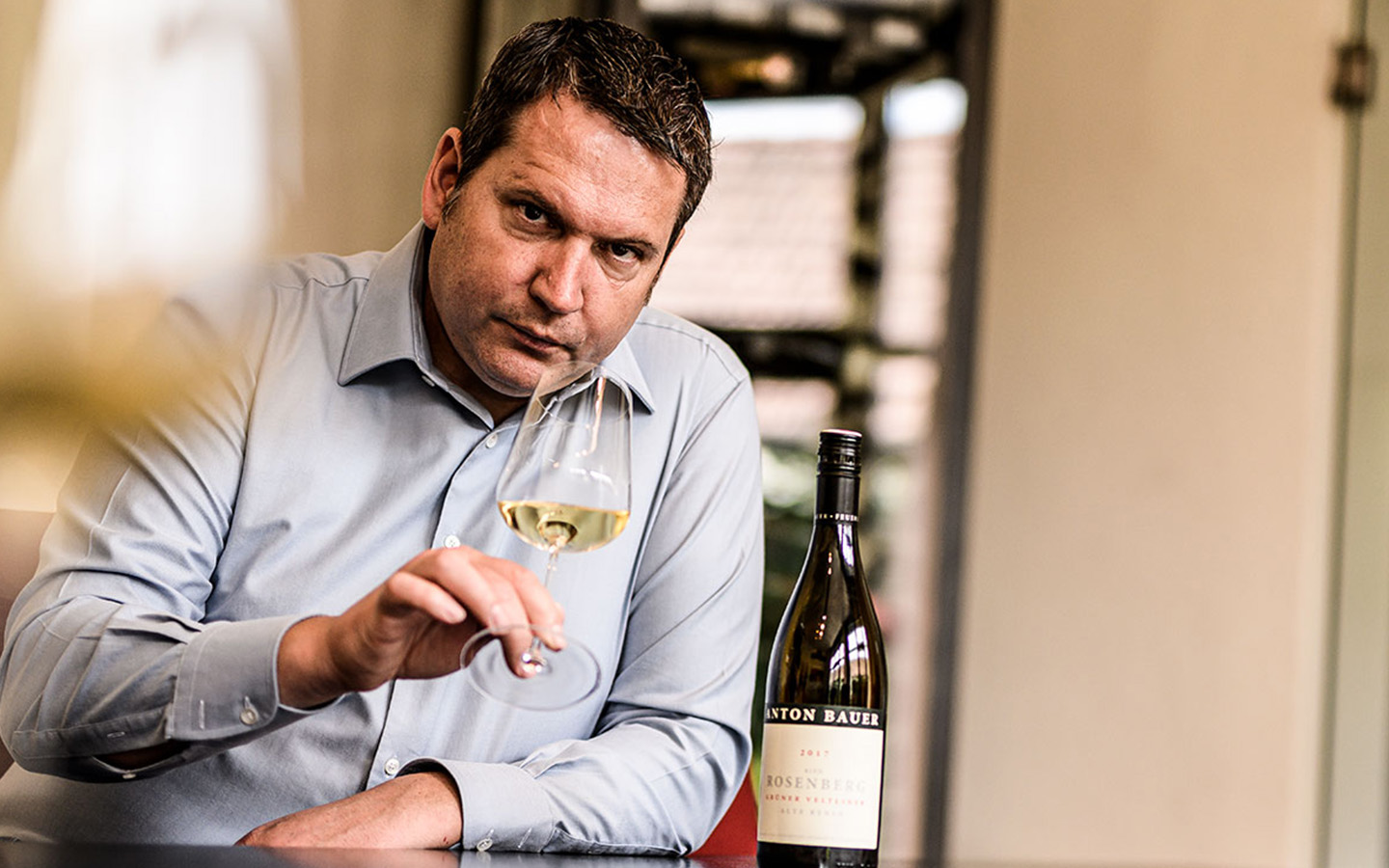
(Manfred Klimek)
There are winemakers whom we describe through their wines. And there are those few with whom we eventually realise that we are actually describing a person who makes wine. Anton Bauer belonged to this second, rarer category.
With his death, the Wagram loses not only one of its most important protagonists, but also an unwavering individualist who, over decades, refused to think of wine as a fashionable product – despite its memorably designed label. Bauer thought in periods of time, not vintages. In decisions, not hesitation. And above all in quality – uncompromisingly, sometimes stubbornly, always consistently. And he was one of the great winemakers of the oenological middle tier in quality winegrowing – and not only in the Wagram. Moreover, he was someone who always delivered reliably. From precise by-the-glass wines for the restaurant trade to genuinely great red wines. He was the reliable one.
Born in 1971, Bauer came from an agricultural reality that had little to do with glamour. The estate was small, the wines rather simple, the market manageable. Yet something became apparent in him at an early stage that would later shape all his work: an absolute determination to be precise. His encounter with Burgundy – when he was still a very young man – did not lead to imitation, but served as a catalyst. There Bauer understood that great wines do not arise from the the-nature-does-everything-itself chaos, but through control, patience and respect for the vine and the grapes.
When he took over his parents’ estate in the early 1990s, this was not a romantic obligation, but an entrepreneurial gamble. Austrian wine was still struggling with the aftermath of the scandal, trust was fragile and prospects scarce. Bauer nevertheless chose not to take the easy route. Instead of bulk wine and regional blandness, he focused on élevage, selection and international comparability – without denying his origins. Stainless steel replaced old vessels, areas were expanded and the range was refined. And above all: standards were raised.
Bauer was one of the first winemakers in the Wagram to show consistently that this loess region is capable of more than just fruity agreeableness, but also depth, structure and longevity – in both white and red. His Grüner Veltliners were not merely traditional ambassadors for the variety, but precisely narrated stories of their sites and even individual vineyard parcels. His red wines – for a long time a provocation to many purists – became a hallmark: individual, full of tension, free from provincial complexes. Zweigelt, Blaufränkisch, Cabernet, Merlot – for Bauer these were not stylistic exercises, but serious attempts to give the Wagram a second voice.
Internationally, this attitude was understood early on. In the USA, Bauer found a response more quickly than in his own country. He travelled, presented and explained – not as a salesman, but as someone who was convinced. Success came slowly, but sustainably. Markets opened up, bottles found their way into discerning cellars and the estate grew. Yet despite all the expansion, Bauer remained remarkably free of vanity. He did not seek the stage, but confirmation in the glass.
That he was named ‘Winemaker of the Year’ (falstaff) in 2017 was less a turning point than a belated tribute to a man in his prime. Recognition of an achievement delivered long before. Those who knew Bauer knew that titles meant nothing to him as long as the wines were right. And they were right – often only after years, sometimes after a decade. Patience was part of his way of thinking.
His sudden death – after two economically difficult yeas and a third party’s rescue of the indebted company – leaves a gap in the estate (and the region) that will not be easy to close. Not because nobody could continue his viticulture, but because Bauer also stood for an anti-opportunist attitude that is coming under pressure in winegrowing during the crisis: long-term, unruffled, uncompromising in its standards and free from fashionable opportunism. He was not an explainer of the wine world, but someone who structured it through his work.
What remains are bottles that also need time – bottles that will remind us of him. And a region that is poorer without him – not only in wines, but in character. Anton Bauer died yesterday at the age of 54.