
(Editorial team)
For years, January has been declared the moral high mass of abstinence. With headlines that sound so unequivocal that they are intended to nip any questioning in the bud: Alcohol is poison. Every drop causes harm. Period. What systematically disappears in the process is not doubt—but the evidence. Or more precisely: the evidence that does not fit the educational narrative.
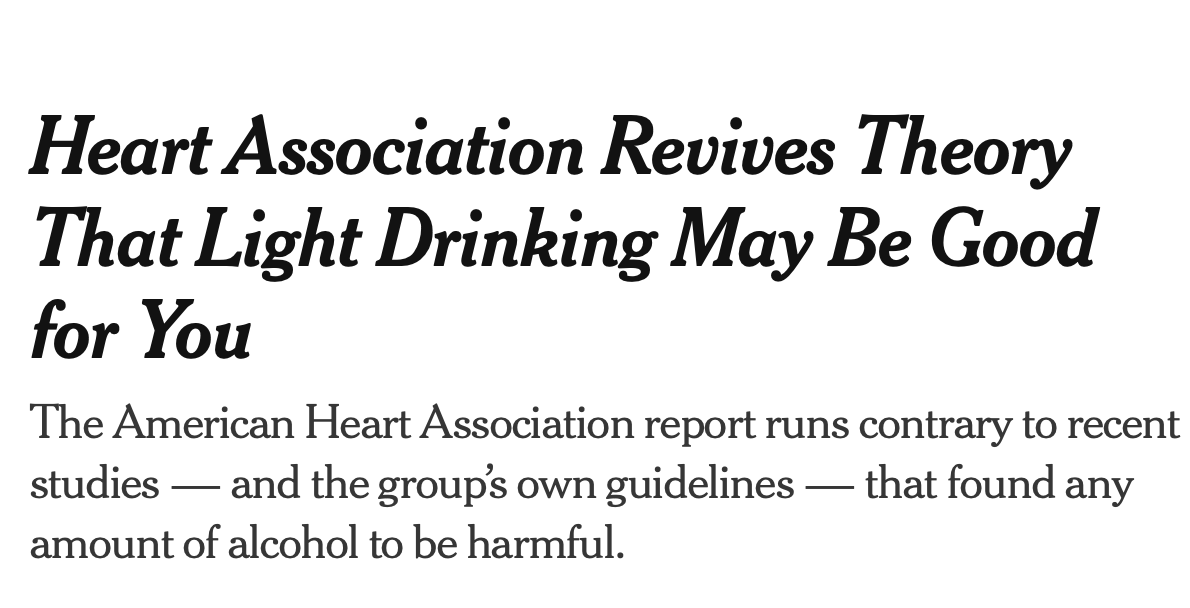
The newly published text by the New York Times from 16 December 2025 brings this suppressed complexity back into the debate with remarkable clarity. And it does something that, in the context of Dry January, has until now almost been considered sacrilege: it shows that the scientific situation is not settled, not clear-cut and certainly not as morally clean as educational media have been suggesting to us for years.
The starting point is a new review article by the American Heart Association, which—having not yet been cancelled or infiltrated by the Health Kennedy, and against the zeitgeist—maintains that light alcohol consumption, defined as one to two drinks per day, shows no increased risk of coronary heart disease, stroke or sudden cardiac death—and may even be associated with a lower risk under certain circumstances. Literally, it says that light consumption “posed no risk for coronary disease, stroke, sudden death and possibly heart failure, and may even reduce the risk” (NYT, 16 December 2025).
This finding alone is enough to set off alarm bells. For it contradicts the “no safe level” thesis aggressively imposed in recent years. And this is precisely where the real problem begins: It is not the science that is unequivocal, but the selection of what is told publicly.
The NYT text clearly reconstructs why the famous J-curve—which, since the 1920s, has described how light drinkers have statistically lower mortality than abstainers and heavy drinkers—has fallen into disrepute. Critics have rightly pointed out that many so-called abstainers were former patients or ex-alcoholics. That moderate drinkers often have higher levels of education, better medical care and more stable living circumstances overall. All valid objections.
But equally valid is the next finding, which the educational rhetoric likes to gloss over: even newer methods such as Mendelian randomisation have so far failed to prove, that moderate drinkers had a higher risk of heart disease or death. On the contrary: in these studies, people who, for genetic reasons, tolerated little alcohol and therefore drank hardly any were not healthier than light consumers. A finding that—according to the NYT—“the hypothesis that light drinking is beneficial” at least has not been disproved.
And this is precisely where it becomes political. For at this point, the question is whether one is explaining science—or trying to educate people.
The New York Times openly identifies what many media outlets conceal: that large parts of alcohol reporting are no longer aimed at gaining knowledge, but at directing behaviour. “If you don’t drink, don’t start”, says the AHA’s medical director—a sentence that sounds reasonable, but at the same time freezes the debate. For there is a difference between not starting and and morally condemning . And this difference has been systematically levelled out in Dry January for years.
Particularly revealing is the accusation raised by critics of the AHA study itself—and not concealed by the NYT: that individual authors had ties to the alcohol industry. That is relevant. But it is made relevant selectively. For the same rigour is rarely applied when studies originate from abstinence-policy networks whose agenda is just as clear. Transparency is not a one-way street.
What becomes visible here is not a fight over health, but over interpretive authority. Not risk education versus enjoyment—but control versus ambiguity. Dry January only works as long as it can claim that there is nothing to discuss. The NYT destroys this claim not polemically, but journalistically. By showing that even leading doctors have to concede: The evidence is contradictory. The effects are small. The relationships are complex. And many statements are based on observational studies which, as Stanford professor John Ioannidis says, are “pretty weak by definition”.
The fact that precisely such texts have so far barely been cited in January, let alone discussed, is no coincidence. They disrupt the clear message. They demand thinking instead of obedience. And they remind us that enjoyment, moderation and responsibility are not the same as abstinence on command.
Perhaps that will change in 2026. Perhaps not. But with this text, the New York Times has delivered something that is urgently missing from the discourse: an invitation to embrace discomfort. And the realisation that moral grades are no substitute for scientific honesty.
Wineparty will not forget this during the coming Dry January. And we will watch very closely who cites this study—and who once again pretends that it does not exist.