
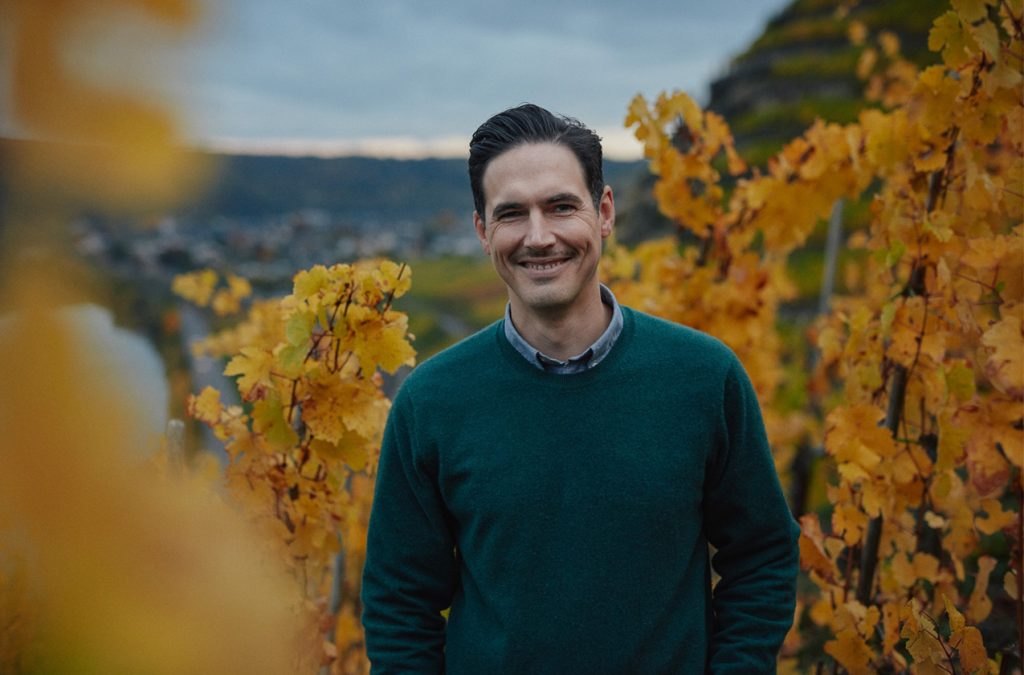
(Claude Auguste / Assistant: Manfred Klimek)
One (the wine enthusiast) has to try quite hard to declare one of the world’s most famous wine regions practically finished. The American magazine Wine Enthusiast has taken on this task. On 23 October, the journalist Clara Dalzell published an article entitled „An Iconic Wine Region Is in Trouble. These Families Are Fighting to Save It“. A legendary wine region is in trouble; these families are fighting to save it. Beneath this, we read stories of abandoned vineyards, unaffordable manual labour and young winegrowers who are clinging to their vines against all economic logic. The Mosel appears as a beautiful patient in intensive care. The relatives have already gathered at the bedside. Now all that is missing is someone to notify the priest.
The economic facts are indeed serious. The vineyard area of the Mosel wine-growing region, which also includes the Saar and Ruwer, fell to 8,287 hectares in 2025. In the Rhineland-Palatinate part alone, 158 hectares were lost compared with the previous year. Steep slopes are expensive to farm, labour is difficult to find, and many small businesses lack capital and successors. Historical terraces, whose walls and vines have been preserved over generations, are particularly at risk. If they are abandoned, Europe’s cultural landscape disappears. In the article, Winemaker Matthias Knebel from Winningen puts his average cultivation costs on the terraces at 14.32 dollars per litre. Dalzell contrasts this with an average American import price for German wine of 3.81 dollars per bottle. The figures are not directly comparable economically, but they do illustrate the enormous effort involved. Anyone producing wine on the terraced Mosel cannot compete with industrially produced wines from vineyards that can be mechanised. This really should not need explaining to anyone. Apparently, it still has to be explained again and again.
Dalzell portrays Andreas and Barbara Adam, Julian and Nadine Haart, and Philip and Rosalie Lardot. People who save old vineyards, take over abandoned parcels and work where others gave up long ago. The story of the Haarts is particularly impressive: they ultimately exchanged their difficult-to-farm plots in the Schubertslay for vineyards in Rheinhessen. Klaus Peter Keller, too, does not intend to continue the lease there once it ends. Such decisions are painful. They show that, under current conditions, certain vineyards are scarcely viable economically. But to infer from this that the Mosel’s imminent demise is roughly as sensible as concluding from the closure of a traditional Parisian bistro that French cuisine is coming to an end.
For the Mosel possesses a density of internationally important wineries that other regions envy. Markus Molitor, Nik Weis with St. Urbans-Hof, Immich-Batterieberg, Joh. Jos. Prüm, Günther Steinmetz, Fritz Haag, Schloss Lieser, Clemens Busch, Dr. Loosen and numerous others have opened up international markets, developed distinctive styles and built a reputation extending far beyond Germany. On the Saar, names such as Egon Müller, von Othegraven and many others stand for an equally unmistakable wine culture. These estates, too, are not immune to economic change. But anyone who derives their future solely from the difficulties faced by the regional average is confusing a wine region with its sales statistics.
This applies particularly to Matthias Knebel. The man from Winningen is one of the great individualists of German viticulture. His terraced Mosel is a different world from the gentler slopes of the Middle Mosel. Here, slate cliffs tower above the river, and the vineyards are sometimes accessible only via narrow paths and steep steps. Knebel farms just under eight hectares together with his mother Beate. His most important sites are called Röttgen and Uhlen, with Uhlen possessing remarkable diversity thanks to its different geological formations. From this, Knebel has developed a very personal vision of Riesling. Spontaneous fermentation, extended lees ageing, minimal cellar intervention and a willingness to preserve the differences between vintages and parcels shape his work. His great dry Rieslings possess a depth and idiosyncratic character that the usual descriptions of minerality and elegance capture only inadequately. These are wines that almost embody their origin. Knebel was named Winery of the Year on the Mosel by the Vinum Weinguide Deutschland 2026 . To regard him as the last defender of a culture in decline is to overlook the fact that he is one of the people who have given this culture a contemporary and internationally respected form.
Interestingly, alongside his great dry Rieslings, Knebel also produces remarkable Kabinetts, Spätlesen and Auslesen. He does not have to choose whether the future tastes dry or off-dry. And that brings us to a question the Wine Enthusiast scarcely asks in its narrative of decline: what does the next generation actually want to drink?
Fifteen or twenty years ago, the answer seemed clear. The future of German quality wine had to be dry. Riesling should finally escape the international pigeonhole in which German white wines had been regarded for decades as sweet, light and somewhat old-fashioned. The great dry wines became the new benchmark. They were meant to show that Germany could produce white wines capable of standing comparison with great white Burgundies. In the Mosel, this was a demanding task. Its historical reputation was based precisely on finely fruity, off-dry Rieslings with low alcohol, lively acidity and exceptional ageing ability.
The rise of dry Mosel Riesling was a tremendous qualitative success. This must be acknowledged by someone like me, who counts great dry Rieslings among his favourite wines. A mature dry Mosel Riesling can be among the most fascinating white-wine experiences of all. I would choose a great bottle of dry Mosel Riesling over a Kabinett at any time. But I am also old enough to know that my taste does not automatically describe the future of an entire industry.
Around 2010, many regarded dry Riesling as the definitive answer to the question of the Mosel’s future. In 2026, that answer is less clear-cut. For, remarkably, the very wine style that the modern German wine movement long treated as a dusty legacy is experiencing a remarkable renaissance, here in Italy too: Kabinett.
Kabi, as its devotees call it, possesses qualities that fit astonishingly well with current changes in the drinks market. It is light, often with seven to nine per cent alcohol, has invigorating acidity and a fruit sweetness that, in good examples, is perceived less as sweetness than as flavour balance. It can be drunk without any gastronomic ceremony, works with many dishes and can just as easily be opened without food. Above all, it possesses something that many modern prestige wines have lost: it makes you want another glass.
Kabinett is, moreover, part of the Mosel’s historical self-understanding. The finest examples from Joh. Jos. Prüm have shown for generations why this style is admired throughout the world. A Wehlener Sonnenuhr Kabinett from this estate can possess such a combination of lightness, precision, fruit and ageing potential that one wonders why the wine world spent so long considering this kind of wine outdated. It is a great wine that does not need to be heavy in order to be significant. While elsewhere people debate ever-greater concentration, longer maturation and greater importance, it arrives with eight per cent alcohol and still has everything one needs.
The new demand for such wines can already be observed. In January 2026, the British Wine Scholar Guild published an analysis by Matt Walls on the renaissance of Mosel Kabinett. In it, winegrowers such as Dorothee Zilliken and Johannes Selbach report growing international interest in wines with low alcohol. Thomas Haag of Schloss Lieser puts it particularly clearly: Kabinett is especially popular with young people. German industry observers are also registering the development. However, the sales figures to date do not yet demonstrate a broad-based boom. A trend is discernible. A new economic doctrine of salvation would be premature.
The cultural irony is nevertheless remarkable. A wine region that spent decades working to shed its historical sweetness and establish itself as the home of great dry Rieslings may now discover that its original style is precisely what appeals most to younger customers. Kabinett offers less alcohol, freshness, uncomplicated enjoyment and a certain playfulness. It can be an excellent party wine without having to sacrifice quality as a result.
Admittedly, climate change makes producing genuinely light Kabinetts more demanding. Warmer vintages result in higher must weights, and low alcohol levels cannot be reconciled indefinitely with the desire for complete physiological ripeness. The best winegrowers must therefore decide ever more precisely when to harvest and which parcels are suited to this style. Economically, too, Kabinett is no automatic solution. Anyone facing high production costs on an extreme steep slope cannot secure their future simply by bottling a wine with eight per cent alcohol. The market must be willing to pay an appropriate price for it.
But the question remains: have we perhaps produced too much of what we ourselves believed to be the future? Have we transferred the taste preferences of a comparatively small, knowledgeable audience to a market whose majority has different expectations? Dry Mosel Riesling has brought the region new international recognition. Yet if more and more estates produce similar dry Rieslings, competition increases. And if demand for wine overall is falling at the same time, those who possess neither the renown nor the pricing power of the big names come under pressure. And, to add to this, the times and the preferences of the generations living in them often change with dramatic speed.
The Mosel might do well to recognise its diversity more strongly as an economic advantage. Historically and under wine law, the Saar and Ruwer belong to this cultural region, but they discreetly possess their own styles and market positions. Today, the decisive boundary runs less between the Mosel, Saar and Ruwer than between wines with a recognisable audience and those fighting for attention in an overcrowded market. A big name helps. An unmistakable origin helps too. What helps most is a wine that people genuinely want to drink.
That is why I disagree with the doom-laden tone of Wine Enthusiast. The author describes a real crisis, but her narrative turns a profound structural change into almost a cultural funeral. Throughout its long history, the Mosel has survived wars, economic collapses, changing trade routes, phylloxera disasters and numerous shifts in taste. Its great vineyards do not guarantee economic success. Its wines do, however, possess a cultural and qualitative distinctiveness that cannot be eradicated by declining vineyard acreage.