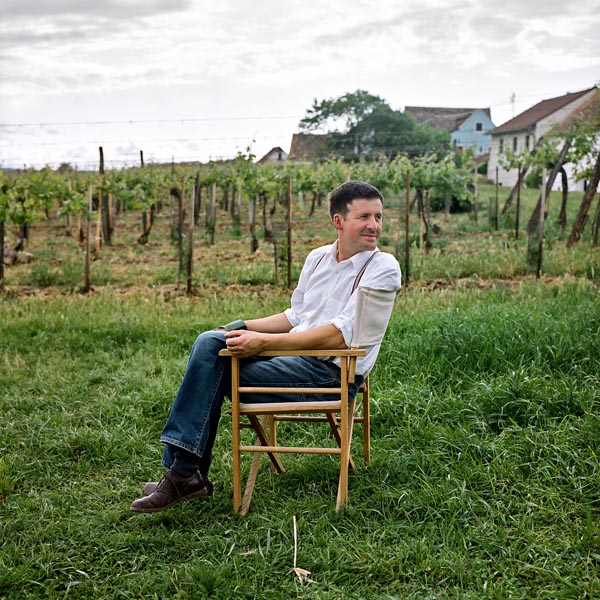
(Manfred Klimek / Winemaker pictured: Pollerhof, Weinviertel)
On wine, change and reality
I was due to speak in Oppenheim am Rhein yesterday. At an event organised by the state government. About wine, change and reality. A so-called keynote speech. No idea what that’s supposed to be – but I’m happy to oblige.
But Deutsche Bahn had other plans for me. And for the audience waiting in Oppenheim: trains were cancelled, services were disrupted, and connections failed to link up. I ended up stranded somewhere between Mainz and insignificance. And ultimately – and significantly – at Stefan Steinmetz’s place on the Moselle, where today I’m jotting down the key points of my keynote speech (what on earth is that, anyway?). What I would have wanted to say yesterday – and what is perhaps even more important today than having said it yesterday.
1. The train as a state of being
Perhaps this breakdown is symbolic. The world of wine, too, is travelling along a route that no one maintains any longer.
Signals fail, points jam, and everyone believes their carriage is better off travelling alone through the harsh realities of the present.
But wine is no soloist. It is an orchestra. And this orchestra is currently in danger of silencing itself. Partly because the orchestra has never had a conductor who sees the bigger picture and wants to preserve it.
I was only a part-time winemaker, albeit one who was awarded 93 Parker points (after which I stopped straight away), but I know the feeling of having to preserve something that is constantly under attack: truth, craftsmanship, meaning, love, life, enjoyment. An embrace of the world.
Wine is like writing – both require patience, climate, self-doubt and a willingness to make mistakes and to forgive.
2. The new Puritanism
Ever since the WHO announced two years ago that not a single drop of wine is safe, and that even moderate consumption is lethal – a claim, incidentally, not based on a single long-term study – a wave of moral revisionism has been sweeping through the wine world – particularly the German one. It hits the wine industry harder than anything else, because wine is a huge market – still a billion-market – which the anti-alcohol lobby only recognised as such very late in the day, and in which it also sees the only relevant adversary in the war it has instigated.
This opposing side, these declarers of war, do not argue on the basis of science, but of shame.
They appeal to ancient instincts: purity, asceticism, control.
They intermingle with religious motifs, with a ‘woke’ morality that has long since become the new church –
only without music and without confession.
Journalists who once asked questions now proclaim truths.
‘Stance’ has replaced research.
In editorials, alcohol is no longer analysed in a nuanced way, but demonised.
And, of all people, those who otherwise champion diversity now accept nothing but monotony when it comes to indulgence.
3. Wine as a canvas for projection
Wine, it is now claimed, is masculine, reactionary, elitist – an impression that, despite a changing world of wine, still proves itself true on social media. With label-drinkers who are nothing more than walking ‘My house, my car, my finca, my wine cellar’ posters.
A drink for the wealthy.
The SUV in a glass.
The bourgeoisie in a bottle.
And just as with cars, the moral unease about the internal combustion engine is enough to discredit an entire culture – especially amongst young people – if such a culture even still exists, amidst the birth strike of the sated, left-liberal middle classes.
Böhmermann’s anti-wine programme two years ago was merely a caricature of a deeper reflex:
the need to overthrow everything old so that the young can feel young.
The Chinese Cultural Revolution of 1966 in the lifestyle format of the post-Covid era.
That is what is new about this era. And viticulture is both a victim and collateral damage of a much, much greater socio-economic upheaval, which can be compared more to the industrial revolution of Manchester capitalism around 1845 than to the advent of the internet around 1990.
Even the smallest of winemakers must recognise this momentous change if they are to grasp and articulate the threat. And soon, ‘wanting to’ will be supplanted by ‘having to’.
4. The Vacuum of the Meaningless
We live in an age without a centre.
Religion, politics, the press – everything that once provided guidance has lost its authority.
What remains is the need for declared purity, for the self-assured dominance of the Good, the Beautiful and the True
. And purity is always authoritarian.
It tolerates no shades of grey, no half-measures, no slightly tipsy wine-induced bliss.
Renunciation becomes a virtue; enjoyment, a sin.
And just as sugar disappeared from parts of the new middle class’s diet (whilst still enjoying a cheerful resurgence amongst ‘the proletariat’), wine is now to vanish from middle-class culture. Unfortunately, the young middle classes – especially those in the media – perceive this as a mission to be fought for. And not as a cultural loss – partly because culture is no longer supposed to have any breadth or room for discourse.
5. The demographic shift
But even setting ideology aside, wine is facing its greatest structural turning point.
There are now only half as many young people as there were in the baby-boomer years, only half as many teenagers as there were in my youth.
And of this half, a third have an Islamic background – and thus a religious aversion to alcohol.
These young people are not against wine; it is simply alien to them.
At the same time, those who still see wine as a way of life are slowly dying out. As a culture standing in contrast to a grey everyday existence shaped by grey capitalism. Caught between a belief in purity and a sense of helplessness, the industry has lost its youth and its young people.
6. The loss of the aura
Wine was once the heartbeat of modern life.
Cordobar, Friendship, Schluck, Noble Rot – that was eight years ago. Wine was hip! Just eight years ago!
Today?
Wine has become quiet again, unsexy, on the ropes.
And not because it has gone to the dog, but because it remained quiet whilst others were shouting loudly.
7. The future tastes different
Bars can adapt. They’re experimenting with zero-per-cent gins, designing non-alcoholic cocktail menus, mixing drinks with zero alcohol content – and it’s actually working. That’s why bars are even possible
in an Islamic context. With wine,
it’s more difficult.
De-alcoholised wines lose what makes them what they are – their fermentation process, their soul, their rhythm.
You can technically ‘repair’ them, mask their flavour with aromatics – but they remain an artificial product. And to bolster this artificial product is a mistake – an amputation that implants a prosthesis controlled by an intelligence that is, on the whole, ignorant. Don’t go down this path!
Hope lies elsewhere: in biodynamics, in craftsmanship, in a belief in cycles rather than control.
The younger generation no longer accepts wine that tastes industrial.
They want provenance, not a brand. Truth in reality, not on a label.
8. The Counter-Offensive
What can be done?
We need a movement. Not a trade fair, not a campaign.
A new language, a new irony, a new passion.
For instance, wine campaign stalls in the upcoming ‘real’ election campaigns, standing up to the campaign stalls of other parties.
‘Wash down politics with a glass of German wine.’
Wine glasses at festivals, at the Berlinale, visible not just at art exhibitions.
And above all: female winemakers, female winemakers, female winemakers
. Because whoever attacks women loses.
That’s the law at Woke. And we should use the laws of Woke to our advantage.
9. Sharing is Caring
But most importantly: the wine world must finally realise that it can only survive by working together.
The era of jealousy, resentment and envy (especially in Germany) must come to a swift and definitive end.
Here on the Moselle, where I am at the moment, it’s still part of everyday life – everyone against everyone else.
Neighbours are fought against rather than admired or praised
; applause from others is seen as betrayal.
Yet resentment is the mould in the barrel of future wines.
As long as winegrowers whisper ill of one another instead of speaking well of one another, as long as another’s success is perceived as an affront, wine will have no future.
Sharing is caring (2)
Every winemaker, man or woman, should share every great contribution made by others –
across borders, generations and wine-growing associations.
This is no mere gesture of kindness – it is strategy.
The algorithm loves solidarity.
What is shared becomes visible.
And visibility is the key to survival in the present day.
This is the only way to create momentum.
This is the only way to create stories that stand their ground against the tide.
For the enemy is not in the neighbouring village –
they sit in the boardrooms of the digital platforms,
where culture is measured in clicks.
(Please also read about our initiative ‘Nobel Peace Prize for Wine’ at https://nobelprize.wineparty.wine/)
10. The German malady
The biggest problem is not the climate, not the market, not even alcohol.
It is the German mentality: endless scepticism, daft bureaucracy, intolerant caution, mindless isolation.
The fear of failing together is greater than the desire to shine together.
In Italy, Austria and Switzerland, they’re starting to get the hang of it.
In Germany, they just write minutes.
11. The Legacy
I would have liked to have spoken about this yesterday in Oppenheim – and in greater detail, too.
About wine, change and reality.
About a drink that was never merely a source of intoxication, but a reminder of cultural significance that extends far beyond viticulture. About a culture that abolishes itself when it renounces wine.
A Western world that is losing its dawn.
For wine is no vice.
It is a teacher.
It teaches patience, devotion, moderation and humility.
It connects the earthiness of the soil with the humanity of the creature, the fleeting with the enduring.
And perhaps it was just as well that I was unable to deliver the speech.
For in this way, it was allowed to breathe for one night.
Like a wine that was forgotten in a decanter on the table.
And then, at last, finds its true self.
Please also read about our initiative, the Nobel Peace Prize for Wine: https://nobelprize.wineparty.wine/