(Editorial team)
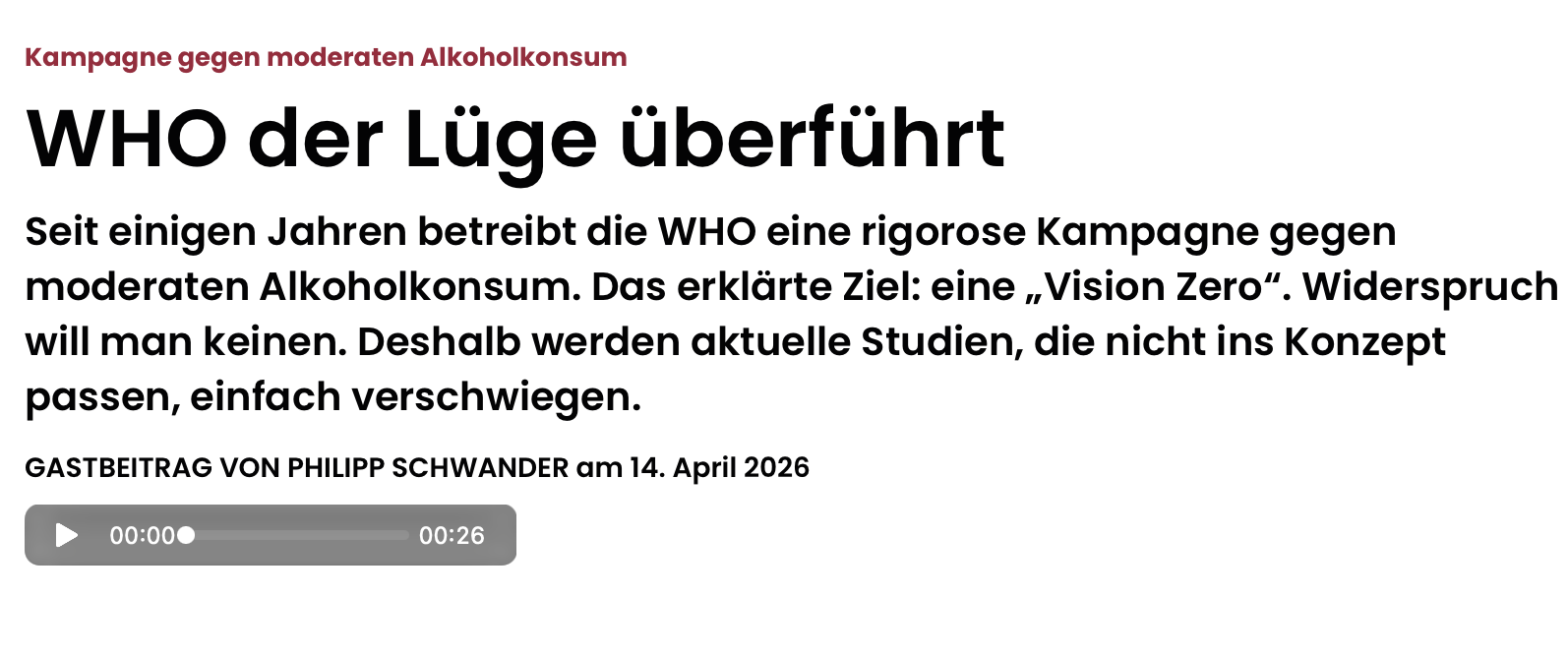
It is a moment that is rarely experienced in wine journalism, or journalism in general. A moment in which a publication does not taste, recommend or enthuse about wine – but attacks. And attacks head-on. On 14 April, the magazine Cicero did exactly that. In an article about the WHO’s anti-alcohol strategy, a word appears that has rarely, if ever, featured in wine journalism so far: “lie”.
One has to appreciate what this means. Over the last three years, the tone in the dispute between the wine world and the World Health Organization has been asymmetrical. On one side, the WHO with its papers (which were never studies), its global campaigns and its moral authority. On the other, an industry that, at best, voiced quiet disagreement, but often did not respond at all. And now an author in a serious, bourgeois-oriented publication writes that the WHO had “systematically ignored important scientific findings”.
The text itself is not a scientific paper. It is a guest article by wine merchant Phillip Schwandner – and is therefore, by definition, a position and self-evidently immediately open to challenge. But it is precise enough not to be dismissed as mere polemic. Like Wineparty has done since January 2025, the author refers to more recent studies that at least qualify, if not completely overturn, the long-dominant narrative that every drop of alcohol is harmful. He recalls the so-called J-curve, the statistical observation that moderate consumption in certain age groups may be associated with lower risks than complete abstinence. And he asks why precisely these distinctions now barely appear in public communication. A question we also ask constantly – and receive only strange, evasive, stupid, unjournalistic answers to.
He calls the WHO’s strategy “Vision Zero”. A term originating in transport policy, where it stands for the complete elimination of fatalities. Applied to alcohol, this means: no safe consumption, no grey areas, no cultural context – only risk. It is not surprising that such a model encounters resistance. That this resistance is finally being expressed with such force, however, is.
What is interesting here is less the question of whether the author is right. Science will answer that – if at all – only slowly and contradictorily. What is interesting is that the tone is shifting. That a medium such as Cicero is prepared to publicly challenge the interpretative authority of a global institution. And not with the usual journalistic caution, but with the deliberately provocative term “lie”. The fact that this text was approved by the editorial board also means that, in the event of legal action, it will stand behind its author.
Of course, we must also read the text critically. It is selective, as many contributions to this debate are selective. It places studies side by side without fully examining their methodological differences – which so-called serious journalism has also been doing on this issue since 2023. It argues from a perspective that is fundamentally sympathetic to moderate wine consumption. But that is precisely where its significance also lies: it makes visible the fact that this perspective exists – and that it has so far had little space.
For the truly remarkable thing is not the criticism of the WHO. It is the fact that this immensely harsh criticism is being published at all. That an established publication is prepared to question a dominant narrative that, in recent years, has been carried almost without opposition by politics, the media and the public. And that in doing so it is taking a risk – the risk of being misunderstood, attacked and torn apart on social media.
Possibly a decisive turning point in the fight against/for wine. Not one study against another. Not the question of whether a glass of wine is harmful or not. But the return to an open debate in which dissent is possible again. In which not every distinction is immediately regarded as downplaying the issue – as a provocation of an old culture that, in the opinion of many young female editors (men included), should disappear from everyday life as quickly as possible.
The damage of the past few years remains. The simplifications, the exaggerations, the moral loading of a complex issue – none of this will simply disappear. But with texts like this, something else begins: a harsh correction. No counter-narrative, no new certainty. But a doubt. And doubt is, in the best sense, the beginning of knowledge.