
German text attached below
(Editorial Department, BBC)
The Catholic Church and Its Sacred Wine: Blessings, Dominion and History
Throughout its long history – often marked by mystery and power – the Catholic Church has not only spread the Gospel to distant lands, but also wine. That “nectar of the grape”, as the Bible puts it, was a symbol of civilisation and faith.
But now, here in Kenya, something surprising has happened: wine used in worship can no longer be treated as an ordinary drink. The Church has decided to act as the guardian of these sacred grapes – in a land where the tropical sun ripens Africa’s new grapes.
New Liturgical Wine – Sacrament or Scandal?
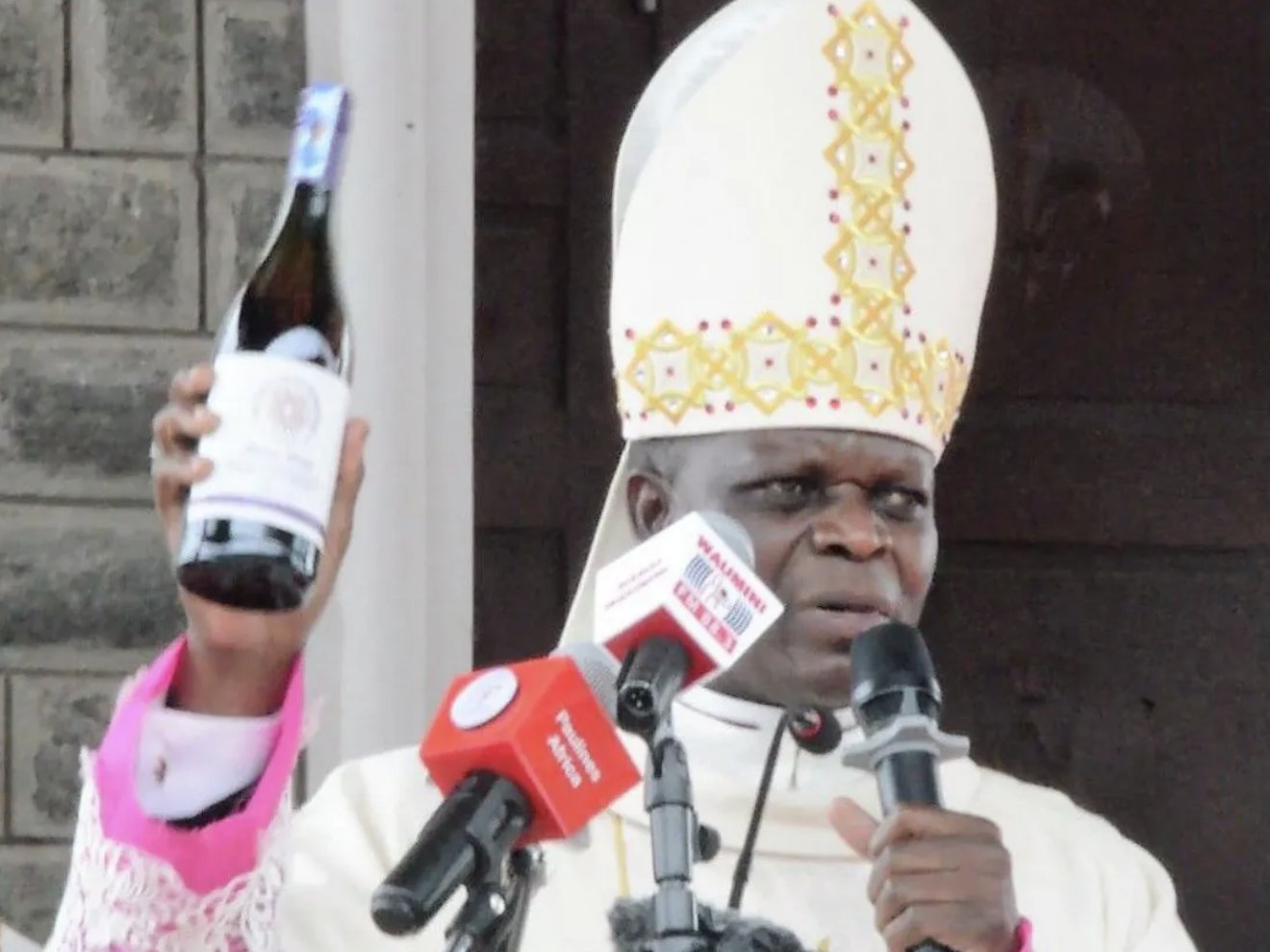
The Kenyan Catholic Bishops’ Conference (KCCB) has introduced a new liturgical wine, “Mass Wine”, after discovering that the old variety was being sold illegally in bars, pubs and shops. They say the aim is to restore the dignity of the chalice – to draw a clear line between the sacred and the profane.
From now on, this wine will be the sole property of the Church, bearing the KCCB logo, and will no longer be sold in shops.
It is a step that can be seen as one of respect – an attempt to protect the sacrament. Many agree that the ‘Blood of Christ’ should not be turned into a market commodity. However, this move raises serious questions: regarding history, ownership and the boundaries of the sacred.
The Church, as the Guardian of the Faith
, regulates wine – by blessing it, inscribing it with a seal, and deciding who may partake of it – and this carries the stamp of authority. The veil no longer functions as a symbol, but as a seal of authority: it is the only ‘official’ symbol that can be blessed.
But this is nothing new. For over one and a half thousand years, the Church has been part of the history of religion, culture and Western perspectives. When missionaries arrived in Africa, they brought with them the Bible and also religious symbols. They claimed to be bringing civilisation and faith – but all too often they also brought oppression and new boundaries between the ‘sacred’ and the ‘profane’.
Today, when we say ‘the Church has brought civilisation to Africa’, we must also remember: there was power, there was control, there was coercion. It was not merely education; it was also a means of controlling the mind.
Religious Alcohol Becomes the Norm
Kenya has seen the other side of this story. Alcohol for religious purposes began to be sold everywhere – in bars, hotels and liquor shops. People loved it; they saw it as a fine drink, not just a religious one.
For the Church, this was a disgrace. What had once been a sacrament had become a commodity. So now they have decided: the wine of old is no longer blessed. It is the new wine, authorised solely by the Church, which will be used at the Lord’s Supper.
Character and Caution
Even so, we cannot simply look the other way. It is a matter of honour that the Church still has the courage to uphold its symbols in a world dominated by the marketplace. In many countries, religions have been forced to abandon even their symbols.
For this reason, the Church deserves praise. We are reminded that even something as simple as a vine – in the context of worship – can be sacred if it is treated with respect.
But within that very respect, there is a major issue: when you say you are bringing reverence, you are also bringing authority. When you say, ‘This is the true faith,’ you are defining people’s identities, their cultures, and the boundaries of participation. Throughout history, this has been a weapon of colonialism: religion intertwined with power, worship transformed into a system of control.
The Church
: Free at
Last
And now, perhaps, there is a turning point. Every church – whether for worship or for farming – carries history within it: of guests, of conflict, of faith and of blood.
The vineyard of worship in Kenya symbolises two things at once: the heritage of the Church, and the dawn of social freedom.
The West still believes it can dictate the course of the world. But Africa is forging its own new traditions – and perhaps the true significance of wine lies in its capacity to transform: from a colonial relic to a voice of its own.
That is why, when we see the new ‘Mass Wine’ on the altar, we should take note. It is a small sign of great changes. The wine, which used to be a missionary, has now been transformed.
And for the first time in many generations, it is free – even if it still lies within the chalice of worship.
Here in Africa: Holy Wine and Holy Contradictions
(Editorial, BBC)
Throughout its largely violent history, the Catholic Church has not ‘merely’ carried the Gospel to distant lands, but has often also brought wine – this ‘divine nectar of the grape’ (Bible) – as a cultural artefact. In Kenya, however, something almost surreal is now unfolding: a sacramental wine that “must no longer be misused as an everyday drink” – and with it, a Church that is becoming the guardian of the sacred drops in what is almost a tropical climate.
New Mass wine – a new sacrament or a new charade?
The Kenyan Catholic Bishops’ Conference (KCCB) recently introduced a new Mass wine – called ‘Mass Wine’ – after it was discovered that the Kenyan Church’s previous sacramental wine was being sold freely in bars, restaurants and supermarkets. The idea behind this is to restore the sanctity of the chalice and redraw the line between the sacred and the profane. In future, the wine is to be the exclusive property of the Church, bearing the coat of arms of the Bishops’ Conference – and not available in shops.
At first glance, this sounds noble – an attempt to protect the sacraments. The faithful, it is said, often welcome the concern that a symbol representing the ‘Blood of Christ’ must not be trivialised. Yet this approach also raises weighty questions – particularly with regard to history, power and cultural intervention.
The Church as sommelier and guardian
The fact that a church controls, labels, imports and monitors wine – all of this has a certain monarchical air about it. Wine is no longer merely a drink, but a seal of authenticity: only the ‘official’ wine may be blessed and drunk. A tight straitjacket that the Church has imposed upon itself – historically speaking.
For, of course: viticulture, vines, cellar expertise – all of this has often been a major export of colonial culture over more than 1,600 years of European Christian history. Wherever European missionaries went – wherever the climate permitted vines to grow – there followed the winery and the idea that wine was a symbol of civilisation. The Church was often able to pretend that it brought faith and pleasure in the same breath – but in truth, it also brought control, hierarchy, and the distinction between the sacred and the secular.
When we applaud today that ‘the Church brought wine culture to Africa’, we must also recognise that this was not merely civilisation, but also coercion. Not merely education, but conversion. Not merely wine, but a worldview.
Death at the wine rack
In Kenya, this control eventually turned into a nightmare: ‘holy wine’ became a celebrated everyday drink. Bars, hotels, off-licences – it accompanied cocktails, aperitifs and regulars’ gatherings. The faithful observed that what was supposed to be ‘holy’ was appearing everywhere – in mundane everyday life, in intoxication, in commerce. What was once a sacrament became a commodity.
In hindsight, this is how it is explained: the wine previously used in Mass had lost its exclusivity; the boundary between the sacred and the profane had become blurred. Non-Christians were drinking it, and the Church is now responding by retreating into the theological: only the official wine – strictly controlled – is to be consecrated in future.
Both
praise and a warning
I do not wish to succumb here to simplistic cultural pessimism: it is impressive that, in this globalised world, the Church still possesses enough sense of its own identity to defend the sanctity of a symbol – and does not allow itself to be steamrollered by market forces. In many parts of the world, such a step would be unthinkable. In this respect, the Catholic Church deserves praise: it reminds us that even something as mundane as wine – in its context – may be sacred if one shows it respect.
Yet it is precisely this stance that harbours contradictions: when you claim to bring sanctity, you often bring domination with it. When you, as a church, dictate what ‘the right wine’ is, you control culture, taste and participation. Throughout history, this has all too often been part of subjugation. When proselytising went hand in hand with cultural homogenisation – involving wine, language and rituals – it was often a tool of a colonial worldview.
Holy residual sugar
So what remains? Perhaps a realisation that we so often overlook in wine: that every bottle, every vintage, every liturgical communion carries with it a piece of history – with the bitter aftertaste of power, faith and violence. The Mass wine in Kenya is both a symbol and a mirror: a sign of assimilation, but also of autonomy.
For whilst Europe still believes it defines the taste of the world, new traditions have long been emerging in Africa. Perhaps the true sanctity of wine lies not in its purity, but in its ability to transform – from a colonial tool into an expression of its own culture.
Seen in this light, what is happening in Kenya is not a quirk, but a small exodus: the wine, once a missionary, is being converted. And for the first time in centuries, it is truly free – even if it remains in the chalice.