
by Manfred Klimek
It begins with a number. 98. There it is, in black and white, beneath a wine unlike any Austria has seen before. 98 Parker Points for the Blaufränkisch “Ried Spitzerberg – Obere Spitzer”. The highest score ever awarded to an Austrian red wine. You can read it as an accolade. Or as a turning point.
Dorothea Muhr has never made wine for points and accolades. She has worked towards an idea: the idea of Blaufränkisch as a quiet, deeply mineral, highly elegant answer to a red-wine world that too often loses itself in fruit and fat. Now she stands there with a rating that commands international attention, and a wine that eludes every spectacle.
The Becoming
The story begins with a return. In the 1990s, Muhr returned to Prellenkirchen, to the Spitzerberg, where she grew up in a solid smallholder family. What followed was not a career plan, but a confrontation with the landscape. The Spitzerberg is not an inviting place. The soil: barren. The winds: harsh. The yields: low. And yet she began acquiring parcel after parcel. Planting vines, putting down roots. Not because it is easy – but because the mountain is worth it.
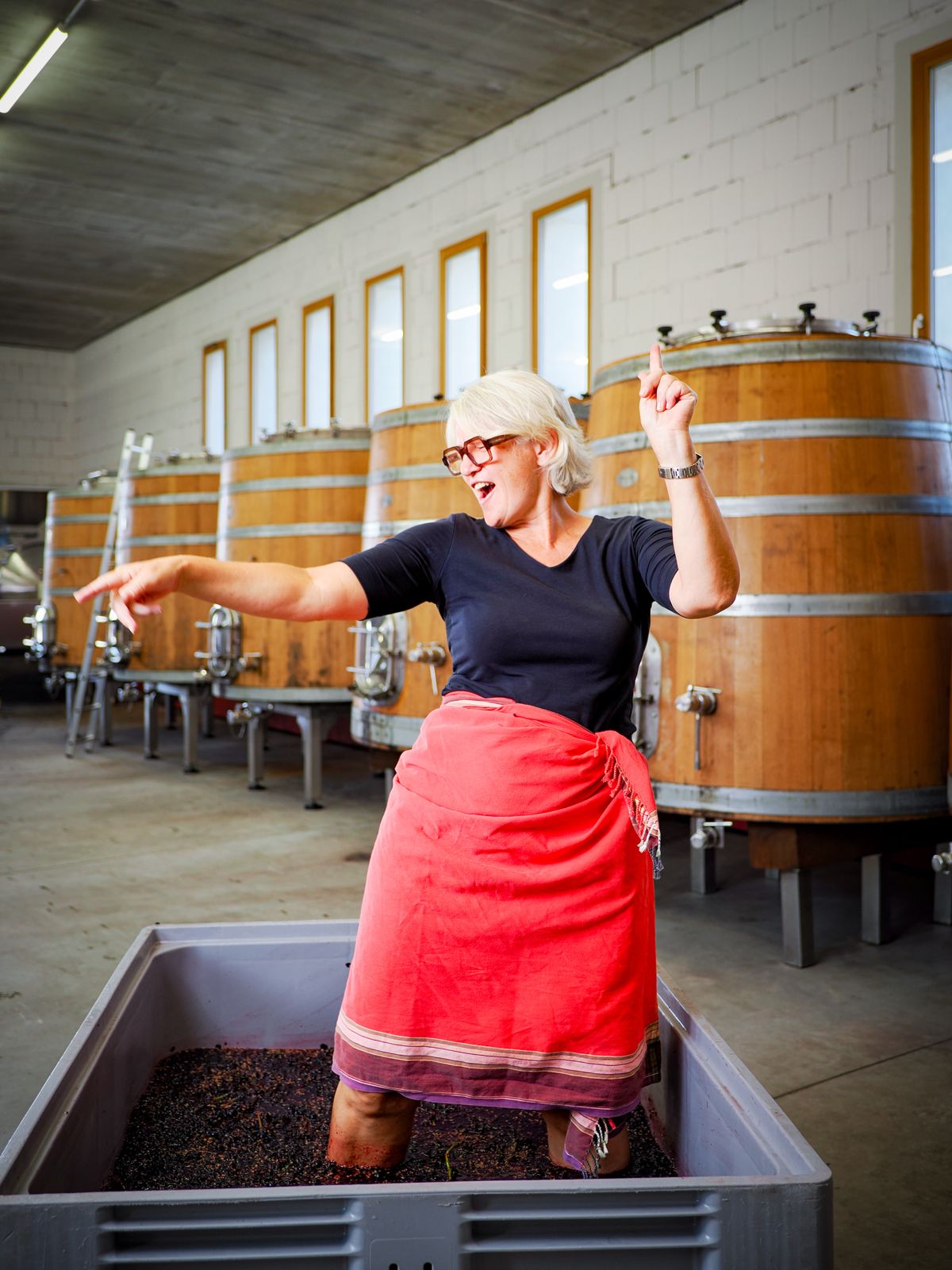
She ferments spontaneously, treads with her feet and bottles late. Reduction instead of construction. The wines should not come across as made. They should feel like something that has happened. Blaufränkisch, she says, needs no mask. It needs time, and the right terrain.
The Mountain
The Spitzerberg is the opposite of comfort. It demands clarity. The wind dries. The soil stores little. The roots search for nourishment. And find it deep in the earth. In this field of tension, a style emerges that refuses to please. Salty, cool, tart. Not a red wine for the fireside. But for palate and mind. For those who do not confuse depth with density.
Dorothea Muhr did not reinvent Blaufränkisch. She stripped it bare. Until only the essential remained.
The Points
And then the moment arrives. 98 points. Robert Parker’s Wine Advocate. A monument in the wine world. Suddenly, Obere Spitzer is no longer a secret address, but a benchmark. For some, a crowning accolade. For others, an irritant.
For the voices appear immediately. Naysayers mutter: It’s a bubble, surely. A few media and wine people are simply writing their own version of the world. Wine is tasted, assessed and scored as though it were all a club. They know one another. They taste one another. They raise one another up.
What nonsense!
Anyone who drinks Muhr’s wines, whether blindly or consciously, immediately recognises that it is not a narrative being assessed here, but character. It is not about a scene, but about a profile. And it is about a Blaufränkisch striving upwards against every force of gravity. Because it can.
The Line
Obere Spitzer is not alone. The other sites – Roterd, Liebkind (single parcel), Samt & Seide – also show profile, bare earth, substance. It is no coincidence that the ratings are high across the range. It is the result of consistency.
What Muhr has done is not merely viticulture. It is topography. She has given the Spitzerberg back its voice – and given us the ability to listen to it.
Moving Forward
Muhr has a new cellar – with a new winery building. Reduced, functional, built close to the mountain. She has organic status. She has international recognition. And she has an agenda: Blaufränkisch is not a compromise wine. Not a substitute for Spätburgunder. Not a second choice. But a category of its own. An Austrian answer to the question of what red wine can taste like when you leave out everything that makes it heavy.
The Astonishment
What remains is astonishment. That a region which for decades had been on nobody’s radar is suddenly setting the pace. And that a winemaker is drawing a new line – against noise and in favour of precision. And this in the most difficult times red wine has probably ever faced. Now, however, it is back. At least briefly, at least in the headlines. At least, at any rate.