
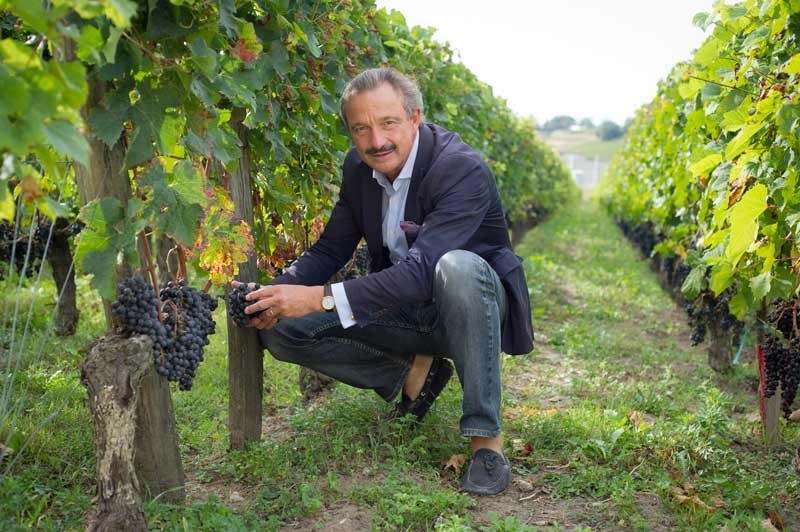
I have a weakness for Château d’Aiguilhe. It goes back to those years when Count Stephan von Neipperg began transforming a historically interesting but oenologically insignificant estate in Castillon into one of the most remarkable affordable red wines of Bordeaux. I regularly bought a few cases at the time. Not as an investment, nor out of a collector’s passion, but because I wanted a good, affordable Bordeaux to have with dinner. When I bought it, I did not factor in that a quarter of a century later this wine would still give me so much pleasure.
At the weekend, I retrieved the 1999, 2000, 2001, 2006 and 2009 vintages from the cellar and retasted them. The young 2020 was also included, although its current stage of development naturally has little in common with that of its older siblings. The old bottles had spent their years undisturbed at a constant nine degrees Celsius. This deserves explicit mention, because the following observations cannot readily be applied to bottles that have spent a quarter of a century in a comfortably heated sitting room.
Stephan von Neipperg acquired Château d’Aiguilhe at the end of 1998. The estate lies east of Saint-Émilion, in a wine-growing region whose principal problem for a long time was that it was not called Saint-Émilion. The geological conditions, at any rate, only partly justify the considerable price difference between the two appellations. On d’Aiguilhe’s plateau are limestone-rich soils with clay and loam topsoils, excellent conditions particularly for Merlot and Cabernet Franc. Neipperg understood early on that, with comparatively modest land costs and the appropriate investment in the vineyard and cellar, a very serious Bordeaux could be produced here.
It is one of the more likeable features of recent Bordeaux history that, despite its success, this wine has not gone completely mad on price.
The 1999 is a pleasure today. And one of those pleasures for which no complicated tasting guide is required. The wine is fully developed, supple and exceptionally easy to drink. The fruit has come to terms with the aromas of maturity, while the tannin has shed its former authority. Nothing pushes itself to the fore any more. The wine possesses that natural harmony which no technical intervention in the cellar can create. You have to let it develop. The alcohol level of just 13 per cent is also noteworthy. The 1999 vintage in Bordeaux was always somewhat overshadowed by its famous successor. That was certainly an advantage for buyers at the time, and it still is for drinkers today.
The 2000 is also at its peak. It has the somewhat more generous architecture of its vintage, but is in a similarly pleasing condition to the 1999. Incidentally, both wines underwent cellar treatment that is remarkable by today’s standards: 80 per cent Merlot, 20 per cent Cabernet Franc, 18 months in exclusively new barriques, then bottled without fining or filtration. Today, one might accuse a young wine in this price bracket of having been too ambitiously made. After a quarter of a century, there is no longer any sign of problematic oak dominance. Time has vindicated the oenological decisions of those years in its own way.
I would drink both vintages now. Not because I fear they might fall apart tomorrow, but because there is no sensible reason to wait for further improvement. They have arrived at the destination to which one hoped to send them when they were purchased.
The 2001, by contrast, surprised me. I had expected it to be closer in its development to the 1999. In fact, it still possesses sufficient reserves to spend another five years in the cellar and presumably gain in harmony as a result. This is also interesting because, in the general perception of Bordeaux vintages, 2001 never quite emerged from the shadow of the millennium vintage. The two wines illustrate brilliantly how little an abstract vintage rating says about the individual maturation trajectory of a bottle. The supposedly greater vintage is already there; the supposedly lesser one still needs time. Incidentally, the 2001 was matured with only 70 per cent new oak. It has 14 per cent alcohol. Neither of these two parameters adequately explains its current condition.
Wine maturity is a complicated matter. Which is why I have always viewed the drinking windows given in many wine descriptions with a certain scepticism, particularly those specified with the precision of a Swiss railway timetable.
The 2006 has arrived. A wonderfully useful Bordeaux in the very best sense of the word. You can open it with a meal today without feeling that you are interrupting a process of development that has not yet been completed. 2006 is an interesting vintage for such experiences in particular. It followed the enthusiastically acclaimed 2005 and consequently received less public attention. Twenty years later, the hierarchy of the two vintages at the time interests me only marginally. What interests me is what I want to drink this evening. And the 2006 d’Aiguilhe has excellent cards in its hand.
The 2009 is a very different matter. This wine is still a long way from its true drinking maturity. It possesses the substance of that exceptionally ripe Bordeaux vintage, but has by no means completely left its youth behind. After seventeen years. Anyone who bought a few cases at the time may be pleased with their decision, but should continue to exercise patience. I consider it one of the most interesting wines in this small vertical, precisely because it does not yet reveal everything. Its real story is likely to begin in the years ahead.
And then the 2020. A fruit bomb, if I may use that somewhat unacademic expression. The still-young d’Aiguilhe, which has been stored in stable conditions in my cellar, is currently presenting an almost lavish abundance of fruit. I suspect, however, that this open, welcoming phase will not last long. There is enough structure behind the fruit to suggest that a second closed phase is likely to arrive soon. Anyone wishing to drink the wine young after its bottling should not rely on it proving as approachable then as it is now. I would certainly reserve it a place in the cellar.
What has occupied me after this tasting is less the quality of the individual vintages than the fundamental question of why we have forgotten how to lay down wines in this price bracket. The current wine market increasingly distinguishes between wines one consumes soon and those one collects because of their price and prestige. In between lies a considerable space that is becoming ever smaller in the public perception: that of affordable, skilfully made wines capable of developing over the long term. Bordeaux, in particular, has a surprising number of them.
The old d’Aiguilhes reminded me at the weekend of my beginnings as a mindful wine drinker. I bought them then because I liked the way they tasted and because I could afford them. I drank some bottles early, forgot others and was later pleased to discover that I had forgotten them. It was not a particularly sophisticated strategy. But it was a successful one.
Today, a wine’s capacity to age is often cited as justification for its high price. The six vintages of Château d’Aiguilhe suggest the opposite perspective: it is precisely in a relatively inexpensive wine that the ability to age represents an extraordinary increase in value. For a mature Bordeaux, you may have to pay a great deal of money. Or, 25 years ago, you bought a young, good and affordable Bordeaux and stored it sensibly.
Naturally, nine degrees Celsius is an exceptionally low cellar temperature. It favours a slow process of development and probably at least partly explains why the 2001 and 2009 in particular still present themselves so youthfully. The quality of storage in a vertical such as this is not some incidental technical footnote. It is part of the result.
I will also buy a few bottles of the 2025 again. Whether I will be granted another 27 years to follow its development personally is beyond my knowledge. But a wine cellar need not be arranged exclusively for its current owner.