
(read aloud in his voice by Marcel Reich-Painicki)
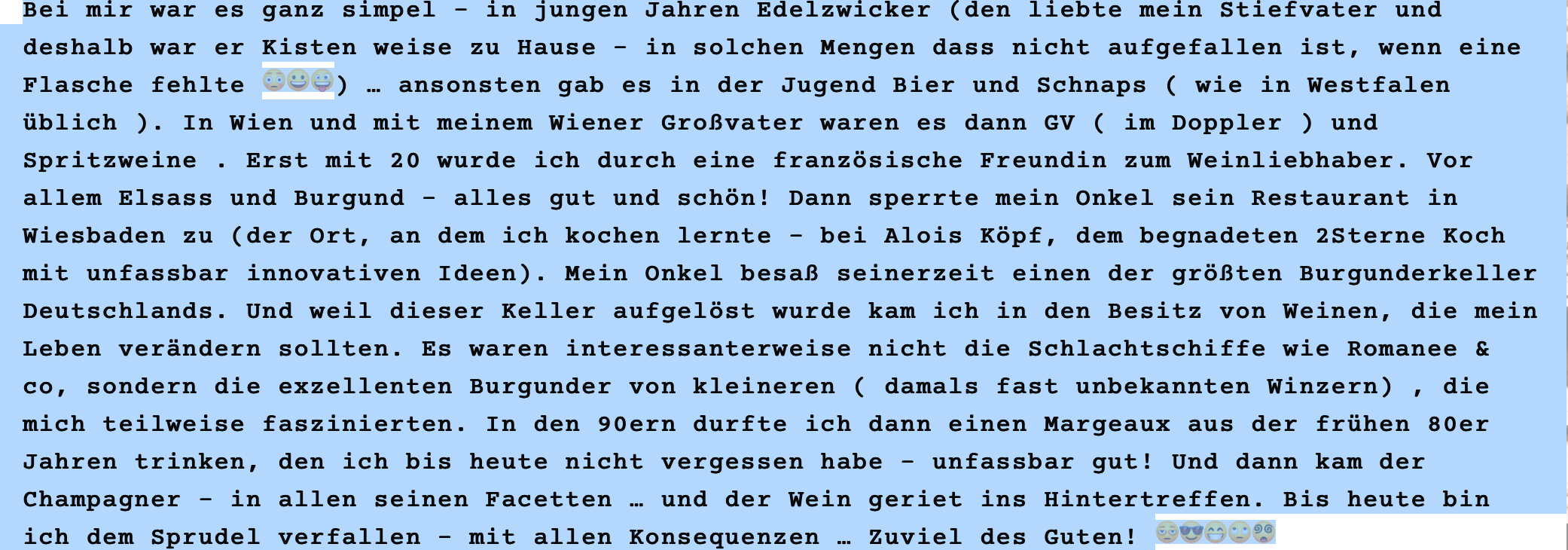
There are texts, ladies and gentlemen, which, however unassuming they may appear, are a document. A document not merely of a private memory, but of an era, an attitude, indeed, of an entire culture. Such a text lies before us here. It is the story of a man – a wine enthusiast, as he calls himself – who recalls how it all began. But anyone who now believes this to be a banal anecdote is mistaken. For what this reader presents us with is, for all its modesty, literature.
First, the opening: “For me it was very simple – Edelzwicker in my younger years…” No great autobiography begins like this, no heroic epic begins like this. But this is how life begins. With a simple, an unpretentious wine, a wine that, one might say, was more quantity than quality. But the Edelzwicker is not merely a drink in this story. It is a symbol. A symbol of origins, of the narrow confines of the parental home, of the banal, the everyday. This is the prose of youth: beer, schnapps, Westphalia. The language is terse, almost contemptuous. And yet: it is the prerequisite for everything that follows.
Then the turning point: Vienna. Grandfather. Grüner Veltliner in a Doppler, Spritzwein. Suddenly culture, suddenly history, suddenly tradition. Vienna here is not merely a city; it is a school. The grandfather as mentor, the Veltliner as tutor. What we experience is the awakening of a passion. And yet: it is not the great breakthrough. Not yet. It is still preparation, prelude, prologue.
Then, as in any good piece of dramaturgy, the decisive moment. At 20, through and with a Frenchwoman, real life begins. What symbolism! It is love – and it is wine. Above all Alsace, Burgundy. It is, if you will, the first serious encounter with Europe in the glass. And here already we see what all great wine stories have in common: it is never only about the wine. It is about the people who bring it, the places where it is drunk, the love that accompanies it.
But the real catastrophe, and at the same time the great opportunity, arrives in the form of the uncle. This uncle, the owner of one of Germany’s greatest Burgundy cellars, closes his restaurant. And suddenly, for the young man, a treasure chamber opens up. It is not the great names, not the monuments of wine history, that shape him. It is the small, the unknown, the then nameless winegrowers. Here, ladies and gentlemen, the secret of true passion reveals itself: it does not arise at the altars of the famous, but in the side streets, in the shadows, among the unknown.
Burgundy, then, not the “battleships”, as the reader so drastically puts it, but the fine, the subtle, the scarcely noticed. This is of great importance. For true education, including that of the palate, consists not in venerating the obvious, but in discovering the hidden.
In the 1990s then comes the next high point: a Margaux from the early 1980s. What emphasis! “Incredibly good!” cries the narrator. One feels the ecstasy, one senses how here, perhaps for the first time, wine becomes not merely a drink but a revelation. Such moments are rare, but they shape a life.
And then, almost ironically, almost in passing, comes the change of direction: Champagne. Suddenly fizz enters life, and with it a new obsession. It is the beginning of an infidelity, a turning away, a shift in priorities. Wine, however much it was once celebrated, falls “by the wayside”. And the reader admits it without shame: to this day his love belongs to fizz, champers, the sparkling and the foaming.
“Too much of a good thing!” he adds at the end, half laughing, half desperate. It is a sentence that says everything. For in this small turn of phrase lies the entire ambivalence of passion: it is blessing and curse, enrichment and danger.
One might now object: Is this not merely a private account, a sentimental recollection of a few bottles of wine? No! It is literature. Literature because it points from the individual’s experience towards the universal. Literature because it shows how a person – every person – becomes who they are through the things they love. And finally literature because, in a few terse words, it hints at an entire biography stretching from France to Vienna, from Wiesbaden to Burgundy.
It is a story of awakening, of discovery, of enjoyment. A story that leads from the provinces into the world, from simple Edelzwicker to divine Margaux, from Westphalian beer to a Champagne glass.
And yes, one can, one must, take this text seriously. For it shows us what wine really is: not merely a drink, but a biography. Not merely taste, but destiny. Not merely enjoyment, but literature.