
(Manfred Klimek, Editorial Team)
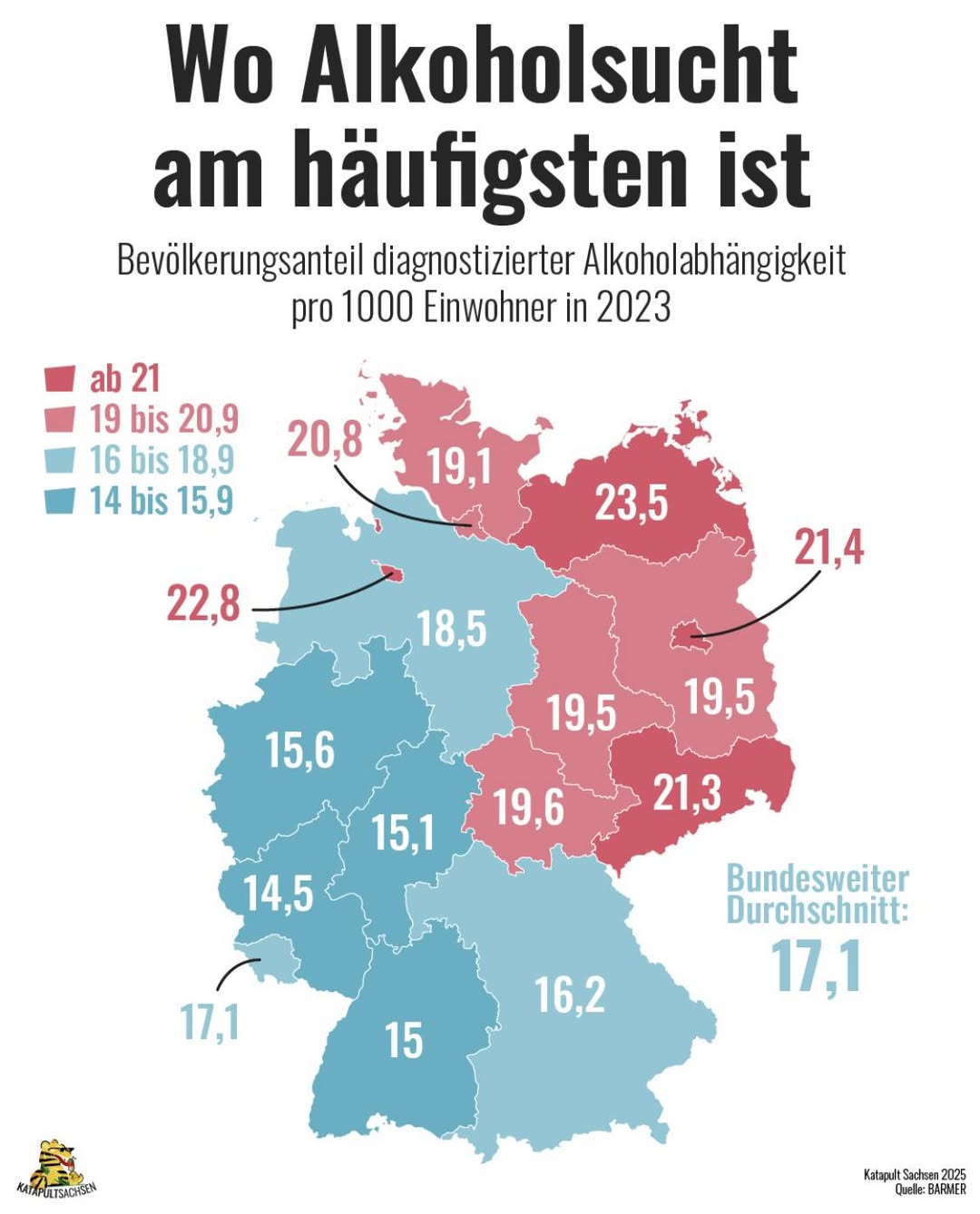
There are maps that reveal more about a country’s culture than about its landscapes. The map of alcohol dependence in Germany (source: Barmer), which has been doing the rounds for the past few days, falls squarely into this category. Put simply, it shows that, of all places, it is precisely those regions where wine-growing has been part of everyday life for centuries that have the lowest rates of alcohol dependence. The Moselle, the Rheingau, the Palatinate, Baden, Franconia: all regions that not only boast stunning scenery but also remain strikingly low in the statistics on alcohol dependence.
Discreetly low. Statistically at the lower end of the scale. And this in a country that has been convincing itself for the past two years that wine is the new ‘national drug’ of a saturated class society.
I still remember the summer of 2023 well, when, out of sheer curiosity, I rang several addiction clinics in Berlin, Hamburg and Vienna. No scientific study, no clean dataset, just a journalistic approach, the sort we used to call ‘research’. The responses ranged from 1.4 to 3 per cent of people who are primarily addicted to wine – with an estimated unreported figure of 5–7 per cent, because people addicted to wine are less likely to recognise their addiction and even less likely to admit to it. This is a serious matter in terms of health policy. It is socially relevant – without a doubt. But it is the exact opposite of the threat scenario that the media’s sensationalist narratives are currently playing up.
Anyone looking more closely at the map will spot a second pattern: the highest rates of dependence are not found in wine-growing regions, but in economically disadvantaged areas of northern and eastern Germany. And yes: Saxony has a wonderful, albeit small, wine-growing culture centred around Dresden and along the Saale-Unstrut – far too small to make a statistically significant impact on the state average. A breakdown of the data would be useful, but is not possible due to a lack of accessible records.
Nevertheless, the pattern remains clear: a culture of living trumps a culture of risk.
Where wine is not consumed as a means of escape, but as part of an everyday, ritualised quality of life, the rate of alcohol dependence (which is predominantly unrelated to wine) is significantly lower.
This is no coincidence.
It is the history of civilisation.
Nevertheless, in public debate, wine is treated as if it were the ‘SUV’ of drinking: a symbol of a saturated patriarchy that must now finally be pushed to the sidelines of cultural history. Except that not a single epidemiological dataset supports this narrative.
What the figures actually show – and we should be allowed to state this soberly – is a dramatically high level of alcohol dependence overall. Germany (and not just Germany) has a problem. A big one. But this problem does not lie with wine, but with cheap, readily available plonk, spirits, energy drink-alcohol concoctions, weekend excesses, and the compensatory rituals of a country that is increasingly oscillating between exhaustion and a loss of meaning.
If, of all things, wine – the very drink produced and consumed in the regions with the least notable statistics – is now being declared the bogeyman, then this has less to do with prevention than with economics: the wine market remains a multi-billion market. And anyone who funds political campaigns knows that it is more lucrative to attack a previously well-regarded wine-making culture – one that is visible and vulnerable – than those who make money in the underground world of spirits and cheap booze.
So the map tells us something very simple, yet for some very uncomfortable and very important:
wine is not the primary problem.
The problems lie where a culture of enjoyment is lacking – not where it has been practised for centuries.
And it is high time that both politicians and the media faced up to this reality.
For prevention without differentiation is not prevention.
It is merely moralising in the service of those who shout the loudest.