
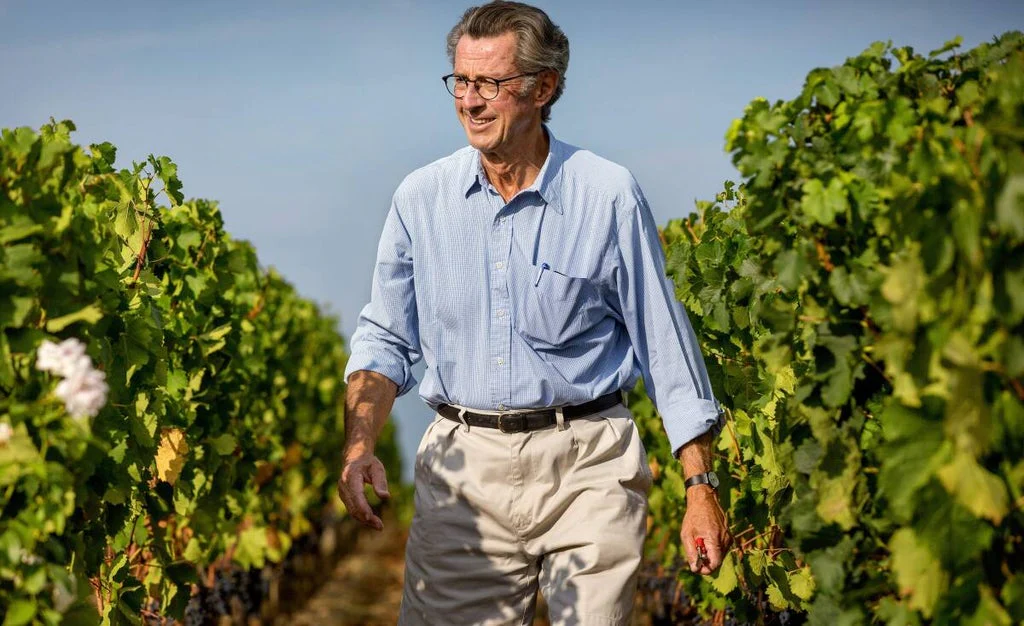
(Manfred Klimek, WELT am SONNTAG, photo: Moueix)
It seems like a provocation, and indeed it is: Château Lafleur, a small and world-renowned vineyard in the equally small and world-renowned region of Pomerol – home to some of the world’s most prominent vineyards – is leaving the prestigious area in terms of wine-growing regulations. The drought of 2025 has revealed an almost cruel reality: the old pride of dry farming – winemaking without irrigation – is reaching its limits. What has been a mark of quality for decades is now threatening to become a risk to quality.
The fact that Lafleur in particular – that Pomerol legend, small, rare and precious – is taking the plunge and will in future label its wines as ‘Vin de France’ is more than just an administrative formality – it is a harbinger of things to come. The bureaucracy of the appellation, once a guarantee of prestige, is now a stumbling block to prosperous development.
Christian Moueix, one of Bordeaux’s defining figures – owner of La Fleur-Pétrus and Trotanoy, among others, a visionary and, for decades, one of the most consistent advocates of dry farming – speaks of a turning point: “The long drought in the summer of 2025 is forcing producers to rethink the rules of their appellations. Irrigation was long banned to prevent abuse. But we must accept reality: climate change threatens the survival of our vineyards and the quality of our vintages. After 55 vintages, I have to rethink my position.”
If even Moueix, who had elevated dry winemaking in the Bordeaux region to a virtue, is abandoning his stance, it shows that climate change is no longer a future scenario. It is here. And it brings certainty.
Olivier Tregoat, Technical Director at Domaines Barons de Rothschild (Lafite) and one of the most analytical minds in viticulture, goes even further. He describes the generational divide and criticises the fact that bureaucratic officials are mostly very old men who, due to their traditional mindset, are leaving too late.
This deadlock is paralysing the entire system. Meanwhile, the vines are drying out. Tregoat explains the critical situation facing the soils: “The gravelly soils in Pomerol, which retain less water than the clay soils here, need rain in late June and July. Otherwise, we’ve got a problem. At L’Évangile, we asked for permission to irrigate. We were granted it – but not until August, just before the harvest. By then it was too late.”
Even more serious is the issue of grape varieties. Merlot, the very soul of Pomerol, is beginning to falter. Tregoat: “Even with the best methods – shading, new genetics – I don’t know whether we’ll still be able to produce top-quality Merlot in Pomerol in 30 years’ time.” A statement that would have been considered blasphemy just ten years ago. Today, it sounds like a sober prognosis.
The problem is the pace. “Global warming is advancing faster than our ability to adapt,” says Tregoat. “It takes us ten to fifteen years to establish new clones and varieties. But we have to make decisions today.” At L’Évangile, more Cabernet Sauvignon will be planted in future – another sign of a new era.
What does this mean for the Bordelais? Lafleur is setting an example that goes beyond this individual case: anyone who clings to the dogma of dry farming is putting their wines at risk. Anyone who insists on the bureaucracy of the appellation is gambling away their future.
The romantic notion that great wines arise solely from the vine’s deprivation imploded in the summer of 2025. Top-quality wine requires not only terroir, but also water. Not irrigation as an industrial tool, but irrigation as a lifeline.
The fact that a château such as Lafleur, of all places, is now producing ‘Vin de France’ shows that the reality of the soils and the vines is harsher than any bureaucratic regulation born decades ago.
Thomas Duclos, a leading oenologist at the Œnoteam laboratory – renowned far beyond the Bordelais region – describes behind the scenes just how deep the crisis runs and how urgent the need for action is. Speaking of the paralysing bureaucracy, he says: “Everyone works in their own corner and urgent matters are not brought together. There must be a political will to reflect, but this has yet to emerge. Yet this is where the centralised system reaches its limits.” Duclos warns that too much that has been neglected cannot simply be made up for.
Looking to the long-term future – particularly regarding early-ripening Merlot – Duclos paints a further bleak picture: “If we do not reflect, if we do not recognise the scale of the problem, there will no longer be the Pomerol we know today, the one we love and which is such a strong source of identity. We are a long way from having explored all the means of preserving great Merlot wines in Pomerol.” His conclusion is clear: we need more courage, more innovation and a collective approach rather than merely locally isolated decisions.
Fiona Morrison, Master of Wine and a journalist and author based in the Bordelais, offers a pragmatic perspective on the conflict between tradition and adaptation: “The key here lies in tackling the issue of irrigation. Yet we will never be able to bring everyone into line, as the differences in terms of reputation, price and terroir are too great. But any producer with deep gravel and sand (and not clay soils like Petrus, for example) should be concerned about the health of their vines under current climatic conditions.”
When asked about the authorities, Morrison offers a nuanced assessment: “I don’t believe the wine-growing authorities have been idle. The issue of irrigation has been the subject of heated debate for at least a decade. This is not about controlling yields, but about access to available water through the digging of wells or the use of reservoirs. That is the central issue here.”
On the long-term consequences of climate change for Merlot, Morrison says: “Of course, we must preserve our Merlot. I must admit that I am surprised at how well it has weathered the recent climate changes. This is primarily because most top producers have worked very hard and spent far more time in their vineyards than they did a decade ago. However, we must help the vines withstand the ongoing challenges. And anything we can do to make them healthier and stronger is in the interests of the entire wine world.”
Morrison also emphasises that alternative grape varieties are being discussed: “But I believe that almost every winegrower and producer in Pomerol feels that the grape variety is an essential part of the terroir and the character of our individual estates – and, at least for the time being, would prefer to find a solution using their indigenous grape varieties.”