
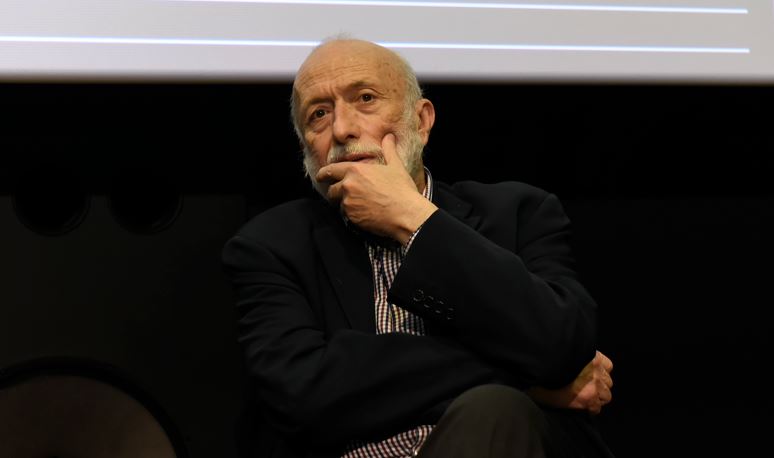
(Claude Auguste / Manfred Klimek / Editorial Team)
Carlo Petrini is dead. And with him disappears one of those rare figures in Europe who did not merely found a movement, but changed the culinary and culinary-political thinking of an entire era. Petrini was 76 years old. He died in the town of Bra in Piedmont, where his ideas also came into being: among farmers, trattorias, markets, vineyards and that Italy which never understood food merely as simple and incidental nourishment, shaped by the misfortune of Protestantism, but as part of life itself.
Today, much of what seemed almost subversive forty years ago sounds self-evident: regional products, artisanal agriculture, biodiversity, provenance, old varieties, producer pride, slow-paced gastronomy. Yet all of this was once a counter-movement. And Carlo Petrini was its most important organiser.
We must not forget the world from which Slow Food emerged. Europe's post-war decades were shaped by industrialisation, standardisation and technocratic rationalisation: food was increasingly thought of in functional terms: long-lasting, cheap, standardised, efficient. Agriculture industrialised at a speed that radically transformed historic cultural landscapes within a few decades. Supermarkets displaced markets, industrial yeast displaced sourdough, standardised grape varieties displaced old clones, and global corporations began to think of taste in spreadsheet form. Petrini understood early on that far more was being lost here than mere culinary diversity. A way of life was disappearing.
His resistance to this began not academically, but physically. When a McDonald's opened near the Spanish Steps in Rome in 1986, Petrini organised protests against it. Today that seems almost harmless. At the time, it was a cultural uprising against the idea that food had to become the same everywhere. Slow Food grew out of this protest.
Suddenly, something began to shift. For Petrini did not speak like an ascetic: he never wanted to abolish pleasure, never wanted to discipline it morally. That was precisely where his enormous appeal lay. Slow Food was not a movement of prohibitions, but of rediscovery. Food should be “good, clean and fair” – good in taste, clean in production, fair towards producers and nature. This was not nostalgic peasant romanticism. Petrini thought politically, ecologically and culturally at the same time. He understood that agriculture is never merely economics. It shapes landscapes, communities, traditions, dialects, family structures and identities. When a cheese is industrialised, it does not merely change a product, but often an entire region. Petrini's thinking was particularly powerful, therefore, in places where provenance was already deeply rooted: in viticulture.
Without Slow Food, today's natural and biodynamic wine scene would scarcely be conceivable. Not technically – but intellectually. For Petrini restored to an entire generation of winemakers the cultural legitimacy that industrial wine production had taken from them for decades. In the 1980s and 1990s, viticulture in many places was seen above all as a question of technical perfection. Cellar hygiene, cultured yeasts, temperature control, international styles, barriques, scores. Wine became increasingly standardised. Large parts of the wine world began optimising themselves like industrial products. Slow Food countered this way of thinking with something that seemed almost revolutionary at the time: provenance matters more than perfection.
Suddenly, winemakers were once again interested in old grape varieties, spontaneous fermentation, local traditions, small family businesses, biodiversity in the vineyard and individual signatures. It was no coincidence that many of the natural wine movements that later became famous emerged precisely in the regions where Slow Food was strong: Piedmont, the Loire, the Jura, parts of Burgenland, Slovenia, Styria and also Penedes.
Of course, this later also gave rise to a great deal of ideology. The natural wine scene sometimes developed its own dogmas, its own orthodoxies, its own vanities. Some wines were faulty, some movements became missionary. Yet the original impulse came from a deep longing for authenticity. Petrini understood this longing early on: he realised that modern people seek not only products, but relationships. Relationships with provenance, producers, landscapes and stories. That is why Slow Food was never merely a movement centred on pleasure. It was also an attempt to reverse alienation.
This became enormously visible in wine in particular. Biodynamic viticulture, for example, which many traditional oenologists had long spoken of mockingly, gained cultural momentum through Slow Food. Small winemakers could suddenly explain why they wanted to work differently. Not out of technical backwardness, but out of conviction. Today, many biodynamically farmed estates rank among the most renowned wineries in the world.
Despite everything, Petrini himself remained remarkably uncynical. While large parts of modern food culture eventually tipped into lifestyle, luxury marketing and Instagram aesthetics, he held on to something almost old-fashioned: the shared table. For him, food meant time. Conversation. Community. Slowness. Attention. Not optimisation. Not self-promotion.
And that is precisely where his greatest relevance lies today, because the world Petrini criticised has since accelerated even further. Food is now photographed, rated, algorithmised and turned into content. Restaurants struggle with online pillories, chefs become brands, wine (less often now) becomes an investment object, and gastronomic experiences become digitally exploitable status signals. Petrini, by contrast, thought in almost radically analogue terms. A good meal was not content for him. It was an interaction between people. The disappearance of such a person now feels like the end of a European post-war story in which pleasure was still understood as cultural education. Not elitist. Not ascetic. But human.
Carlo Petrini leaves behind more than an organisation. He leaves behind a different understanding of eating and drinking. One that continues to resonate today through Europe's vineyards, farmers' markets, cheese cellars, small restaurants and family businesses. We will probably only fully understand in a few years how powerful this influence really was. For much of what seems self-evident today was once resistance.