
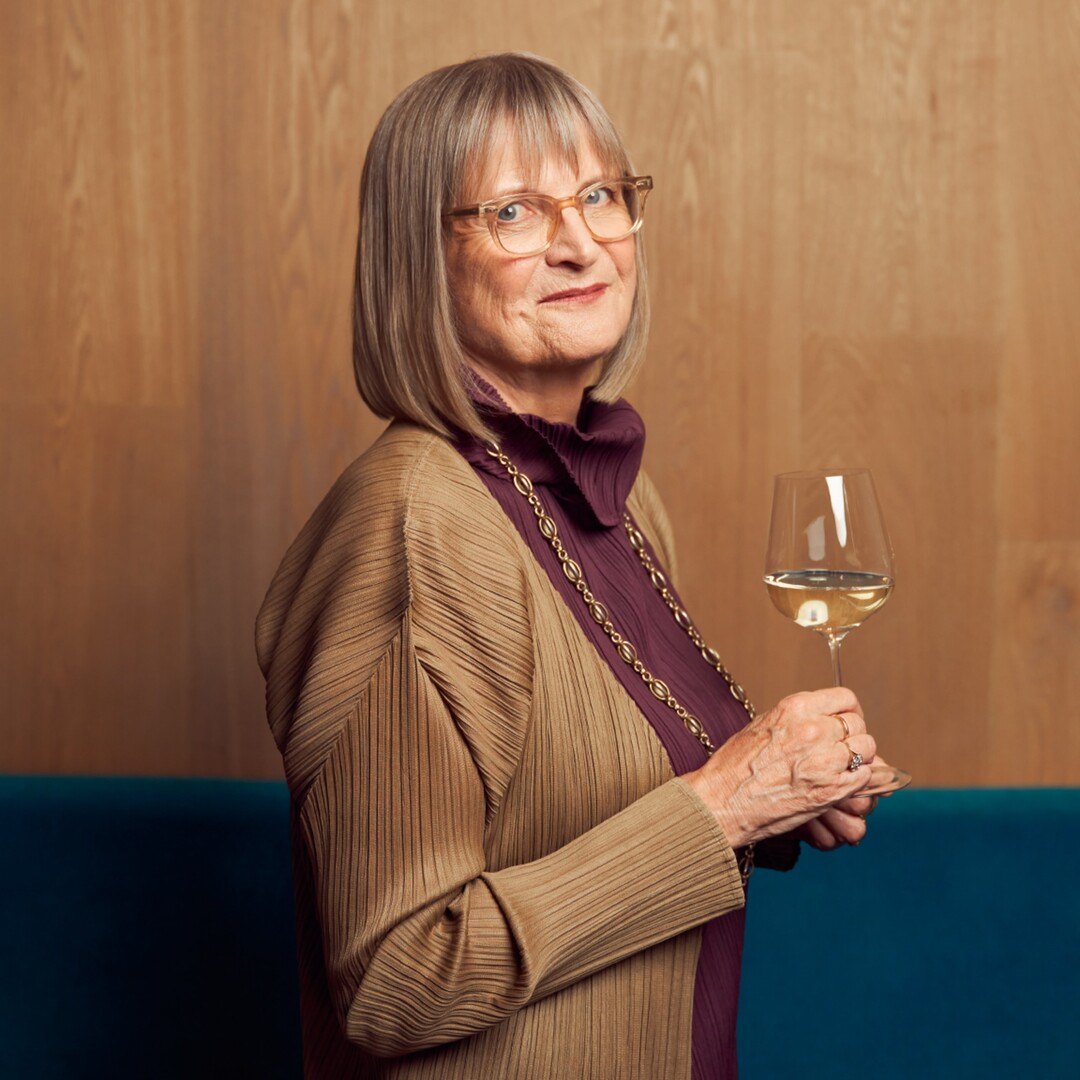
When Jancis Robinson began her first day at the long-defunct British trade magazine Wine & Spirit on 1 December 1975, Britain’s best-selling wine was Harveys Bristol Cream. Twelve million bottles of sweet sherry were sold every year. Babycham, a sparkling perry, was advertised as “champagne perry”, while Australian, South African and Cypriot producers wrote “Sherry” on their bottles with complete impunity. Details such as these show us what fifty years changed in the way wine was received.
Robinson has now written for the Financial Times about what has happened to wine since then. Fifty changes for fifty years of professional life. At first, this sounds like one of those anniversary lists that editorial offices love. In fact, the text is something else: a short cultural history of modern wine. And, incidentally, the account of a woman who has herself accompanied a significant part of that history.
Even Hugh Johnson's first World Atlas of Wine, published in 1971, tells of an order that has passed away. France was given 74 pages, Germany 24 and Italy 14. South America had to make do with two pages. New Zealand with seven words. Robinson writes one of the finest sentences in her essay about this: “Wine is, after all, geography in a bottle.” Wine is geography in a bottle. Today, that sounds almost self-evident. Back then, it was revolutionary. Wine was either sold as a drink or practised as an arcane science. The specialist shops were, as Robinson writes, populated by distinctly intimidating experts, and customers first had to prove that they could pronounce the French name of the wine they wanted correctly. Then came supermarkets, grape varieties on labels and a new wine world. Chardonnay and Cabernet Sauvignon became global brands. California wanted to copy Bordeaux and Burgundy, and so did Australia. Even where the climate was actually unsuitable, the two grape varieties were planted. For a time, genuine Chardonnay was so scarce that wines labelled accordingly in California and Australia were topped up with Colombard or Chenin Blanc.
After that came Lambrusco, Beaujolais Nouveau, Australian Chardonnay, Shiraz, Pinot Noir and Prosecco, Robinson recounts in her text. Fashions emerged, exploded and disappeared again. Some left collateral damage behind. Robinson writes wonderfully dryly about Beaujolais Nouveau that Georges Duboeuf was largely responsible for it – “I say blame” – because the often miserable quality of the quickly produced young wine damaged the reputation of serious Beaujolais. Then Robert Parker appeared. No wine critic before or after him, Robinson writes, wielded such power in the nineties and noughties. She even believes that Parker may have coined the term “wine critic”; his predecessors had tended to see themselves as wine writers. Parker turned taste into a number. 92 points. 96. 100. The merchants understood immediately. Numbers did not need translating. They worked just as well in London as in New York, Hong Kong or Shanghai. Merchants, Robinson writes rather pointedly, had in some cases almost stopped selecting wines themselves and instead followed Parker's taste.
In passing, she also tells the story of wine as a speculative asset. Château Lafite 1787, with the alleged initials of Thomas Jefferson, auctioned for £105,000 in 1985. Hardy Rodenstock. Rudy Kurniawan – the fraudster. Bordeaux 2009 and 2010. China. Hong Kong. En primeur. Agriculture became an asset class.
But Robinson's most interesting observation concerns not money, but the shift in attention. In the nineties, the stars were the oenologists. Michel Rolland flew around the world, new barriques were considered a status symbol, and cellar technology promised perfection. Today, Robinson writes, the focus has shifted from the cellar to the vineyard: organic farming, biodynamics, soil life, biodiversity, cover crops, trees between the vines, regenerative agriculture. “Bare earth in a vineyard is no longer a virtue.” Bare earth in the vineyard is no longer considered a virtue. That is a remarkable sentence because it compresses fifty years of viticultural history into nine words. In the past, a neatly raked vineyard showed that the winemaker had mastered their work. Today, the same sight may prompt the question of what actually still lives there.
The old division between the New and Old Worlds also dissolved. Young European winemakers now work in Australia, New Zealand, South Africa or California. Australian oenologists, conversely, brought hygiene and cellar technology to Europe. Cabernet and Chardonnay are losing some of their former global dominance, while indigenous varieties are gaining in importance. Wine has learned to travel around the world, only to return home afterwards. Naturally, Robinson also comes to natural wine. She describes the movement as a generational conflict: for some, liberation from technical winemaking; for others, a gustatory imposition under a misleading name. Reading her, one can tell that after fifty years she is still willing to argue about wine. That is more important than her opinion on it.
Jancis Robinson is now 76 years old. She could comfortably retreat into the library of her own certainties. She has written books, made television programmes, influenced generations of wine drinkers and, together with Hugh Johnson, continued the standard work whose first edition could still explain the wine world with 74 pages on France and seven words on New Zealand. The ninth edition is appearing now. Robinson is involved as an author for the fifth time. And yet her story does not end with Romanée-Conti. It ends with climate change. Harvests have on average moved forward by around two weeks. Fires, smoke, hail, frost, floods and, above all, drought are changing viticulture. The world's wine map is moving northwards. England gets an additional page in the new atlas, and northern Europe two. Robinson then writes a sentence that is probably more important than all the discussions about Parker points, natural wine and screw caps: “It pains me to admit that in a world desperately short of water, wine may increasingly be seen, like golf courses, as an unnecessary luxury.” In a world short of water, wine may one day be viewed in much the same way as a golf course: as a luxury we can no longer take for granted.
After fifty years of wine journalism, it would have been easy to become nostalgic. Robinson does the opposite. She tells of Harveys Bristol Cream and Babycham without laughing at them. Of Parker, without retrospectively turning him into a villain. Of natural wine, without declaring the young generation mad. Of climate change, without turning it into a sermon. That is her great achievement.
Jancis Robinson has never stopped being curious about the next bottle. Anyone who writes about the same subject for fifty years eventually risks no longer observing the world, but only their own memories. That has not happened to Robinson. The wine world in which she began scarcely exists any more. The world in which she writes today will disappear too. She knows this and carries on writing.