
(Text and photo by Manfred Klimek)
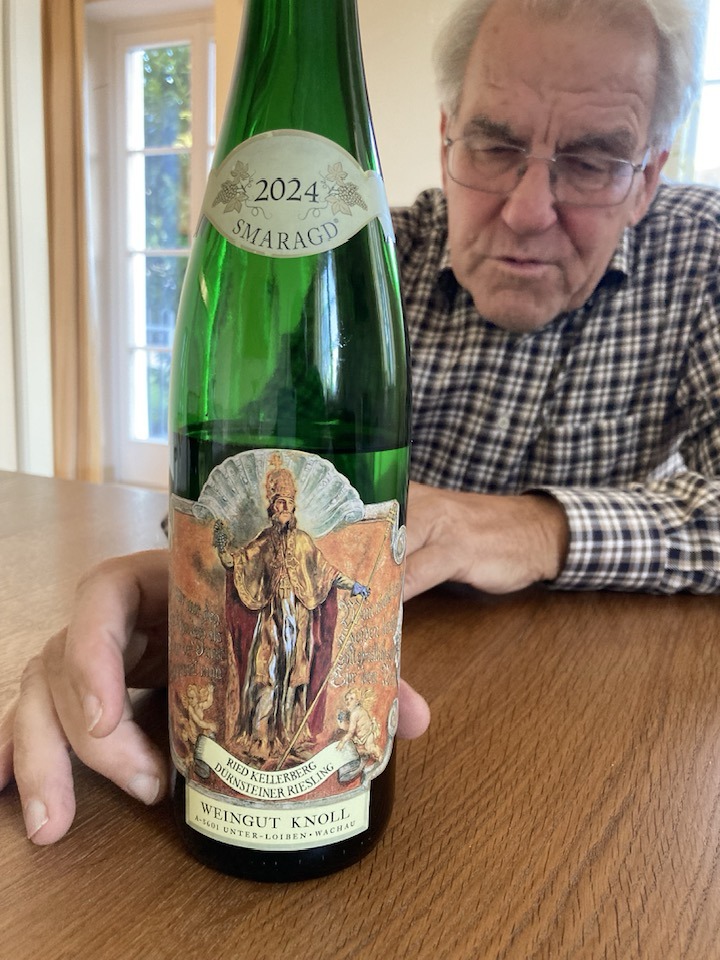
He sits at the table, his hands still at first, then patting the bottle of Riesling – the green bottle on the table, the one with the saint, the bishop, on the label – this little baroque spectacle that has been telling wine connoisseurs and casual drinkers alike since 1961: Nothing here is invented to follow the latest trends; here, contemporary winemaking is constantly refined as part of a 600-year-old tradition. Emmerich Knoll senior, the grand old man of the Wachau, is not one for grand words. ‘We do it the way we’ve always done it – only now we understand it better,’ he says, smiling to himself. Knoll lets his wines do the talking; he has been making them for years alongside his like-minded son, Emmerich Junior – a true innovator whose work is still too little recognised. The 2024 vintage of this Kellerberg Riesling sounds like a freshly tuned grand piano.
I take a sniff of the glass and have to inhale that aroma twice: on the nose, the wine is initially reserved, almost shy – yet how exquisitely the Knolls bring out the fruit! Peach, apricot, quince, all in wafer-thin layers, without any artificial fragrance, without a touch of sugar. Here, restraint becomes seduction. This is not a scent that panders; it is a scent that brings order.
“The Kellerberg is no ordinary vineyard,” says Knoll, “it forces you to be patient. You mustn’t try to extract anything that doesn’t come of its own accord.” The Kellerberg – terraces, barren primary rock soil, cool breezes from the Danube – is a master of balance. The 2024 vintage displays the character of a great classical conductor, but without the former, heavy-handed opulence of some Smaragd wines. The wine doesn’t grab you; it draws you in: into the palate, into your thoughts. It begins with soft, juicy yellow fruit, then everything tightens up – as if a conductor were adjusting the tempo during a dress rehearsal. Suddenly there is this mineral note, not a quarry-like spectacle, but the delicate salt of the terraces, razor-sharp yet never harsh. One might debate whether ‘terroir’ can be tasted. Here it can, because the fruit gives way to what lies beneath.
On the palate, what was merely hinted at on the nose unfolds: one of the most exquisite expressions of mineral salts I have ever tasted in the Wachau. This is the art of winemaking at its most precise, yet without technocracy – more like a Johann Strauss waltz of the highest calibre: vitality, elegance, a smile in time with the beat, and underlying it all, iron discipline. The finish is long, very long, yet cool and crystal-clear. Nothing is tampered with that isn’t necessary.
“We do less in the cellar today than we used to,” says Knoll, “because the grapes can achieve more if you leave them in peace.”
The 2024 vintage also reveals something new. Not loudly, but with conviction. It hints at a Wachau Riesling style that does not betray the baroque opulence, but refines it: less muscle, more fibre; less heaviness, more depth of field. It is as though Knoll has loosened the screw by half a turn – not to please, but to make the inner tension more audible. One senses the confidence in the grapes, in the selection, in the patience of the ageing process. No grand gestures, no fashionable reduction for reduction’s sake. Instead, precision, timing, a steady hand.
And so the wine stands before me as the sum of decades of experience – yet with the keen curiosity of a winery that does not rest on its laurels. “If a wine speaks clearly whilst still young, that’s good. But what’s more important is that it still has something to say in ten years’ time,” says Knoll.
The Kellerberg 2024 is art, but not a feat; it is a case for patience, for moderation, for the art of striking the right note, not the volume. Those who open it young will experience the structure, the minerality, that slight electrifying shimmer. Those who give it time will discover the fruit in compartments that are still closed for now. Both approaches are right. And truly excellent.
I take one last sip and think that this bottle holds a promise: the Wachau can – without betraying its essence – become even more precise, even more elegant. Emmerich Knoll senior and Emmerich Knoll junior don’t need to explain this to anyone. They simply bottle it.