
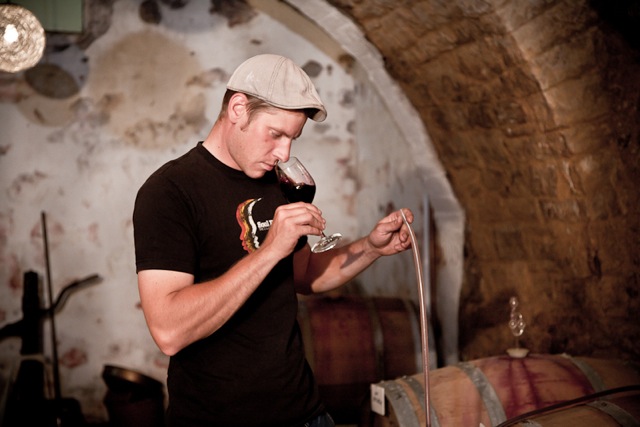
Photo by Rachel Wirth: Daniel Aßmuth, a winemaker who failed despite doing excellent work
(by Claude Auguste)
“Yesterday’s” – what a convenient word, when one does not want to accept an uncomfortable observation. I admit it: yes, I do not write to the rhythm of TikTok seconds. But that is because wine itself does not live to the rhythm of the second. Anyone who plants vines—he, or increasingly she—thinks in generations. Anyone who talks about wine should therefore also have the right to think for longer than until the next algorithm update.
My thesis is not nostalgia. It is, rather, a diagnosis. Prestige dominates attention. That is not a feeling, but a fact. Most likes, the greatest reach and the strongest response are garnered by those wines that are already famous. Lafite, Romanée-Conti, Keller, Overnoy—they appear reliably, as if they were currency. It is applause for the icon—and that comes at the expense of diversity.
Of course there are also exciting niches, creative voices and bold accounts that make small estates visible. They are important; they are valuable. But they remain the exception. And an exception does not disprove the rule; it confirms it. The problem is not that diversity does not exist—the problem is that it barely gets through. Visibility and attention are unevenly distributed, and the mechanics of the platforms exacerbate this.
Anyone who considers that “yesterday’s”, confuses surface with substance. Social media is a stage, but the roles on it change less than one might think. It is always the same stars who are applauded, while the real reinventions remain behind the curtain. Anyone who has observed how quickly a picture of a prestige bottle receives hundreds of likes, while a superb unknown local wine barely elicits any response, knows that this is precisely the pattern I am talking about.
The truly “yesterday’s” thing is therefore not my text, but the repetition of these reflexes: the old urge to bask in prestige instead of celebrating discoveries. The fact that this pattern is now visible in Instagram stories rather than in the arts pages changes nothing about its essence. Great names dominated the discourse in the past too—today it simply happens digitally and in real time.
A column does not have to please everyone. It should rub people up the wrong way; it should sharpen the point. The fact that some feel vindicated and others wave it away is not a flaw, but proof that it has hit home. Contradiction is not a weakness, but its true function.
Perhaps that is precisely where the irony lies: those who cry “yesterday’s” demonstrate how current the subject being addressed is. For if it had really been overcome, nobody would need to get upset. The fact that there are reactions shows that the question of prestige, visibility and diversity is still far from settled.
And that is why I stand by it: As long as likes and algorithms control perception, diversity will remain under pressure. There is nothing nostalgic about that; it is merely an observation of the present. And perhaps, yes: a plea for a future in which we once again drink with greater curiosity, daring and openness.