
(Claude Auguste / pic: Sansibar Sylt)
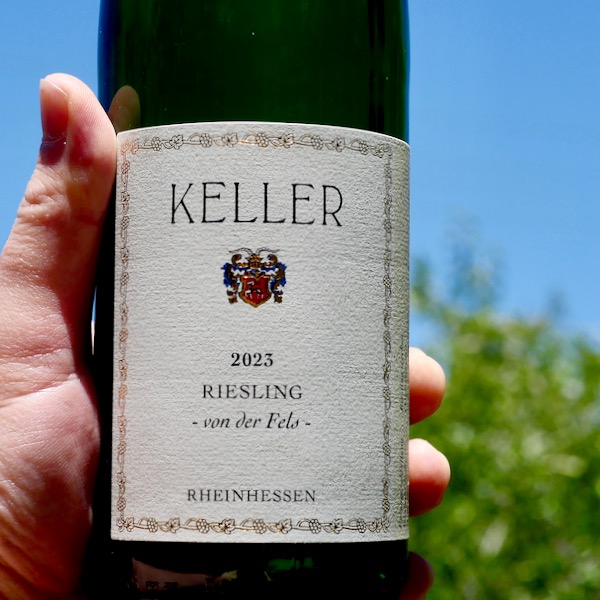
Klaus Peter Keller is one of the great wonders of German winegrowing. Not solely because he makes magnificent Rieslings—others do that too—but because, of all places, in Rheinhessen he established bottle prices that previously would only have been imaginable in Burgundy. Rheinhessen, for a long time synonymous with quantity, Liebfraumilch and pleasantly inconsequential everyday wines, was transformed by Keller into a region where German Rieslings were suddenly traded like cult objects. G-Max, Abtserde, Hubacker, Kirchspiel: names that now appear at auctions as though they themselves were hot commodities even in these difficult years. The wines are great. There is no doubt about that. Nevertheless, the price gap compared with the wine that perhaps shows Keller’s signature most directly remains grotesque: the Riesling Von der Fels.
On paper, Von der Fels is an entry-level Riesling. In truth, it is one of Germany’s most intelligent wines. It comes from young vines in great limestone sites, in other words from material that many other estates would have been selling as prestige wine for years. At Keller, it becomes a wine that conveys the estate’s strict, chalky, crystal-clear style without a grand price tag. That is precisely what makes it so interesting. Keller’s most expensive Rieslings can be overwhelming—not all of them are. Von der Fels, however, convinces. It possesses the same inner structure, the same nervous energy, the same dry precision. Just without the secondary market’s economic megalomania.
The comparison with Wittmann is inevitable in Rheinhessen. There too, great dry Rieslings are made from limestone, often with the same seriousness, differently constructed, biodynamic, no less accessible. Wittmann’s top sites are more reasonably priced by comparison, making the Keller cult even more apparent. The market has long been paying Keller not only for wine, but also for rarity, myth and the desire to own. No one can hold that against a winery. It merely shows how peculiar wine has become once it is no longer drunk, but allocated.
Keller is at his strongest where the cult has not yet covered everything. For years, the Chardonnay–Pinot Blanc cuvée has possessed an almost brazen naturalness. The estate’s Scheurebe (dry) is among Germany’s best because it does not let the variety tip over into exotic perfumery, but gives it structure. And Von der Fels remains the Riesling through which the entire Keller school becomes accessible: limestone, drive, yellow fruit, herbs, salt, no decoration.
2025 naturally comes across as the strongest vintage in this small vertical. The wine smells of apricot, kumquats, a little tangerine, citrus zest and a hint of chalk. On the palate it displays that rare combination of lightness and substance possessed only by great simple wines. The acidity does not stand beside the wine; it pulls it forwards. Everything is bright, cool, precise and yet eminently drinkable. A wine that works already and nevertheless easily has a few years of cellaring ahead of it. Keller’s own term, Zechwein, sounds almost comical here. If this is Zechwein, Germany needs less prestige.
2019 shows itself more mature, broader, but by no means tired. The fruit moves more towards yellow apple, ripe lemon, a little Darjeeling, herbs and wet limestone. The wine has slightly more drive than the 2025, seems denser and more substantial without losing its line. With some air comes the grip for which Keller is famous: no tannin, no hardness, but an almost tactile minerality. 2019 is the Von der Fels for the table. For fish, poultry, Asian cuisine, and also roast pork with horseradish. It demands no reverence. It demands a large glass.
2016 stands more tautly in the glass. Grapefruit, herbs, chalk, a little white blossom, very little maturity character. The vintage never entirely concealed its edges, and that suits this wine well. The acidity is present, but not sharp. The wine seems tense, lean, more serious than 2019, less charming than 2025. In return, it possesses that dry length which only reveals after swallowing how much wine was actually in the glass. A Von der Fels for Riesling drinkers, not for Riesling romantics.
2013 is finally the mature look back. Yellow apple, pear, a very slight hint of honey, nuts, cashew, together with acidity that remains lively. The fruit has lost its youth, but not its shape. The wine shows how well Von der Fels can age without adopting a grand Riesling pose. No petrol show, no drama of age. Rather, a calm, precise, by now mellow limestone Riesling with a lingering finish.
After four vintages, the impression remains unequivocal. Keller does not need to justify his great wines through Von der Fels. Von der Fels instead calls the great prices into question. Not out of rebellion. But because it shows how complete a wine can be before the market begins to make it important.