
(Manfred Klimek / Björn Grebner – photo)
I’m sitting in the warm light
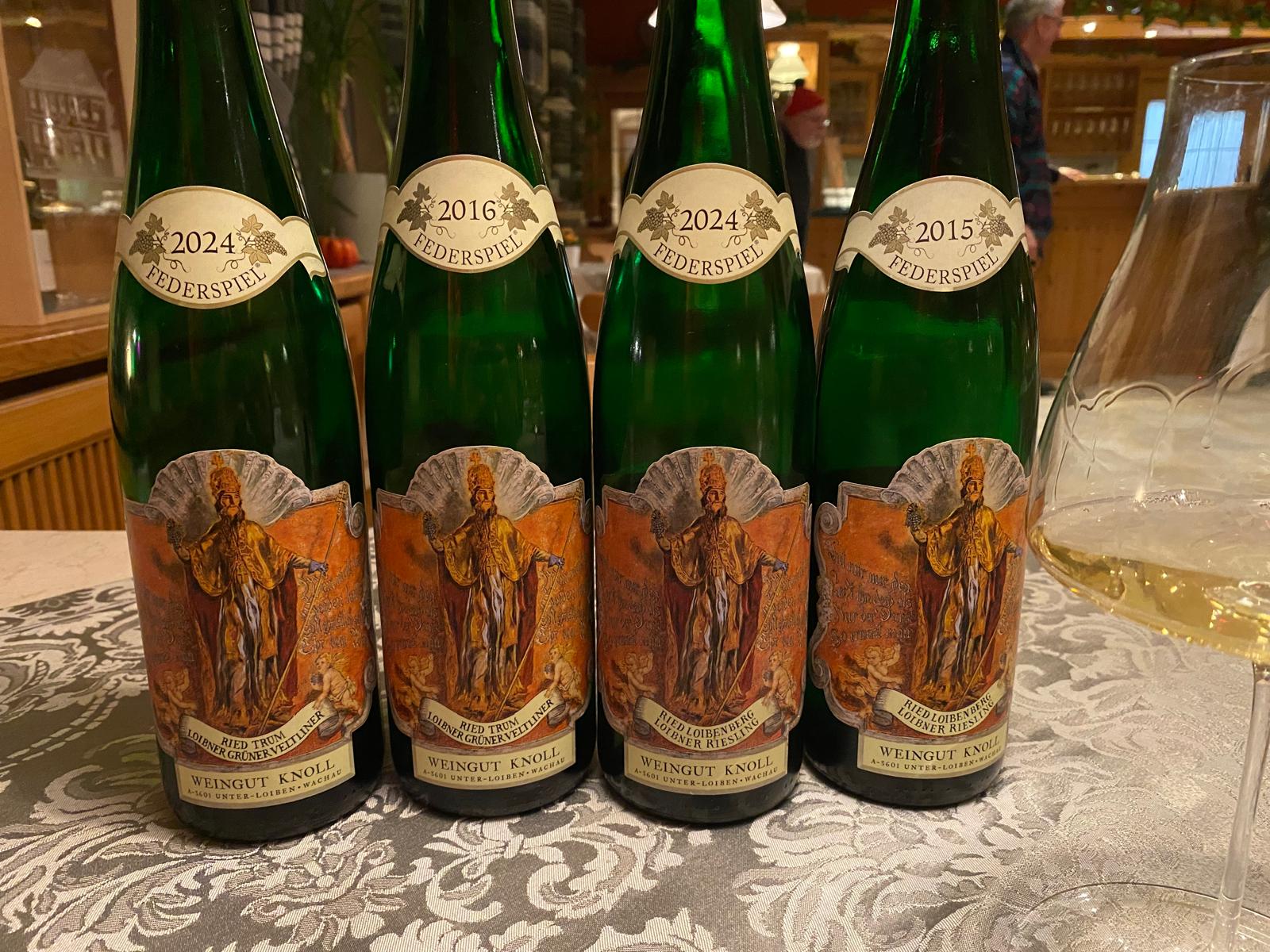
of the last warm rays of sunshine from what has, as so often happens these days, turned out to be a far too warm autumn, in the garden of a Franconian inn (the word ‘inns’ always sounds a bit odd, but that’s just the plural) – so; I’m sitting in the inn, four bottles, four glasses in front of me, each with Saint Urban on the label. One might think I’ve set a small altar table to venerate a Christian dignitary. Yet the four bottles only appear sacred at first glance – rather, they stand there as four attentive witnesses to a turning point in history. If there was ever a moment when it dawned on me that ‘Federspiel’ is making a comeback in the Wachau – indeed, that it must make a comeback, regaining the interest of wine enthusiasts too – then it was this: a flight comprising two vineyards, two grape varieties, two generations – all from the Knoll Winery – Anja, August and the two Emmerich Knolls.
Yet the Federspiel was not always a category for nostalgics or casual drinkers. In the 1980s, it was the solid mid-range of the Wachau, as much a given as roast pork in the village inn. Significantly more of it was bottled than of the powerful ‘Smaragd’ wines. And the ‘Steinfeder’ – now almost extinct – also epitomised the carefree culture of everyday drinking back then: 10 to 11 per cent alcohol, fruity, refreshing, uncomplicated. These are precisely the wines the market is desperately seeking today – especially for women who have had enough of the heavy, full-bodied ‘men’s wines’.
The Vinea Wachau system was and remains clearly structured: Steinfeder for the light wines, Federspiel for the classic ones, Smaragd for the powerful ones. Three tiers of Wachau’s ambition. Yet the Steinfeder is fading into the background, and may even die out – not because there is no need for it, but because it has to battle against the climate. And in the midst of this change, the Federspiel suddenly stands out brilliantly once more: light enough to please, serious enough to endure.
The fact that the Federspiel may now be making a comeback is also down to the fact that the time is ripe for wines that neither boast nor hide. Perhaps they are ‘women’s wines’ in the best sense of the term: accessible, aromatically nuanced, and free from ideological baggage. Or perhaps they are simply the more contemporary wines in a world that once again values elegance and an inherent ‘digestibility’ (a word that winemakers and wine merchants are still forbidden to use effectively in advertising) more highly than a show of strength.
And here they are, these four Knoll delicacies, standing before me – two young 2024s, two mature vintages. And all four are simply magnificent
The young 2024s
The Grüner Veltliner Ried Trum Federspiel 2024 comes across as more light-footed than expected, but by no means inoffensive. Varietal character, clear structure; a wine that wants nothing more than to be what it is – and it is precisely for this reason that it shines and impresses in its price bracket (we’re talking around 16 to 18 euros a bottle).
The 2024 Riesling Loibenberg is its elegant counterpart: more slender in build, finely chiselled, with that breadth of aroma that the Loibenberg has always possessed. This is the Federspiel style that works immediately in the glass: cool, lively, precise.
The matured bottles – the real miracle
The 2016 Grüner Veltliner Ried Trum Federspiel reveals apricot on the nose, followed by vineyard peach, ripe violets, a touch of camomile, a hint of orange peel, along with a nutty note and a bready undertone. On the palate, it is ripe but never tired; paprika, white pepper, terroir-driven salts, a very subtle hint of black truffle and that rye bread note again. A wine that fascinates even in its youth – without ever faltering; not even after days in an open, chilled bottle.
Ten years on, the 2015 Riesling Loibenberg Federspiel seems almost youthful – stone fruit, a hint of kohlrabi, dandelion, poppy flower, cold pear. On the palate, impressively lively and present, as if it were from 2019 or 2020.
Both wines reveal what we have often overlooked in recent years: Federspiele can age. And how! At least another ten years, five beyond that – with that ‘morbid’ quality that connoisseurs revere.
What remains? A realisation that even Saint Urban would nod in agreement with:
The Federspiel is not that ‘second-tier’ wine that hard-drinking men have labelled it as over the last 30 years. It is the wine of the present. And, even more so, of the future.
Light, but not frivolous.
Delicate, but not thin.
And it is precisely here, in this quiet middle ground between dancing lightness and fruity, peppery dignity, that the old chapter of the Wachau is now beginning anew. If we so choose.