
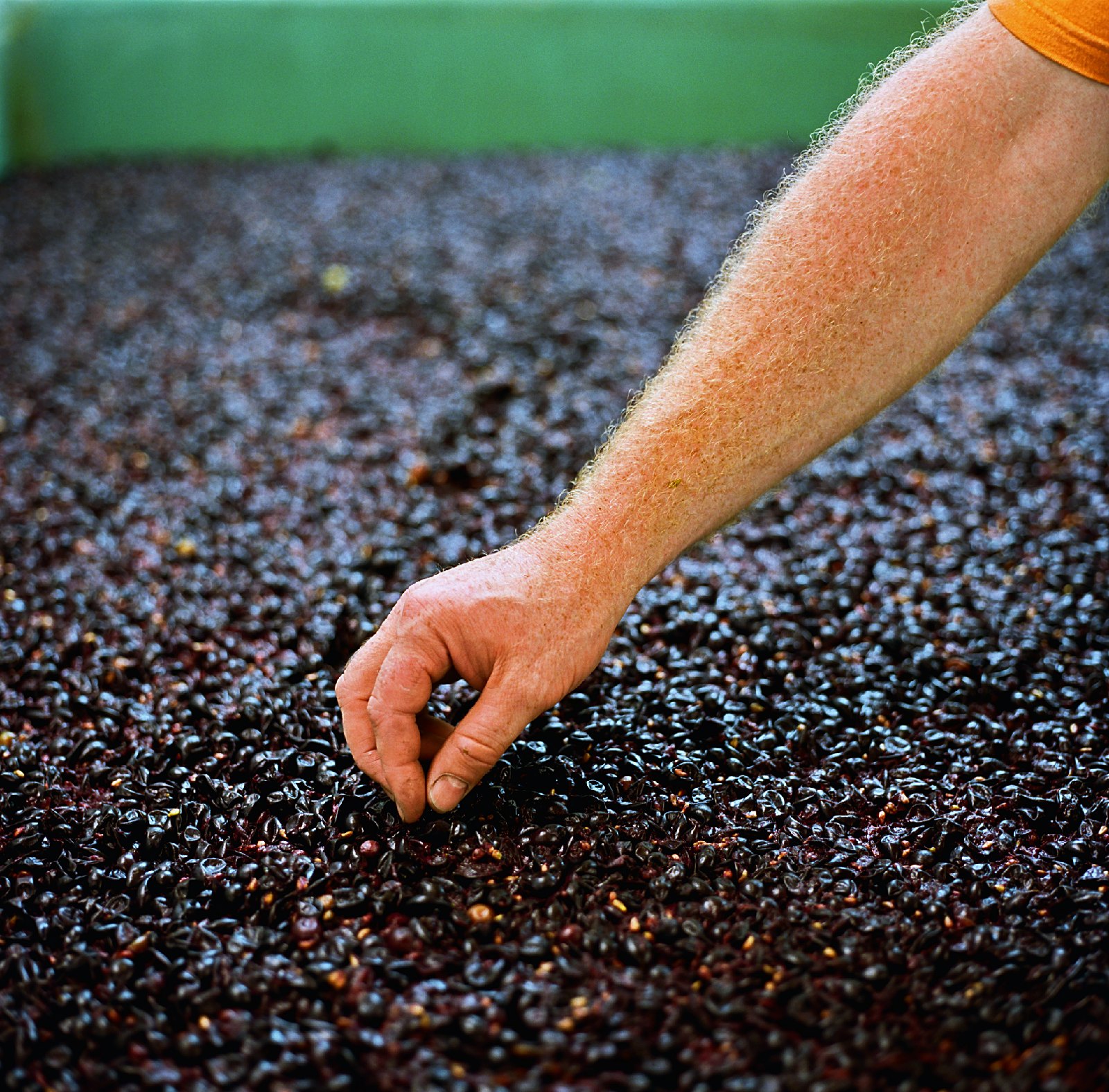
It is early October. In large parts of Europe, the grape harvest is over or on the home straight. Normally, this would be the time of year when winegrowers, associations and wine media tell us about the new vintage. About must weights and acidity, small berries, large berries and healthy grapes, about the decisive rain at just the right moment and, naturally, about a vintage that will be considered at least very good, occasionally great and, of course, completely differentiated from its predecessor. We know this ritual. It is part of the wine world like the first barrel tasting.
In 2026, it is remarkably quiet.
Of course, there are reports. Trade media are writing, associations are sending out harvest reports, regional newspapers are photographing winemakers with crates of grapes. But compared with previous years, the European harvest seems strangely noiseless. There would certainly be plenty to talk about. In France, the harvest began as early as hardly ever before. Burgundy reported a new record; in Bordeaux, the first grapes for Crémant were cut at the beginning of August (!); in Champagne, the harvest began, depending on the commune, as early as between 8 and 22 August. In Italy, Sicily started in July (!). Germany, Austria, Switzerland, Spain and Portugal also followed considerably earlier than usual. 2026 is a European hot-vintage year, shaped by drought, small berries, high ripeness and the question of whether the acidity was able to keep pace with the sugar. So there would be enough material.
Presumably, the silence has less to do with the weather than with the mood. Europe’s wine industry is in a crisis whose scale we should not play down. Consumption is falling, important export markets are weakening, production costs are rising and vineyard areas are being grubbed up. In Germany, a state- or European-supported crisis distillation for Württemberg and Rheinhessen was even considered in 2026. The EU justifies it by citing sharply falling consumption, declining prices and growing stocks; in Rheinhessen, prices for red and rosé wine were at times more than a quarter below the five-year average. France had already had tens of thousands of hectares of vines grubbed up with state support. In Italy, almost 50 million hectolitres of wine were still in cellars shortly before the harvest began. Anyone who has failed to sell so much old wine will understandably be more restrained in cheering the new one.
Whether it really is the greatest crisis since the war years and the immediate post-war period can hardly be measured seriously. Without doubt, it is one of the deepest structural crises in decades. And that is precisely why the communicative response to it seems wrong to me. Wine is currently talking constantly about its crisis and surprisingly little about its wine. Yet for decades the vintage was one of the strongest stories of this cultural product. People knew that 1982 was something special in Bordeaux, that 1990 turned out great almost everywhere in Europe, or that 2010 tasted different from 2009 on the Moselle. Vintages gave wine time, memory and individuality. Today, the industry would rather communicate sales statistics, health debates, alcohol-free innovations and new target groups. All important. But in the long term, it is difficult to sell a cultural asset if one mainly explains why it is currently having difficulties.
And 2026 would happen to be a vintage worth talking about. In the Palatinate, the first harvest for Federweißen began on 12 August. The summer was hot and dry, development was far ahead, the grapes were healthy, although regional areas were badly affected by hail damage. At the end of August, German viticulture quoted laboratory specialist Günter Braun with a sentence that probably applies to large parts of Central Europe: “The right harvest date and time management during the harvest will be of decisive importance.” The harvesting window could be only a few days for individual varieties. That was precisely 2026: ripeness was not the problem. It came too quickly, if anything.
The main harvest also began unusually early in Austria. Early budbreak, early flowering, heat and drought accelerated vegetation; quantities are lower because of the drought, while quality is being assessed optimistically. Winegrowers’ president Johannes Schmuckenschlager expects an “expressive, aromatic vintage”. At first, this sounds like a classic harvest press conference, but the meteorological data make it plausible: healthy grapes, small berries, high concentration. The decisive question there too will be how much freshness the wines retain with this rapid sugar ripening.
Switzerland is even more interesting. In Vaud, people speak of a “sunny vintage”. The drought significantly reduced the size of the berries, particularly in red varieties, but increased concentration and sugar. Olivier Viret of the canton’s winegrowing competence centre says: “The sugar levels are very high, particularly in the reds.” François Montet of the Vaud winegrowers’ association puts it even more clearly: “From a health point of view, it was just perfect.” For him, the harvest conditions were ideal in terms of grape health. At the same time, Valais dispensed for the first time with setting an indicative price for the grape harvest – even though the industry itself considers the vintage excellent. It would be hard to summarise the situation of European wine better: excellent in the vineyard, troubling in the market.
Italy experienced this tension even more drastically. Gambero Rosso headed its early assessment “The great heat hangs over the 2026 harvest”. Astonishingly, Assoenologi, Ismea and Unione Italiana Vini initially even refrained from issuing their traditional national harvest forecast. The weather had become too changeable to predict quantities seriously. Nicola Biasi, one of the most interesting Italian oenologists, described 2026 in Gambero Rosso as “extreme but not difficult”. A clever distinction. A hot year need not be a bad year. What matters is whether vineyards, grape varieties and winemakers can cope with the heat. In Montalcino, the Brunello harvest began at least a week earlier; at the same time, the permitted harvest quantity was limited again. Not because there were no grapes, but because the market does not need any additional quantity.
France presents the most extreme picture. La Revue du Vin de France wrote as early as July: “The coming weeks will be decisive.” In Fitou, the first cut took place on 15 July – according to the magazine, earlier than ever before in France. In Burgundy, Marc Sangoy said after almost forty years as a winemaker: “The records are falling. It’s going fast.” The Crémant harvest began there on 8 August. Later, the other side of the vintage emerged: according to initial estimates, France expects less than 34 million hectolitres, six per cent less than in the already small 2025 vintage and 17 per cent below the average for 2021 to 2025. If this is confirmed, it would be the smallest French harvest since 1957. Heat and drought have therefore both concentrated and destroyed at the same time.
On the Iberian Peninsula, the picture is less gloomy. In Rioja, the technical director of the Consejo Regulador, Alejandra Rubio, spoke in mid-September of the prospect of “a great vintage”. The grapes were healthy, and sunny days and cooler nights favoured quality. However, the analyses also showed what was preoccupying everyone in 2026: rapidly rising potential alcohol, falling total acidity and declining malic acid. La Rioja Alta is already calling 2026 “the earliest harvest in our history” and at the same time reporting exceptionally healthy grapes. In Ribeira Sacra, the harvest began on 12 August, eight days earlier than in 2025; at the end of September, the appellation reported excellent fruit and an historic high for Godello.
Portugal sounds almost like the counterpoint. At the end of August, Revista de Vinhos summed up the vintage as “Early harvest, increased quantity”: an early harvest, larger volumes. After the weak previous year, significant increases were expected in many regions, with grapes and musts generally well balanced. Then rain came and made the calculation more complicated regionally. Here too, then, it is not a straightforward vintage of the century, but a year in which the timing of the harvest decided more than average.
What can be inferred from this at the beginning of October? No final judgement yet. Wine is not finished in the vineyard, and some of the most interesting 2026s have only just begun fermenting. But a European pattern is discernible. Very early vegetation. Extreme heat. Drought. Small and often perfectly healthy berries. High sugar levels. Regionally low yields. The best wines will probably emerge where old vines, good water supply, suitable soils and precise harvest timing prevented ripeness from meaning nothing more than alcohol. 2026 is likely to become less a vintage of regions than of places. Two vineyards a few kilometres apart can tell completely different stories.
And those are precisely the stories the wine industry should tell. Anyone who talks only about falling consumption during the worst sales crisis in decades ultimately reinforces the feeling that wine is a product in retreat. But anyone who explains why a Riesling 2026 had to be harvested within three days, why an old vine withstood the drought better, why tiny berries developed in Vaud or why cool September nights suddenly became decisive in Rioja reminds us why we are interested in wine in the first place.
The crisis does not disappear because of this. Cellars do not become emptier because someone talks about acidity levels. Nor will young people automatically start drinking wine because Burgundy harvested Crémant on 8 August.
But self-confidence begins with an industry still knowing what is interesting about its product. 2026 looks set to become a pretty interesting vintage. We should talk about it.