
(This text appeared previously in WELT am SONNTAG; the announced Tirol text is with our media lawyer, who does not yet want to release it. It will come tomorrow)
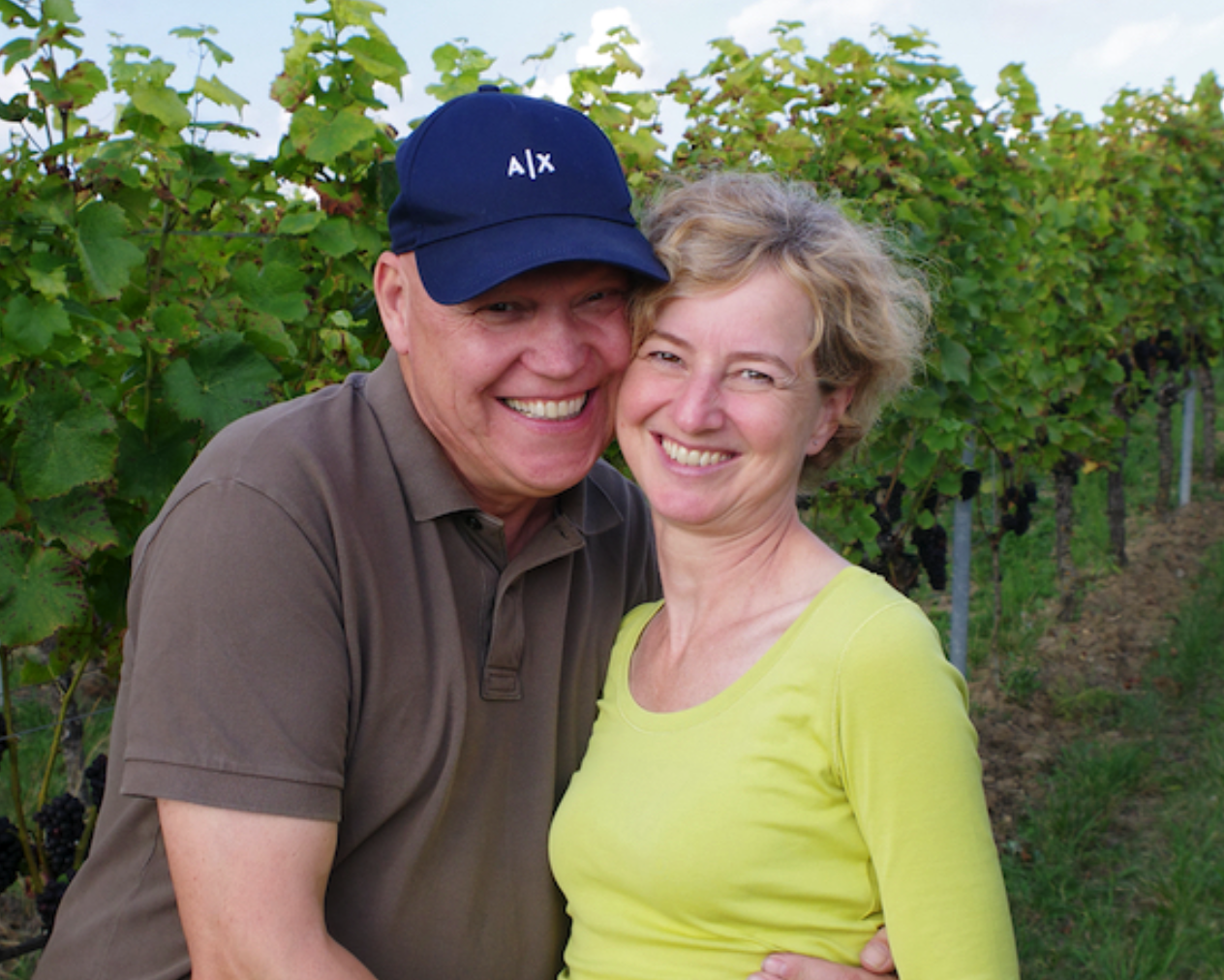
Osterreicher (me) meets Östreicher: the winemakers Kerstin and Richard Östreicher in Sommerach on the Main. Layer upon layer, the vines here have been reaching into the earth for centuries, drawing water and mineral salts from a soil that in turn consists of old vine roots from long-faded vines – DNA of origin. Kerstin and Richard Östreicher know about this DNA and work it out as well as they can. And they can do that very well. Let us spare ourselves further words and go straight to the wines.
The Silvaner Gewanne “Augustbaum” 2022 around (€34.00). Drunk at 10am, when tongue and palate had barely been distracted by food. It spent 12 months on the full lees, in used French tonneau – no attitude, only substance: quince, floral nuances, a hint of raspberry spirit – but without sweetness. The fruit is not young, but mature at every stage. This brilliance of a wine was rejected five times during the examination for the tasting number before finally being allowed through. That tells me that the old high priests among the wine examiners do not understand the modernity of the present. The juiciness of Augustbaum is not an effect, but a state of aggregation. There are around 2,000 bottles of it; no more are needed. When something has been formed rather than designed.
The 2023 from the same site? It is (€36.00) more rustic, but by no means rough. More riverbed than promenade. The nose brings Burgundy to mind, perhaps Mâcon, or a Marsanne from a higher site. That too is a form of identity: not being there, and being as it is there.
The Chardonnay Rossbach 2023 (€65.00) seems cast from a single mould: barrel-fermented in Damy and François Frères, with wood from the forests that also supply Meursault. Clones from there too. The texture is finely taut, like the membrane of an instrument. Spontaneously fermented, 1,500 bottles. Not a wine to admire, but to drink, followed by kneeling down and a prayer of thanks.
Next bottle: the Silvaner “Maria im Weingarten” 2022 (€42.00). A vineyard below a chapel (hence the Maria), on clayey, iron-bearing limestone. More classical than Augustbaum, but with an angular depth. A wine that defines its own contours – more dramatically than other German wines can manage.
And red wines? Yes, of course. For me, red wines from Main-Franconia often rank among the finest in the world. Östreicher’s Spätburgunder (Pinot Noir) from the Gewanne “Rosen” 2018 around (€52.00) – only 1,000 litres, delicate, elegant wood; the soils: sandy loam, shell limestone, 20 metres as the crow flies from the Main, 3.4 metres above the river level. An elegant spiciness runs through the Rosen, as though it came solely from the soil itself. No aromatic enhancement in the cellar, but tectonic tension created in the soils of the vineyards. Those who taste closely will find a line here that could be traced right through to the finest sites of the Côte de Nuits.
The Spätburgunder Gewanne Katzenkopf 2023 (€68.00) brings 20% new wood into play: a clearly defined structure, a form of decisiveness one makes only when one knows what one wants. The Spätburgunder Gewanne Hallburg (€28): cherry, cassis, mint, marzipan, rosemary – an Italian village in January, when the streets are empty but the air still smells of the festival.
Östreicher’s Weissburgunder Hölzlein 2023 (€35.00) is mineral to its very core: planted in 2000, and more Mercurey than Middle Franconia. The 2024 shows more drive, but remains on the same line. Origin here is not a safety net, but a tool.
The Silvaner “sur lie” 2023 (€22.00): slightly cloudy, dense, dramatic on the nose. Peach, beans, hazelnut, walnut shell – no effect, but layering. The soil is shell limestone, but the impression is almost Alpine. A Silvaner that speaks like a Burgundy, without imitating the language. Before that: Maria. Before that: Augustbaum. It is a system of sentences that support, contradict and ultimately complete one another.