(Claude Auguste, Editorial Team, Getty-History)
In America, a late-night show is taken off the air; in Europe, wine is pilloried in the arts pages. And the mechanism is the same every time: constant dripping wears away the stone. No grand blow, no heroic final battle. It is the hum that solidifies into a background noise, the daily micro-erosion of legitimacy. First, it is a storm of criticism; then, an advertiser pulls out. First, it is a cautionary comment; then, a mayor cancels the city’s wine gifts. The logic of ‘cancelling’ is not that of truth, but of persistence. And the wine industry’s response is much like that of US society when it comes to the cancellation of its entertainment: people shrug their shoulders, hope it won’t affect them – and crawl under the duvet.
This resignation is our greatest mistake. We have long since relinquished control of the debate on wine: health? Others are covering that. Climate? Others are covering that. Urban society, nightlife, the hospitality industry? Others are covering that. Wine, which has proven itself over a thousand years as a civilising force – as a ritual of community, moderation and rhythm – is becoming the scapegoat for a moral accounting system that knows only the debit side (the ‘debit side’, editor’s note). Anyone who believes that trade associations will sort this out for us is mistaken. In Germany, of all places: too slow, too averse to conflict, too preoccupied with themselves. Who will protect wine culture? No one, unless we do it ourselves.
The good news is that there is a counterstrategy. It begins not with whingeing, but with what we have to offer. Modernity rather than nostalgia. Lighter wines that aren’t banal. Sleek reds with bite, rather than 16.5 per cent ‘bombs’ for the ‘old men’s niche’. Bottles that don’t just claim to be recyclable, but prove it – lighter glass, returnable bottles, reusable wherever possible. Transparent labelling instead of a wine primer: what’s in it, how much alcohol, what’s the carbon footprint – without an ideological barrage, but sober, verifiable and reliable. Wine must take the first step: it offers moderation before the call for excess grows loud.
Secondly: alliances. As mentioned, anyone pinning their hopes on trade associations is hoping in vain. So winemakers are joining forces with other winemakers – across regions, beyond stylistic boundaries. Alongside them: restaurants, cultural venues, festivals, bookshops, football clubs. Wine back in the neighbourhood, not just at prestigious tastings. A shared annual calendar of open cellars and open kitchens, governed by clear rules: responsible serving quantities, free water, and partnerships with taxis and public transport for the journey home. Not as moral purification, but as urban courtesy.
Thirdly: language. Wine needs a new public vocabulary. Away from ‘seduction’, ‘sin’ and ‘vice’ – these play into the hands of the rhetoric of abstinence. Towards ‘culture with a history’, ‘community’, ‘craftsmanship’ and ‘time’. A concise code that every establishment should display on its door: We serve in moderation. We provide training. We pay fair wages. We recycle. We talk honestly about alcohol. We do not tolerate underhand tactics. This code is not a PR fig leaf, but a contract with consumers.
Fourthly: Tactics. Cancellation is organised, so we organise too. A small, decentralised response team comprising communicators, winegrowers, doctors and lawyers. If tomorrow the XY newspaper claims that wine is inherently deadly, the day after tomorrow there will be a fact-based, non-preachy rebuttal – concise, quotable and freely usable. If a town declares its town festival ‘alcohol-free’, there is an alternative proposal: wine as a culinary cultural programme with clearly designated safe spaces. If a school holds a prevention week, we’ll offer to talk about agriculture, yeasts, sugar, fermentation and responsibility – knowledge rather than panic.
Fifthly: the economy. Yes, the sector will shrink. That is not the end of the world. Shrinking can mean: less volume, higher quality; fewer tonnes of glass, more content. But shrinking without solidarity is decay. So: shared logistics (return schemes, reusable packaging), joint procurement (lightweight bottles, renewable energy), a solidarity fund for businesses that are transitioning and losing revenue in the process. Competition remains, but it ceases to be tribal.
Sixthly: the product. The wine of the coming decade will be precise, not clunky; cool, not cold; drinkable, not thin. It will regard 10.5 to 13.0 per cent by volume as the norm, not the exception. It is based on agriculture that takes water, soil and biodiversity seriously – not to collect certificates, but to secure the future. And it embraces diversity: still, sparkling, gently de-alcoholised, provided it is done properly. Not everything for everyone, but good things for many.
Seventh: The stage. Wine must return to the public eye – visible, but not loud. Collaborations with music, literature and design. Short, clever formats: 45-minute tastings that truly explain a topic. Pop-up wine shops that stock just three wines but know their stories inside out. An award that honours not the most expensive wine, but the clearest concept: the best drinking experience with the smallest environmental footprint.
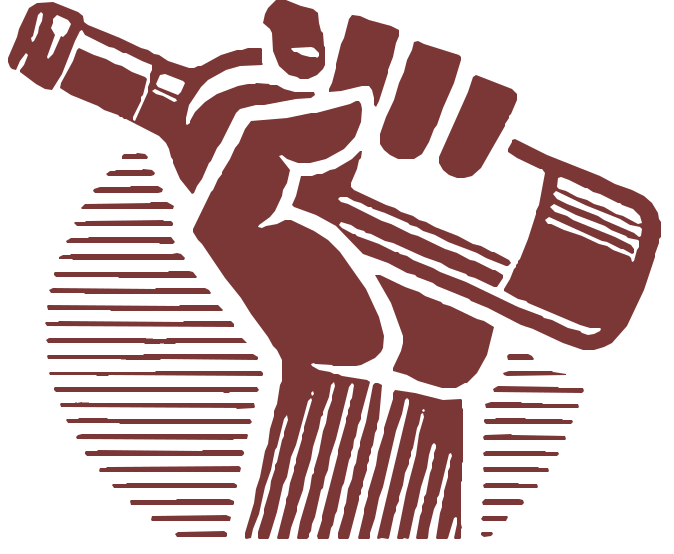
The alternative to quiet resignation is not a heroic uprising, but the steady, repeatable action of many. A small step every month, clearly documented. Constant dripping wears away the stone – and it’s working in our favour too. Anyone who wants to ‘cancel’ wine should meet with resistance: polite, objective, tireless. No culture has ever survived by apologising for its very existence.
I therefore urge you: stop hoping, start taking action. Forge new alliances, because the old structures won’t do the job. Cut down on alcohol without losing your character. Lighten your load without sacrificing your dignity. Speak clearly before others speak about you. And if you want to crawl under the covers, then only to pull them off and turn them into a fluttering banner. Wine is not a vice to be tolerated in secret. Wine is a cultural practice. Those who abandon it will ultimately lose not only the wine, but the ability to uphold culture – in drinking, in debate, in life.