
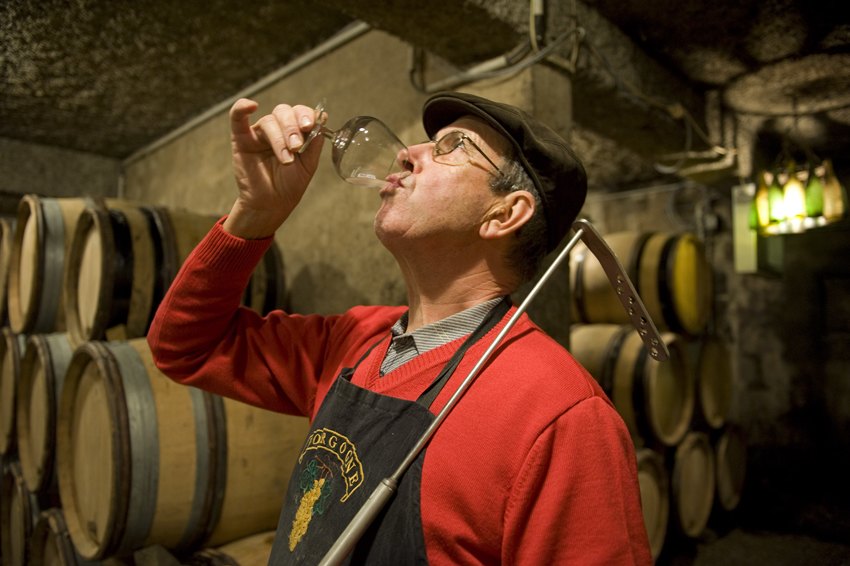
About thirty years ago, I drank a wine from Domaine Coche-Dury for the first time and experienced something that has occupied my thoughts ever since. It was not a particular aroma, fruit or scent—nothing, in other words, that could reasonably be captured using the usual terms of wine description. It only happened once I had the wine in my mouth. An almost brutal deliciousness, combined with a vibrating, almost mystically rapturous mouthfeel that immediately demanded the next sip. The strange thing about it: this certain something was possessed not only by the famous Burgundian estate’s great Chardonnays, but also by its simpler wines and the Aligotés. Today, even these bottles are almost unaffordable. Back then, at least, I could still drink my way through the range and establish: there is something there. And apparently it is no coincidence.
Later, I encountered this phenomenon again in wines from Domaine Leroy. Burgundy again, great white wines again, prices we would do better not to discuss. So I began looking for a practical explanation. At first, I suspected the wood. Many years later, when I recognised this now familiar vibration again in the first Riesling matured in tonneaux from the Deidesheim estate Von Winning, I spoke to the oenologist Stefan Attmann about it. He referred me to the Damy cooperage, whose barrels develop a particularly pronounced character through their wood quality and toasting. That seemed plausible to me. Perhaps this strange deliciousness was not a secret of the terroir at all, but a fairly concrete consequence of barrel ageing and medium-plus toasting. For a while, I was satisfied with the explanation I had given myself.
Until I drank a wine at Sattlerhof in Styria and it was there again. Only the Sattlers did not use wooden barrels for this wine. That put an end to my beautiful theory. The Sattler family suspected that the cause lay more in the length of time on the mash. That made sense to me too. But once again, it did not unequivocally explain all the other wines in which I had experienced the same thing. Since then, I have been collecting clues. Maturation, skin contact, yeasts, reduction, the ripeness of the grapes, cellar work, possibly the interplay of several of these factors. After three decades, I am no decisive step further forward. I recognise the phenomenon fairly reliably as soon as it appears in the mouth, and yet I still cannot explain what causes it. For someone who professionally spends all their time trying to translate wine into words, that is fairly frustrating.
Interestingly, I now encounter this certain something not only in the stratosphere of pricing. I find it, for example, in Vincent Girardin’s basic Bourgogne Blanc, in both astonishingly affordable Chardonnays from J. Neus in Ingelheim, and most recently in the white wines from Schlumberger-Bernhart in the Markgräflerland. I like that partly because it removes another possible explanation: greatness cannot be the answer, at least not the kind of greatness defined by price, renown or a famous site.
One observation, however, has remained remarkably consistent over all these years. I find this certain something exclusively in white wines. The estates mentioned also produce some excellent red wines. There, I search for it in vain. Perhaps that contains the crucial clue. Perhaps several factors come together only under certain conditions. Perhaps one day I will meet an oenologist who explains the whole thing to me in three sentences, thereby bringing thirty years of searching to an end.
Until then, I have to live with a fairly unscientific definition: I cannot smell it. I do not know exactly how it comes about. But as soon as the wine is in my mouth, I recognise it. And I immediately want to drink the bottle dry, jubilantly.