
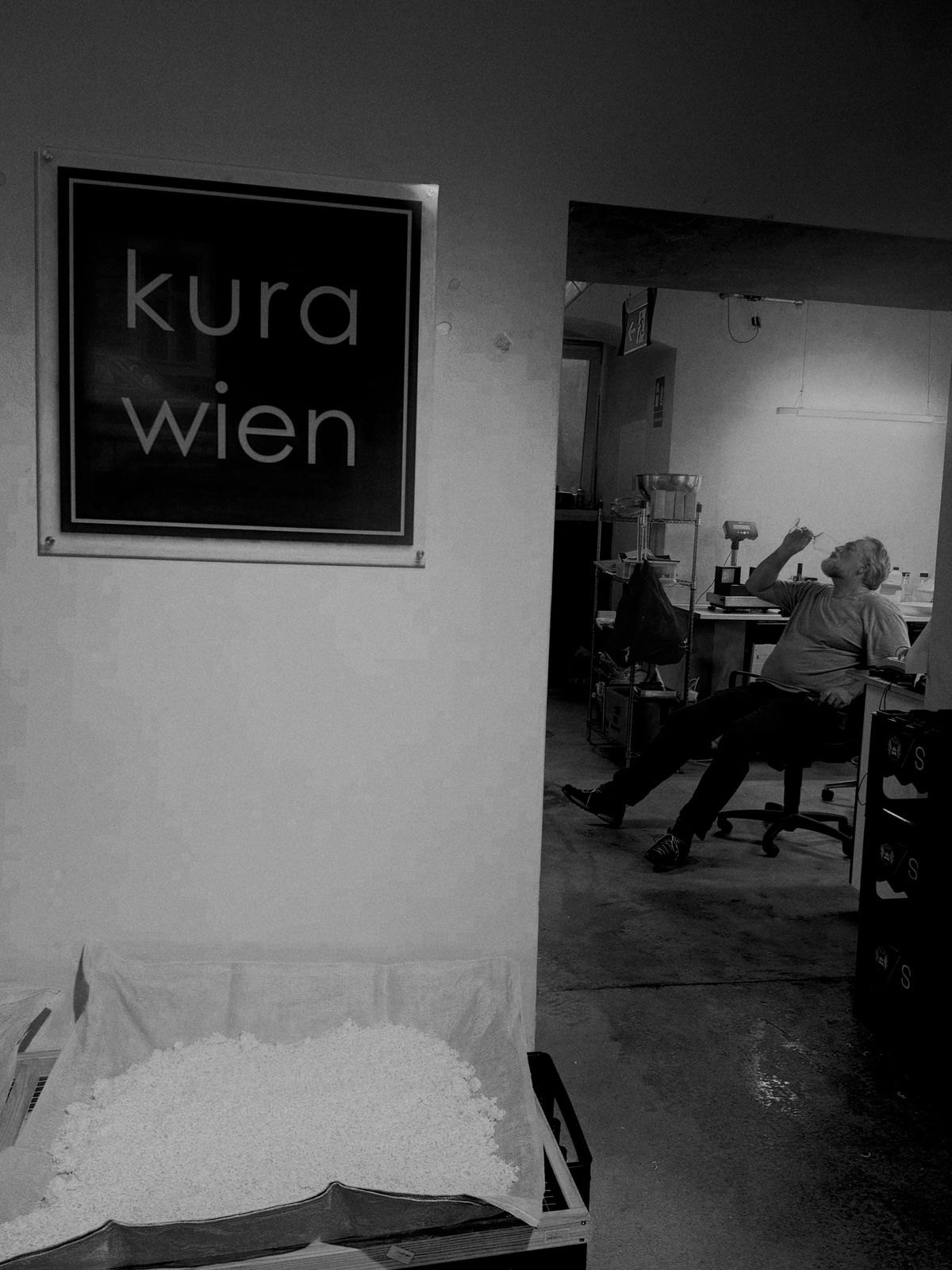
There is a lot one can drink in Vienna. Really a lot of good stuff – I know what I’m talking about. The fact that this has also included a serious, locally brewed sake for several years now first occupied me six years ago. At the time, I wrote in WELT am SONNTAG about Matthias Schweger, the founder of Sake Wien. His idea: to brew sake in a city whose identity is based on wine. Schweger has since moved on and devoted himself to a very singular, Asian-influenced and impressively good food project called Oustoria. But his brewery lives on. Just without him now: today it is called Kura Wien, and I went back there.
Sake has a history of around two and a half millennia. The art of producing alcohol from rice travelled from China to Japan, where it was refined over the centuries. Initially, sake was primarily a drink for religious ceremonies and the imperial court; later, temples and monasteries further developed the brewing techniques. By the 17th century, it had become a significant industry. The term rice wine is misleading, incidentally. Sake is brewed: a noble mould called koji converts rice starch into sugar, which yeasts then ferment into alcohol. A pretty sophisticated affair, long before anyone invented the word biotechnology.
Its great career in Europe began in the noughties. Japanese cuisine had long since arrived in the major cities, sushi had lost its exotic status, and ambitious sommeliers discovered that good sake could do far more than be served lukewarm with raw fish. Haute cuisine in particular took a liking to its versatility. Sake often has a pronounced umami component, little of the acidity that can clash with certain dishes when it comes to wine, and an astonishing aromatic range. With mushrooms, fermented vegetables, seafood, mature cheese and even difficult asparagus dishes, it is said to be an excellent choice. Its temperature can also be varied: some sakes gain depth through careful warming. The best sommeliers now treat it as an entirely natural part of their drinks pairings. Why? With good reason!
Anyone brewing sake in Vienna, however, has to source suitable rice from Piedmont, master Japanese fermentation techniques and explain to the largely ignorant Viennese (I’m allowed to say that, because I’m one of them) why they should drink fermented rice instead of Veltliner. After Schweger’s departure, entrepreneur Fred Kranich took up the initiative, accompanied by Claus Dirnbacher, the property financier of the previous project. Brewing takes place in Barmherzigengasse in the third district. Master brewer Markus Csenar develops medical emergency injectors as his main occupation. Director Satoshi Mühlöcker is also part of the team.
It evidently hasn’t been a profitable business so far. Measured against the effort involved, it is self-exploitation. Yet nobody seems unhappy about it. Kranich throws himself into the project with such élan, as though he personally had to convince Japan of sake from Vienna. I find ventures like this appealing, as long as the drink itself is convincing in the end.
And it is. Particularly the Midorishachi 2025, at around 32 euros a bottle. Brewed from organically grown Arborio rice and Vienna’s high-spring water, it smells of pear, quince, a hint of peach, fresh leather and champignons. Astonishingly dry on the palate, with a fine bitterness reminiscent of Campari. Fifteen per cent alcohol, but not a trace of aggression. I pour myself another and eat freshly cooked veal sausages alongside it. Its affinity with an uncomplicated Veltliner is probably related to the Viennese wine culture in which Csenar lives – and in which I am happy to be a guest today.
The Aoshachi 2026, also around 32 euros, smells of an open window in winter: snow, forest floor, yeast, porcini mushrooms. Alongside these are wild raspberries and something that reminds me of the sweet meringue confectionery on my childhood Christmas tree. More body and noticeable sweetness in the mouth, yet fresh and wilful. It’s astonishing how many worlds of flavour rice can open up!
The Kinshachi 1873, at around 42 euros, is the most powerful. Almonds, peanuts, pear, apricot, gingerbread spice, butterscotch and rice pudding. Alongside this, the olfactory memory of an old, unheated wooden hut in the Alps. A good sixteen per cent alcohol, warmth and depth. The name recalls the 1873 Vienna World’s Fair, at which Japan presented sake for the first time. A gilded kinshachi, a mythical creature with a tiger’s head and a fish’s body, was among the much-admired attractions at the time. So Vienna had an opportunity to discover sake 153 years ago. It took a little while for something to come of it.
Finally, Marumero, a three-year-matured sake macerated with Demeter quinces: 12.5 per cent alcohol, just under 30 euros for half a bottle. Quince, naturally, but also old Austrian apple, lovage, bay leaf and the rind of a mature mountain cheese. For me, more a course in its own right than an aperitif.
Kura Wien will certainly not displace the Japanese master breweries that have been producing fantastic sakes for centuries. But here, people from different professions are creating something beyond Japanese folklore and Viennese eccentricity: something very much its own, calm and self-contained.