
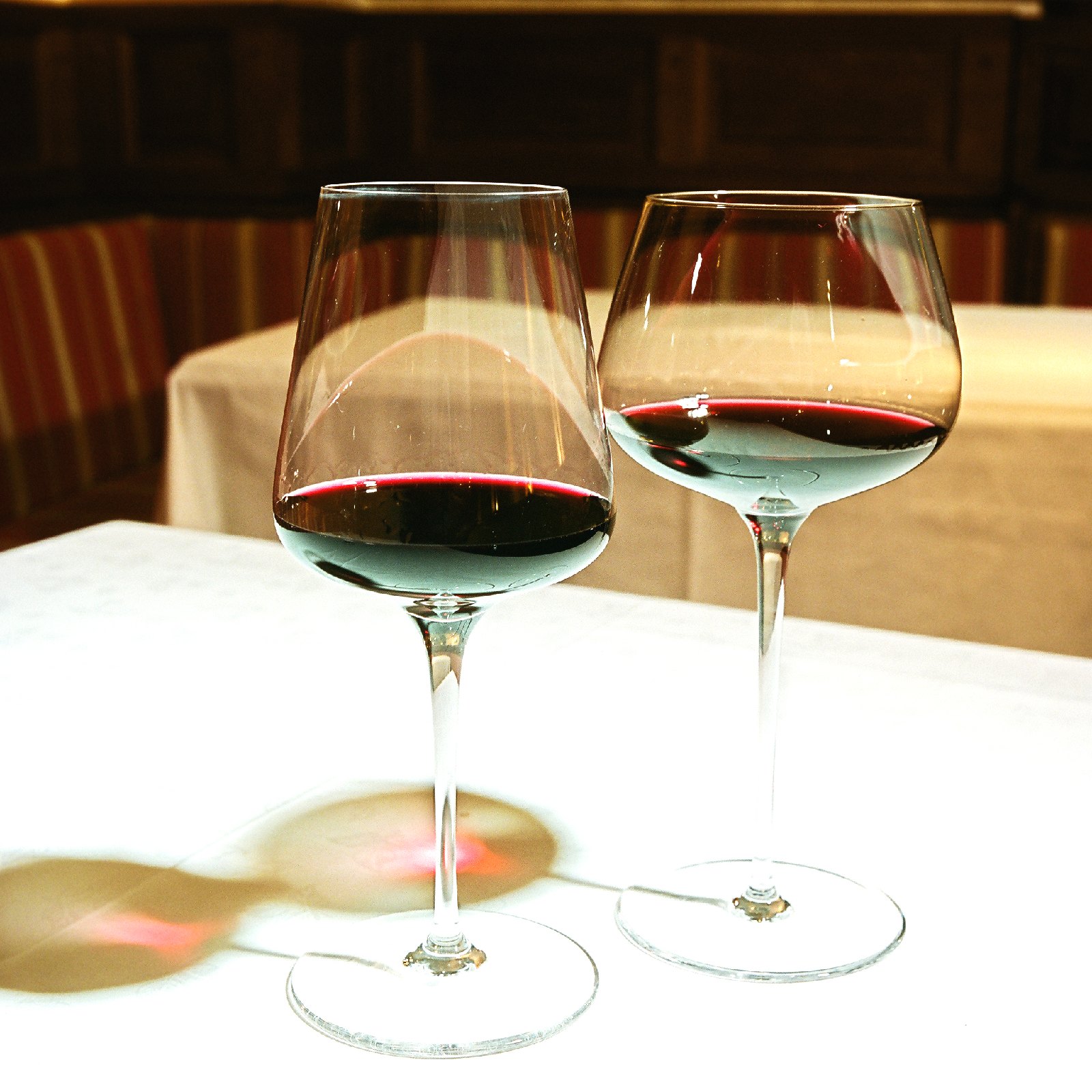
Red wine belongs to the world’s cultural heritage. Is that presumptuous? No! World cultural heritage not in the official sense, because UNESCO apparently has other things to do than knock back a historically significant glass of red wine. But hardly any other agricultural product has accompanied our civilisation for so long and produced a comparable culture in the process. The Romans bear the main responsibility for this; around 2,000 years ago they already distinguished between simple wines and great wines, and also knew about sites, parcels, provenance, vintage and ageing. Wherever the Romans were, the vines usually remained too.
Two of the most important vessels in our wine culture also owe their careers largely to red wine. The wooden barrel developed by the Celts initially established itself in the Roman Empire as a more practical alternative to the amphora; the sturdy glass bottle of the eighteenth century, together with the cork, ultimately made a new dimension of ageing and transport possible. Wine became something we could not only drink, but also lay down in the cellar for our children. The idea that a great red wine after 30, 50 or even 70 years is not merely still drinkable, but may possibly be more beautiful than in its youth, is among its greatest cultural achievements.
I have selected eight of them here. Naturally, such a list is unfair. And it commits an almost criminal sacrilege: there is no wine from Burgundy here. No La Romanée, no Musigny, no Chambertin. Instead, the Pinot Noir comes from Burgenland. Because it is the most successful cultural appropriation in wine history
BURG RAVENSBURG – BLAUFRÄNKISCH 2024
Let us begin with a German wine, and a simple wine at that. The Ravensburg Blaufränkisch vines grow in Sulzfeld in the Kraichgau, on mighty gypsum Keuper soils. The grape variety has an astonishingly long history there; Blaufränkisch, or Lemberger, belongs not only in Austria and Hungary, but for centuries also in south-western Germany.
This 2024 shows why, when it comes to German red wines, we should not talk exclusively about Spätburgunder. Blaufränkisch can be dark, spicy and powerful while still possessing an acidity that carries it for decades. This one also has a singular note: cool, astonishingly powerful chalk, a touch of graphite, a little eucalyptus. A mouthful of simple drinking wine – almost addictive.
(Source: Hawesko Germany)
LES FORTS DE LATOUR 2009
A second wine for which the term eventually becomes meaningless. Les Forts de Latour does not simply come from grapes that were not good enough for the Grand Vin of Château Latour, but predominantly from its own parcels and the outskirts of the famous Enclos. In 2009, Bordeaux also experienced one of its great modern vintages: plenty of sunshine, fully ripe grapes, enormous concentration and still enough freshness. At Latour, even the Grand Vin turned out monumental – and Les Forts benefited from the same exceptional year.
The blend consists of around 65 per cent Cabernet Sauvignon, 32 per cent Merlot, and small amounts of Petit Verdot and Cabernet Franc. That is considerably more Merlot than in the Grand Vin and explains part of its charm: blackcurrant, blackberry and cherry, along with a touch of graphite, tobacco, cedarwood and a little mint. The wine possesses tremendous substance, but no heaviness; after 17 years, the tannin, fruit and the spice of bottle ageing are beginning to combine wonderfully.
CHÂTEAU LAFLEUR 2009
A good four and a half hectares in Pomerol and a wine that has long been among the most sought-after Bordeaux wines of all. Lafleur is not a typical Pomerol, however. The unusually high proportion of Cabernet Franc – also called Bouchet in the Bordelais – gives it that austerity, spiciness and vertical structure that distinguish it from the more opulent Merlot wines of its neighbourhood. In the 2009, the blend consists approximately half of Cabernet Franc and half of Merlot.
And in 2009 Bordeaux was widescreen. Plenty of sunshine, ripe fruit, concentration. Lafleur performs the feat of not allowing opulence to become heaviness. Raspberry, dark berries, violets too, liquorice, forest floor and spices; enormous density, but extremely fine tannin. A wine that is rare simply because of its tiny production, but whose true greatness has nothing to do with its rarity.
(Source: KATE & KON Austria)
GIUSEPPE MASCARELLO E FIGLIO – BAROLO MONPRIVATO 2006
If there is an alternative to pumped-up red wine, it stands in Castiglione Falletto. The Mascarello family has been making wine for more than 150 years and bought its first parcels in Monprivato in 1904. Today, this Crulage is inseparably associated with the name. The wine is, of course, made from Nebbiolo, the variety that, with acidity, tannin and longevity, shows that a somewhat paler colour in red wine is a rather primitive unit of measurement.
2006 is a wonderful vintage for this: structured, firm, capable of ageing. Red cherry, not least roses, spices, graphite, stone and powerful tannin. By now, all of this is beginning to draw together. The fruit is still there, but the years have produced those additional aromas for which we leave Nebbiolo to age for so long in the first place: earth, dried flowers, herbs and that barely explicable mixture of delicacy and austerity.
Barolo can come across for years as though it does not want to talk to us. Then at some point it opens the door. And lets us in. The 2006 Monprivato is currently standing invitingly behind that door.
(Source: Trinkreif Austria)
HEITZ CELLAR – MARTHA’S VINEYARD CABERNET SAUVIGNON 2005
Californian Cabernet has many faces. Heitz’s Martha’s Vineyard is one of those that had already understood Europe before Europe was ready to take Napa seriously. The wine comes from Oakville and is a Cabernet Sauvignon whose history at Heitz goes back to the 1960s. It also became famous for an aroma that is hard to forget in a blind tasting: eucalyptus and mint alongside cassis, dark fruit and cedarwood.
2005 was a comparatively cool year with a late harvest. Today the wine is aromatic, with fine-grained tannin, well proportioned and almost European in character, without denying its Napa origins. Napa does not have to be sweet, hot and broad. Martha’s Vineyard possesses that rare combination of Californian ripeness and classical austerity.
After more than twenty years, the fruit is beginning to recede and lets appear the reason why we allow Cabernet to age at all: herbs, earth, tobacco, cedar, mint. And its passage through time.
(Source: Ungerwein Germany)
M. CHAPOUTIER – ERMITAGE LE PAVILLON 2004
One hundred per cent Syrah, from a single parcel of around four hectares in Les Bessards on the Hermitage hill. The vines for Le Pavillon are in some cases nearly 100 years old and rooted over granite. Hand-harvested, completely destemmed, left on the skins for a long time and then matured in wood for around a year and a half. That sounds like a technical data sheet. In the glass, it explains one of the great archetypal forms of Syrah.
2004 was not a monumental vintage in the northern Rhône. That is precisely what makes the Pavillon interesting. The great years of this wine are built for decades; 2004 shows it as more elegant and less massive. Smoke, dark berries, raspberry, tar, liquorice, later tobacco and cocoa – but all without the sweetness and breadth that Syrah sometimes acquires in warmer regions. And a wine that makes you hugely keen on mature wines.
(Source: Trinkreif Austria)
SCHLOSS HALBTURN – PINOT NOIR 2002
Now for the announced sacrilege. If there is no Burgundy on a list of eight red wines, there must be a damn good reason for it. It is called Schloss Halbturn 2002. In the Wittmannshof, a large contiguous site near the castle close to the Austrian state border with Hungary, there are old Pinot Noir clones whose origin lies in Burgundy. Red gravel and embedded calcareous sediments form a soil in which Pinot Noir evidently did not ask about its French birth certificate.
For me, the 2002 is among the best Pinot Noirs ever made outside Burgundy. And precisely for that reason it belongs on this list: not as a substitute Burgundy, but as a counterargument to the idea that great grape varieties are the property of their most famous origins. Halbturn took Pinot Noir and translated it into Burgenland. The result has delicacy, cool spice, depth and that peculiar transparency because of which Pinot Noir is one of the most difficult and fascinating grape varieties of all.
Cultural appropriation? Absolutely. But of the kind on which wine culture has lived for millennia.
(Source: WeinArt Germany)
CHÂTEAU LYNCH-BAGES 1989
Finally, Pauillac and a wine that makes the 1855 classification system look a little ridiculous. Lynch-Bages is officially Cinquième Cru, or fifth growth. The 1989 does not care. It is among the most famous vintages of the estate. Cassis, black cherry, graphite, smoke, cedarwood, leather and cigar box: the entire old Pauillac vocabulary is allowed to appear here once again.
Cabernet Sauvignon leads the classic Bordeaux blend, accompanied by Merlot, Cabernet Franc and Petit Verdot. 1989 produced enormous concentration and tannin, but also precisely the substance that more than three decades of bottle ageing does not merely survive, but requires. Even today, dark fruit and power meet the tertiary aromas of a great mature Cabernet. The wine is not interesting despite its 37 years. It is interesting because of those 37 years.
(Source: Ungerwein Germany)
Red wine has given us perhaps the craziest idea in the whole of wine culture: to buy something that we deliberately do not drink straight away. We put it away. Wait ten years. Twenty. Thirty.
And at some point we pull the cork and drink more than just wine. We drink time. We drink life and transience.