
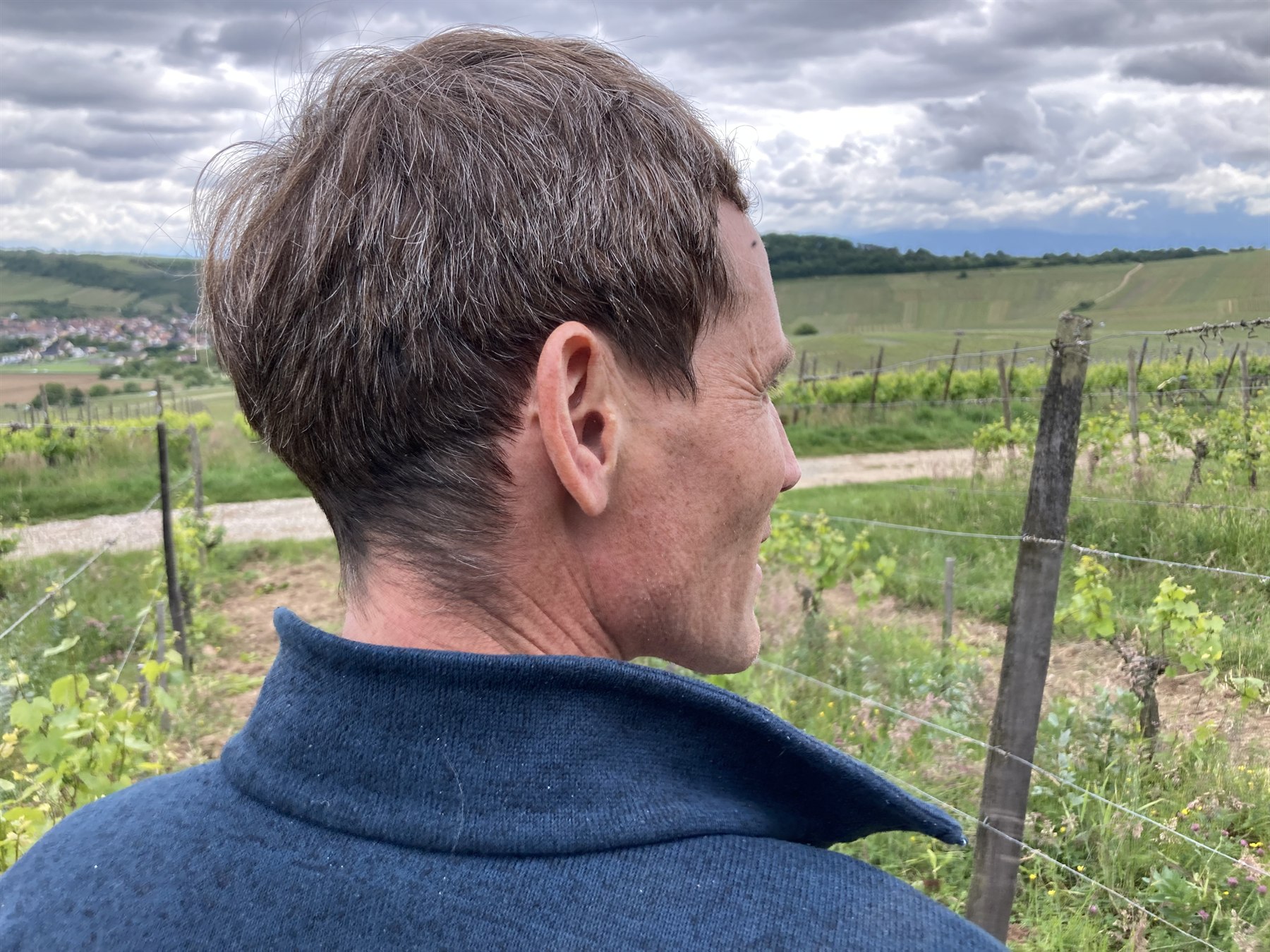
From the Baden Markgräflerland, it takes barely fifteen minutes to reach Alsace on the French side of the Rhine. Fifteen minutes that feel like a brief journey through time. On the German side of the border river, we encounter newly built cellars, modern architecture and investments that visibly demonstrate the economic success of recent years in many places. As soon as we cross the river, the picture changes. Alsace seems more old-fashioned, more rustic, almost as though it has fallen out of time. In the vineyards, French farm labourers still work here who have been part of viticulture for generations. They drive simple tractors, speak about soils, vines and weather with astonishing matter-of-factness, and carry out their work with a mixture of pride and composure that has become part of Alsatian wine culture. This romantic image of farm labour has largely disappeared on the German side of the Rhine. One might think that Alsatian viticulture had fallen behind its German neighbours. After a few visits, it is clear: the opposite is true. The regions are equal in quality, but Alsace has the bigger name worldwide.
Wineries such as the biodynamic Domaine Léon Boesch in particular show that great wines do not necessarily emerge from glossy cellars. The facilities are simple, the cellar technology seems unremarkable—and deliberately not state of the art. Owner Matthieu Boesch speaks German very well, which is rather unusual for a Frenchman, and embodies an unshakeable confidence in the family craft. His Sylvaner Pierres Rouges (€21.50) possesses precisely this unassuming greatness: meaty notes, leek, walnut, a hint of ginseng, lime and orange zest lead to a vegetal, delicious finish with a surprising touch of redcurrant fruit at the end of the sip. The spontaneously fermented Muscat L’Amandier (€21.50) is equally surprising: dark nut aromas, salt, density and an elegance that at times reminds me of the rusticity of some Wachau wines. Except that Boesch’s wines come in at around two-thirds of the monetary outlay.
Just a few kilometres away, Domaine Hurst makes wines that interpret the same landscape with equal success. The Riesling Lieu-Dit Boland 2022 (€26.00) opens with notes of fresh writing paper, caraway and a hint of printer’s ink. Herbs, white vineyard peach, green apple and a fine smokiness then lend it an idiosyncratic personality that eludes any straightforward varietal typicity. The Riesling Grand Cru Brand 2022 (€32–34.00) initially seems closed, opening with air and revealing the dark nuttiness and calm depth that great Rieslings often disclose only with patience. Particularly impressive is the Pinot Gris Brand 2022 (€26–28.00). What elsewhere sometimes tips vulgarly into lush tropical fruit is handled here with discipline and precision. Pineapple and apricot meet damp red-grey earth, mushrooms, lime and chalk. Later come quince, a hint of pear, pink candyfloss and finally a touch of turmeric. A wine of remarkable tension with an estimated ageing potential of twenty years.
It is precisely this immediate proximity that makes the Upper Rhine region a European singularity. Two wine landscapes lie just minutes apart and could nevertheless hardly be more different in their culture. Decades of political separation have left far fewer traces in other European border regions. Between Austria and the Czech Republic, Hungary or Slovenia, the wine cultures remain astonishingly similar despite their borders. The same applies to the Collio, divided between Italy and Slovenia. Between the Markgräflerland and Alsace, by contrast, the Rhine has preserved two entirely different wine worlds. That is precisely why the short journey across the border is worthwhile. Not to judge differences, but to experience how diverse wine can be—and how little cellar technology and national borders ultimately determine the greatness of wines.