
Manfred Klimek & Editorial team
Which vines should remain – and which may/should go? This question is currently not being debated publicly in German winegrowing. Yet yesterday, a business commentary on WELT Online spoke of a reduction in vineyard areas of at least 50% in the near future. Is this once again German crisis-mongering? Germany’s delight in worst-case scenarios? In any case: despite all the adverse circumstances of this “era”, 50% seems far too high.
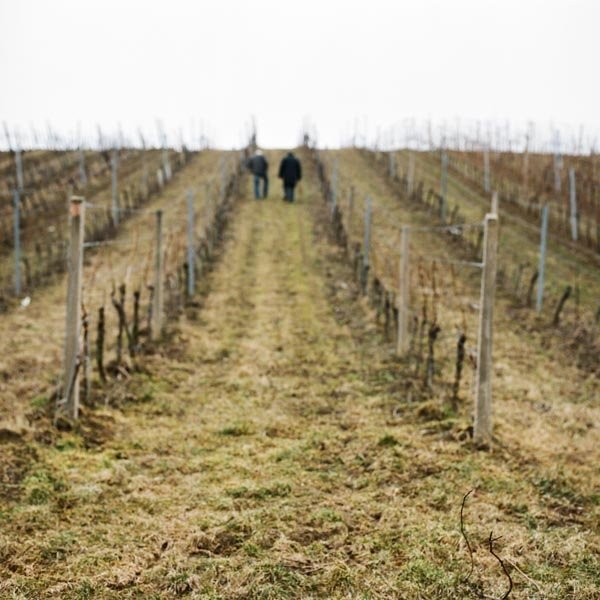
So which vineyard areas are supposed to go? The question is currently being asked quietly but frequently: by regional civil servants and among tourism experts. We are asking the question: who decides what stays and what goes? This is existential. For what is considered “valuable for tourism” today may perhaps decide tomorrow whether entire sites survive or not.
Viewed from the outside, German winegrowing looks like a success story bearing a cultural seal of quality: well-maintained sites, gentle and very steep slopes, a glass of Riesling at the Saarschleife. Yet behind this postcard idyll uncertainty begins. Rising costs, falling consumption and massive overproduction are putting many businesses under pressure. 2024 brings another blow: a significantly reduced yield as a result of extreme weather conditions. And yesterday there was hail again in Rheinhessen, causing massive damage.
Despite the smaller harvest, price pressure remains high, explains Professor Simone Loose of Geisenheim University in an interview with WELT (2024). “The price for bulk wine in the Palatinate is currently around 70 cents per litre – but production costs are at least €1.20.” Even wine estates with strong direct marketing are feeling the reticence, according to the VDP in the same publication: demand is declining particularly in the domestic market, while the hospitality sector is also holding back.
Yet amid this crisis, precisely this larger, uncomfortable question arises: Which growing areas still have a future – and which do not? Or, more precisely: Which areas will disappear – and which will remain because they possess “tourism value”?
Geisenheim’s Loose stated it openly in 2024: to prevent a further fall in prices, production volumes would have to be adjusted – and this would also require deciding which sites would still be economically viable in the long term at all. What is implied here in passing is explosive: it is about selection. Will vineyard slopes that attract no visitors, produce no picturesque images and house no visitor centre lose their right to exist in future?
Christian Schwörer, Secretary General of the German Winegrowing Association, also introduces the concept of “rotational fallow land” in an interview with WELT. The idea: after a vineyard is grubbed up, the planting right remains valid for six years. Winegrowers could use this time to create flowering areas that promote biodiversity. An ecologically sensible model – yet economically inadequate. EU funding amounts to €200 per hectare, whereas according to Schwörer around €3,000 would be needed just to cover fixed costs.
In this economically strained situation, it becomes clear how unevenly distributed the prospects for the future are. Anyone farming sites that are rich in tourism appeal, attractive in landscape terms or marketable culturally has better cards. Others – in structurally weak regions, away from wine trails – will have to shut down or change their operations. But who makes these decisions? The market? Politics? The winegrowers themselves? Probably politics above all. Some winegrowers in Rheinhessen and the Palatinate should take this as a warning.
The sector is calling for more support: tax relief, advice and a stronger political commitment to wine culture. “Today’s and tomorrow’s winegrower must not only be a good winemaker – more than ever, they must also possess entrepreneurial qualities,” says Geisenheim study staff member Loose on WELT. She calls for professional customer retention and emphasises: “A well-maintained digital customer database is actually more valuable today than the vineyard area itself.” A sentence that reveals a great deal.
For the battle for market share has long been in full swing. Demographic change – young people drink less, while older people drink less for health reasons – is causing overall wine consumption to decline. The call for abstinence, including from official bodies such as the German Nutrition Society, is growing louder. Christian Schwörer disagrees in WELT: there was a lack of scientifically robust evidence for the recommendations to abstain from alcohol altogether.
Instead, he advocates “market segmentation” and calls for clear political signals in favour of wine culture. “Wine is not merely an agricultural product – it is also part of our cultural heritage,” says Daniela Schmitt, Minister for Winegrowing in Rhineland-Palatinate. Ernst Büscher of the German Wine Institute reminds us that although twice as much wine is consumed as produced in Germany, only 42 out of 100 bottles come from German regions.
A sober look at the market shows: Italy and Spain dominate the lower price segment. Anyone who buys wine in a supermarket for two or three euros will be difficult to win over to an eight-euro bottle.
The question remains: who decides which areas disappear – and which remain? The top sites with a view? Those that are economically viable? Those that can be exploited for tourism? Or is there still a vision that is not guided solely by market logic and Instagram suitability?
The transformation of the wine landscape has begun. It is time to talk about what we are losing – and what we want to save.
(If you, dear readers, would like to comment on this article, we ask you to do so on social media (Instagram, Facebook, elsewhere), where this text has also been shared extensively)