
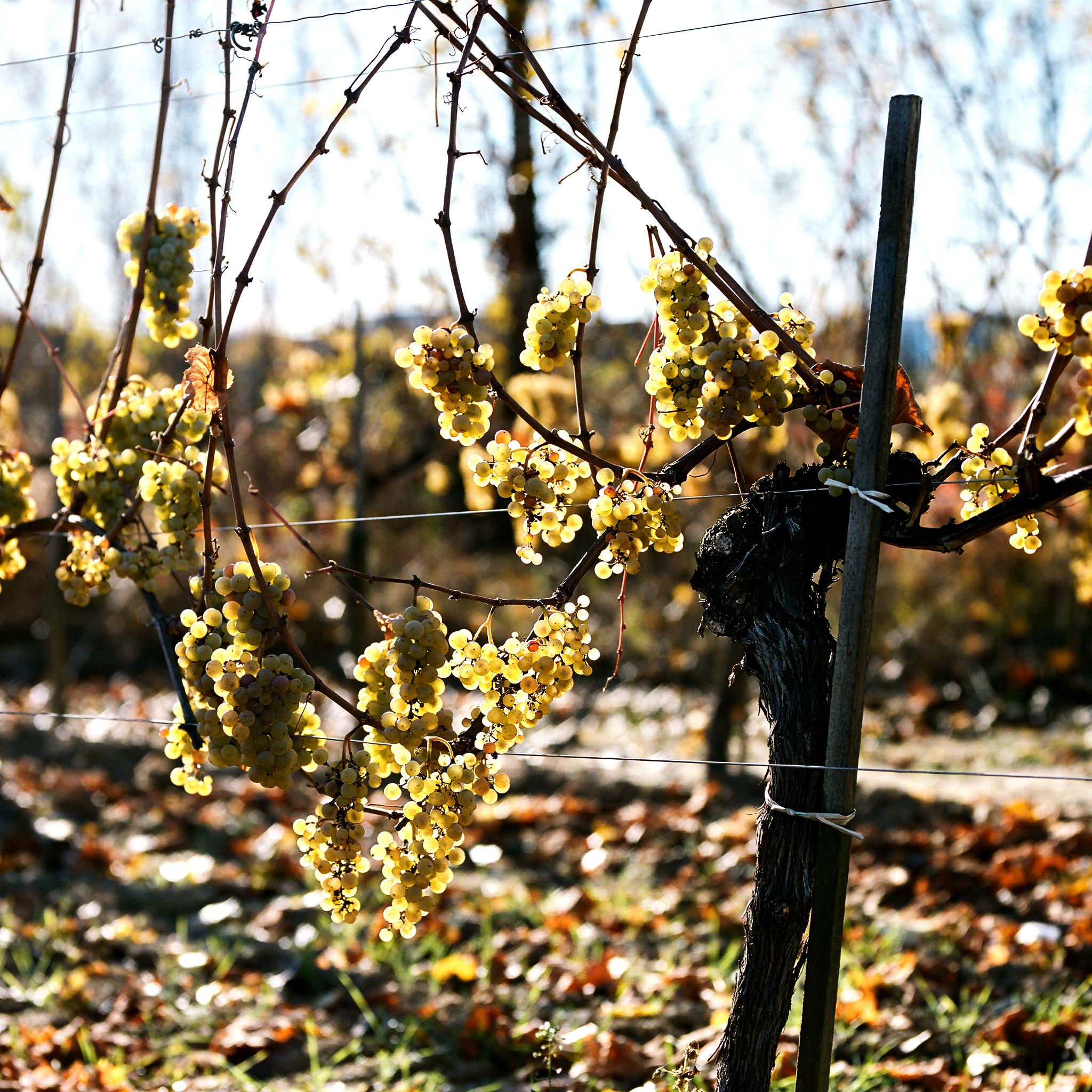
(Gerhard Retter / pic: Manfred Klimek)
When it comes to wine, we talk about almost everything. About soils and rocks, about slate, limestone, loess or volcanic soil. About spontaneous fermentation, large wooden casks, extended lees ageing and that famous minerality which everyone describes and nobody can really explain.
We talk about water surprisingly rarely.
Probably precisely because, in Central Europe, water was taken for granted for generations. Anyone who grew up in Austria or Germany did not learn to regard water as a precious resource. We turned on the tap, and it was there: cool, clean, reliable. Winegrowing, too, lived for a long time with this certainty. Rain came. Sometimes more, sometimes less. But usually enough.
That certainty is now disappearing.
Not as spectacularly as it should. No one will wake up one morning and discover that suddenly no more grapes are growing. The change is happening much more quietly. It begins in individual parcels, with young vines, on shallow soils or steep terraces. It also becomes apparent in those years when, statistically, enough rain has fallen, yet the vines still suffer from drought stress. For it has long ceased to be decisive how much water falls within a year. What matters is when it falls, how quickly it infiltrates and whether the soil is still capable of storing it at all. In the worst case, during torrential rain, it washes away essential, fertile layers of earth. And we need not even begin to talk about water bound up in hailstones.
Over the past thirty years, winegrowing in Germany and Austria has been among the beneficiaries of warming. Riesling ripened more reliably, and red wines achieved qualities that had previously been possible only in exceptional years. Many winegrowers remembered decades when they hoped and worried deep into autumn for sunshine, wondering whether the grapes would ripen at all. In many places, that concern has disappeared.
Another has taken its place.
Heat alone does not produce a great wine. At some point, the advantage tips over. Early ripeness becomes overripeness. Dry autumns become dry springs. The vine switches to survival mode, photosynthesis slows down, leaves wither, young vines struggle to survive and even old vines draw on their reserves.
The romantic notion that great wines are born only from suffering vines therefore belongs in the realm of wine myths. A vine may be challenged. It must develop roots; it should not grow comfortably. But it must not die of thirst.
This is particularly clear in Austria. Although the country as a whole has enormous water reserves, the most important winegrowing regions lie precisely where precipitation is often scarce: in the Weinviertel, Burgenland, Carnuntum and the Thermenregion. The national average is of little help to a vine in the Seewinkel.
In Burgenland, the future of European winegrowing is already beginning today. Gravelly and sandy soils lose water quickly. Old vines have an advantage because their roots reach deep. Young vines do not have this luxury. At the same time, winegrowing, agriculture, tourism and sensitive natural areas are competing for the same resources. Water is therefore becoming not only a matter of good farming, but also a social issue.
A permit under water law does not answer it yet.
In the Weinviertel, the solution often lies not in the well but in the soil itself. Loess can store enormous quantities of water. But only if rain is allowed to infiltrate. Compacted soils, erosion and open wheel tracks mean that precious water disappears within minutes. Cover crops, building up humus, mulch and careful soil management are therefore no longer merely green accessories. They determine whether a vineyard will still function in twenty years' time.
The situation is quite different in the Wachau, Kamptal and Kremstal. There, steep terraces and thin layers of soil produce the distinctive wines for which these regions have become world-famous. At the same time, they are particularly sensitive to longer periods of drought. A thunderstorm in Spitz or Dürnstein tells us nothing about how much water is actually available to a south-facing stone terrace.
Even Styria, long regarded as a rainy exception, is now experiencing new problems. The water is often not lacking overall. It simply arrives at the wrong time. Torrential rain rushes down the slopes, carries soil away and disappears just as quickly as it came. A few weeks later, the same vines are suffering from drought.
Winegrowing is rediscovering a lesson that earlier generations knew long ago: it is not rain alone that determines a vintage, but the soil that can retain it. And these soils must be protected more than ever.