
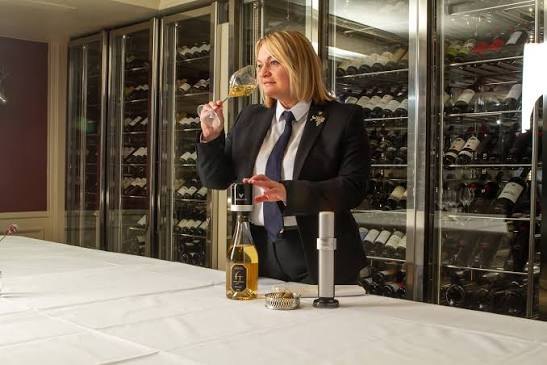
Everyone who is more interested in wine than is strictly necessary knows the situation in a restaurant. The sommelier appears at the table, enquires about the guests’ preferences and, as soon as the word Riesling is mentioned, begins a discourse on slate weathering, slope gradient, possible spontaneous fermentation and, by way of supplement, the astonishing story of a winegrowing family whose great-grandfather allegedly already knew that the parcel at the top end of the vineyard produced better grapes than those near the river (which is usually true). The presentation is technically accurate, the man is excellently trained and the wine is probably outstanding. After seven minutes, however, we only want something to drink. Quickly! And preferably what we originally wanted to order.
Sommelier training has developed into a genuinely demanding discipline over the past few decades. Anyone who thinks highly of themselves knows not only the major wine regions and their most important producers. They know about soils, clones, rootstocks, maturation methods, vintage conditions and the differing philosophical approaches of biodynamic agriculture. A good sommelier can turn this knowledge into a wonderfully fascinating story. A less good one regards their guests as an audience that ought to be grateful finally to be allowed to learn something. The line between advising and lecturing is a fine one. Some cross it as early as the greeting.
In the United States of all places (and not only there), where the sommelier profession has experienced a remarkable rise in social standing over the past twenty years, a different form of wine service is now being developed. In more and more wine bars and restaurants, the printed wine list is disappearing. Instead, the guest is simply asked one question: “What are you in the mood for?” What are you in the mood for? Red or white? Light or full-bodied? Fresh, fruity, dry? A particular country? An approximate price range? The staff then bring a wine that matches these preferences. Sometimes it can be tasted beforehand. Duration: a maximum of 2 minutes, more likely under one.
The American magazine Wine Enthusiast examined the phenomenon as early as last year. The author John Sumners considered abolishing the written wine list an extremely bad idea. His objections are interesting because they identify precisely those weaknesses concealed behind the promise of greater informality. Anyone who is not given a wine list does not know which bottles are actually available in the restaurant’s cellar. They do not necessarily know the prices, cannot compare vintages and have to rely on the staff member correctly understanding their wishes. For guests who like to choose for themselves, the new freedom can become a rather patronising affair. However, several well-known establishments are already practising the concept successfully, such as Sauced in Brooklyn and Nashville, and Les Enfants du Marché in Paris. It cannot yet be described as a full-scale revolution, though.
Nevertheless, the idea strikes a chord. The traditional wine service has a problem that is surprisingly rarely discussed within the industry. It often focuses on the needs of people who work professionally with wine. For them, a list with two hundred entries is a pleasure. For many guests, it is an imposition. After a long day at work, anyone going out to eat with friends does not necessarily want to spend twenty minutes thinking about the differences between three villages in Burgundy. They want a good wine whose price seems reasonable and which suits their current mood. A Pinot Noir, because they like Pinot Noir. A Sauvignon Blanc, because they happen to fancy Sauvignon Blanc. And that’s it!
A full-bodied red wine, even though fish has been ordered. That happens too. And, remarkably, the gastronomic world has survived every such breach of the rules so far.
The new American informality takes the guest’s wishes more seriously than the sommelier’s received wisdom. If someone wants to drink Cabernet Sauvignon with grilled turbot, they get it. The wine-service professional can politely point out that another wine might pair better with the dish. If the guest nevertheless continues to insist on their Cabernet, the matter is settled. The fish will not be offended. This matter-of-fact attitude ought really to have been part of hospitality for centuries. Apparently, it took a gastronomic trend to rediscover it.
There is also an economic consideration. An extensive wine list ties up capital. Hundreds of bottles have to be purchased, stored, inventoried and regularly checked. Vintages change, prices alter and individual listings suddenly become unavailable. The larger the list, the greater the demands on purchasing and staffing. A carefully assembled selection of twenty wines is much easier to manage. It can be changed more frequently, stock remains manageable and staff learn about the wines on offer more quickly. Anyone who concentrates the selection on a few flavour profiles also needs to do less explaining. After all, most guests are not looking for an oenological surprise. They want to drink something they like.
However, two things should be kept separate. A restaurant without a printed wine list does not necessarily have only twenty wines. Some American establishments work with constantly changing stocks and quite unusual bottles. That is precisely why they dispense with a list that they would otherwise have to reprint almost every day. Conversely, a restaurant with twenty carefully selected wines can easily offer its guests a clear list. The question, then, is less how many bottles are lying in the cellar. More interesting is why the guest should no longer be allowed to choose them for themselves.
For restaurateurs looking for ways to cut costs in the face of rising expenses, the concept is certainly tempting. A small wine programme requires less storage space, less tied-up capital and possibly no employee dedicated exclusively to wine. The service can be handled by trained waiters. A good restaurant manager will know and be able to explain the twenty wines served by their establishment. They do not need to recognise every Grand Cru of Burgundy blind or recite the soil profiles of the Wachau from memory.
And that brings us to the uncomfortable question of whether the sommelier profession is currently abolishing itself.
The answer depends on what one actually needs this profession for. If its task is to parade as much specialist knowledge as possible in front of the guest, things could indeed become difficult. Knowledge alone is no longer a particularly exclusive commodity in 2026. Anyone wanting to know which grape varieties are permitted in Châteauneuf-du-Pape can look it up on their smartphone within a few seconds. In American restaurants, sommeliers are already observing guests consulting artificial intelligence while the wine expert responsible is standing just a few metres away. There is a certain comedy to the situation. For decades, the industry has trained its experts, and now their customers are allowing software to explain which wine they should order.
A piece of software does not know which bottle in the cellar has currently matured particularly well. It did not taste the young Barbera yesterday, does not know the exact and correct temperature of the wine being served, and does not notice that the guest actually just wants an uncomplicated glass. These are abilities that still distinguish a good sommelier. Provided they use them for the guest’s benefit and not to demonstrate their own importance.
Another factor is also influencing this development. The American hospitality industry has to adapt to a public that is becoming increasingly critical of alcohol. Younger guests often drink less, switch between alcoholic and alcohol-free drinks or give up wine altogether. In its current drinks trends report, the American Restaurant Association explicitly points to the growing importance of high-quality alcohol-free options. For the hospitality industry, this is initially a commercial reality. A guest who does not want to drink alcohol should still be happy to return. And anyone who only wants to order a glass of wine should not have to justify themselves for doing so.
An unobtrusive wine service fits into this changed environment. No one is offered a bottle without being asked. No one has to work their way through an extensive wine list only to explain afterwards that they would rather drink mineral water. The guest is asked about their wishes and receives a corresponding recommendation. This may lower the threshold for ordering wine at all. But it may just as easily mean that they stick with their alcohol-free drink. The abolition of the wine list is therefore not a strategy for countering falling demand for wine. At most, it can help make people’s relationship with wine less complicated.
It is interesting that the new method has a weakness precisely where it believes its greatest strength lies. Asking about the guest’s current wine mood works brilliantly as long as they know their wishes reasonably precisely. Anyone who says they want a fresh, dry white wine will probably get something suitable. However, anyone looking for a mature white Burgundy, wanting to compare a particular vertical of vintages or simply wanting to know which unusual bottles the restaurant has will find little use in being asked about their mood. They want to see the list. And they have a good reason for that.
After all, it is a different thing to allow oneself to be advised and to have the opportunity to make one’s own decision taken away. A wine list also has a democratic function. It shows what is available and makes prices comparable. Without a list, the guest is entirely dependent on the knowledge and honesty of the staff. Are they being recommended the wine that best suits their wishes? Or the one of which the restaurateur currently has particularly large stocks? The two need not be mutually exclusive. But the temptation exists. Even an exceptionally likeable sommelier remains a salesperson.
And there is another argument against abolishing the wine list entirely. It can itself be a cultural document. A good list tells the story of an establishment’s preferences, its relationships with winegrowers and its understanding of the world of wine. It can arouse curiosity, introduce unfamiliar regions of origin and tempt guests into discoveries that they would never have arrived at by answering a question about their wine mood. Anyone who always gets only what they already fancy will probably rarely broaden their preferences. A large part of wine culture owes its existence, however, to people who at some point tried something they had not previously known they might like.
The claim that a small selection can fundamentally manage without a sommelier also deserves to be challenged. Selecting twenty wines so that they sensibly cover different tastes, price categories and dishes requires considerable experience. Limiting the task does not automatically make it easier. Anyone offering only a single Riesling should know precisely why it is that one.
It may therefore be that the new American movement is announcing not so much the end of the sommelier as the end of a particular idea of the profession. The sommelier as a walking wine encyclopaedia, as the master of ceremonies of a complicated order of enjoyment, as the man or woman who accompanies even the simplest order with a little technical lecture, will increasingly encounter guests who can do without that. The sommelier as a host who listens, recognises wishes, respects prices and occasionally recommends the perfect bottle in a single sentence, on the other hand, is likely to have a fairly good future.
However, they will have to learn something that is apparently neglected in some training programmes: to keep their mouth shut in good time.