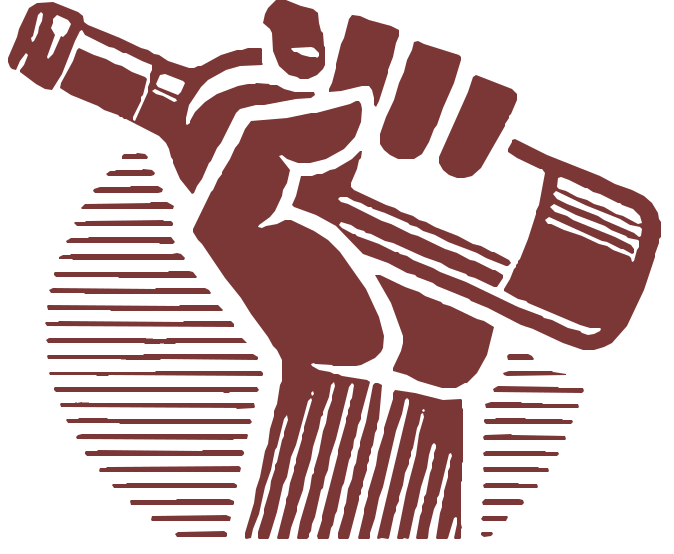

(Essay in The Healthy Times magazine, published by the Healthy Boy Band / Photo: Cover of The Healthy Times)
Two Ways of Remembering
Petting with Pet-Nat? Intercourse with Bordeaux? Sex after wine, with wine, because of wine. Is that even conceivable in the age of the Dry-Whatever movement? Yes! But..
Neither can be explained with PowerPoint. Both elude pure functionality. Both are – if you do them properly – less a matter of wanting than of feeling. And that is the common core of good sex and great wines: They are not something one can simply have. Rather, they are something that happens. Often like a whirlwind. But usually like a gentle breeze.
The great mistake of modernity, now drawing to an end, was wanting to force wine and sex into categories: points, price, performance. Yet anyone who has ever drunk a truly great wine – so great that, as you exhale, you can feel that something inside you is being put in order – knows that wine is much closer to the body than the anti-alcohol abstinence movement would have us believe.
The sip is only the beginning. What remains afterwards is decisive. The aftertaste, the after-feeling, the quiet fluttering on the skin. Anyone who knows this understands: in wine too, the sensual is not an accessory, but the core.
Sex works in a similar way. The body as stage, touch as tannin, breath as backbone. The technical craft matters – but only if it is allowed to be forgotten. The finest note of a wine is the one that does not need explaining. With sex, it is the same.
Both are – at best – not consumption. Rather, a dialogue. A resonance between two bodies. Between skin and palate. Between warmth and coolness. Between what was and what is possible.
For what connects a truly good wine with a truly good moment in bed is this: The memory remains not only in the mind. It also remains in the body.
Wine & Sex – Cultural Reflections of an Ancient Desire
Ever since there have been people who wanted more than merely to be full, the same stories have grown up around wine and sexuality. Dionysus, the clamorous god of ecstasy, did not dance by chance among vines and naked skin. Intoxication was never merely the glass, the cup, in the hand. It was always also a transgression of the body's boundaries. Wine and eroticism – for the Greeks, this was not a lascivious afterthought, but a question of the order of the world: Apollo for moderation, Dionysus for excess. And both were necessary.
Later, in the medieval monastery, wine was disciplined. Pleasure became sacrament. The monks fermented the juice with devotion, but also with that secret delight that arises when the forbidden leaves a quiet crack open. The monks knew: wine is body. And the body – even in prayer – can never be completely tamed.
When the Enlightenment arrived, people believed they could save wine – like sexuality – through rationalisation. They spoke of bouquets, terroirs and acidity levels, while at the same time the etiquette of bourgeois chastity reduced eroticism to, at most, the confines of marriage. But here too: anyone who drank with an alert palate knew that pleasure had not disappeared. It had merely disguised itself better.
In the 19th century, finally, both wine and sex were rediscovered as what they are: experiences of corporeality. The Naturalists described with fiery tongues what remained on the tongue. And artists from Courbet to Klimt painted the transition: from landscape to skin, from vineyard to love.
Today, in the post-ironic age, both are simultaneously destigmatised and flattened. The wine industry puts scores on bottles, dating apps put scores on people. Yet anyone who takes the time to taste rather than consume feels that the real thing remains: the quiet prickling of bitter compounds, the interplay between fruit and acidity, the temperament of the moment.
Wine – like sexuality – was never made for the production line. Rather, for the moment when two bodies – or body and palate – stop being strangers.
Wine: Not Alcohol Like Any Other
But before we drift too far into the poetic: wine is not gin. And certainly not tequila. Anyone who reaches for a bottle of Greco di Tufo on a date and then wonders why the conversation flows less uninhibitedly than after the third gin and tonic has not understood the nature of wine.
Wine intoxicates differently. More slowly. Closer to the body. Where spirits often hammer inhibitions with a sledgehammer, wine is the foil fencer among intoxicants. It loosens without transgressing boundaries. It warms without burning. And that is precisely what makes it both so dangerous and so wonderful for sensual approaches: it creates an in-between space. No crashes, but a fluttering. No loss of control, but a game with the loss of control.
Changing Colour? Better Not.
And yet the evening's most beautiful choreography is quickly ruined if we fail to keep the rhythm. The golden rule of experienced connoisseurs: do not change colour. Anyone who starts with white and ends with red risks not only a headache, but emotional ruptures too.
A cool, mineral Chablis tells a different story from a sun-warm Grenache. Anyone who mixes wildly ruins the evening for themselves – and gets up the next morning without a narrative, but with a throbbing head.
So stay with one style. Make a decision. Follow the rhythm of one wine, one colour, one texture. The body will thank you. And so will the evening.
Consent Does Not Begin and End with a ‘Cheers’
And finally – this is part of it too: Nothing is more erotic than an intoxication that remains as a good memory. Not the blackout in one's memory, but the quiet shimmer of an evening one is still happy to inhabit twelve hours later.
That means: both – or all – participants must be aware of their intoxication. Wine is not an alibi for crossing boundaries. Rather, it is a medium that reveals boundaries, if one knows how to listen to it.
One glass too many? It can happen. But it must never result in what happens during the night being regretted in the morning. Wine is dialogue, not an excuse. And especially in moments of togetherness, the rule is: whoever drinks must remain aware of themselves – and of the other person.
The Democratic Bottle – Choosing Wine as Dialogue
There were times – not so long ago – when it was considered good form for the man at the table to order the wines. Just as he spoke up when the commis arrived. Or placed his napkin on his lap first, while the ladies waited with polite smiles. This was called a ‘connoisseur's eye’, a ‘gentlemanly gesture’ or simply ‘the boss chooses’. A relic of an era in which wine was not understood as a sensual common good, but as a stage for male competence.
Those days are over. Thankfully.
For anyone who invites people to the table today – and who understands wine as dialogue, not monologue – knows: choosing a wine is the first part of the approach. It is part of the game, part of the preliminary flirtation already revealed in leafing through the list and discussing grape varieties, vintages and regions. So why should this moment still be one decided patriarchally? Why leave the grand theatre of labels and vintages to men, while women are allowed only to provide the applause when the wine is poured?
No, the bottle, the wine, belongs at the centre of the conversation. And choosing the bottle becomes the evening's first shared choreography. What mood is everyone in today? Where do we want to go together? In the mood for the cool, mineral white that leaves everything open? Or perhaps the velvety, warm, dark red that says: now is the moment to let go?
Wine is always also a reflection of the moment. And moments do not arise through announcements, but through resonance.
Perhaps this is the most beautiful change wine has undergone in recent years: from an instrument of power to a relationship generator. The sommelier who speaks only to him has had his day. Today, people lean over the list together, laugh, marvel and taste. And let themselves be surprised. The most exciting bottles emerge from this interplay of voices. From this tentative, searching, sometimes even argumentative togetherness.
The bottle as compromise? No. As complicity.
For wine is, if we are honest, foreplay. And nothing ruins foreplay more than someone who thinks they know everything better. So let us leave the old gestures in the museum of good old masculinity fossils. And let us drink to a new order at the table. One in which the wine does not decide who speaks – rather, the dialogue decides which wine is opened.
For everything good begins – like wine itself – with sharing.
Wine & Sex – A Brief Closing Remark on the Big Picture in a Small Sip
Wine and sex – they have more in common than just the myth of Dionysus. They are rituals of the body. And rituals need time, respect and awareness.
It is no coincidence that great wines speak quietly. And that great lovers do not shout. The tender, the unspoken, the playful – in both worlds, all of this is the true core of the experience.
And anyone who has experienced it once knows: The best nights are not those in which everything was said. Rather, they are those in which what remained was allowed to breathe.