
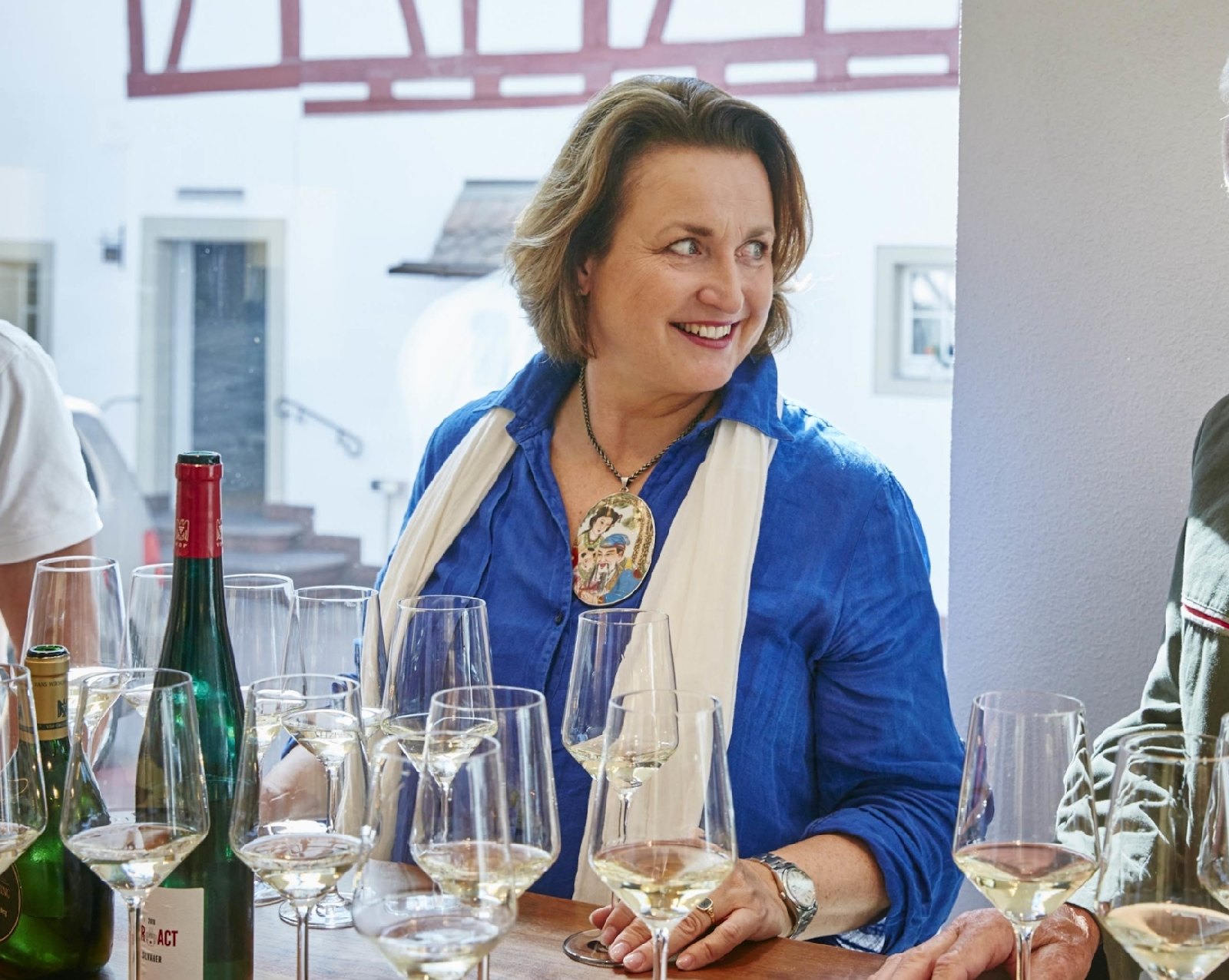
In retrospect, the name of the wine was almost prophetic. In 2011, Andrea Wirsching and her younger half-sister Lena made a wine together and called it “Sister.Act”. Silvaner and Riesling from old vines, spontaneously fermented and matured in large-format oak. For the traditional Franconian winery Hans Wirsching, this was a small departure from its own established order at the time. Andrea had gained experience with spontaneous fermentation on the Saar, while Lena had studied in Geisenheim and, among other places, trained with the biodynamically minded Alois Lageder in South Tyrol. Two sisters in Iphofen doing their own thing. Fifteen years later, the name takes on a second meaning. Lena von Gemmingen takes over the management of the family winery. Andrea leaves.
And not to retire. At 62, that would certainly have been an option. Andrea Wirsching is doing something much more interesting: she is starting again.
On 1 October, she will take over the management of the Karthäuserhof on the Ruwer. Not as its owner, as some reports could misleadingly be interpreted to suggest. The winery will remain the property of Albert Behler, whose family has owned it since 1811. Wine, however, has been made there for considerably longer. Carthusian monks founded the estate in 1335. Almost 700 years later, a Franconian woman is now arriving to take charge.
The area is not entirely unfamiliar to her. Andrea Wirsching began working at Schloss Saarstein on the Saar as early as 1993, at the time alongside her then-husband Christian Ebert. After their separation, she returned to Franconia and eventually took over the management of the Hans Wirsching family winery. She has officially been at its helm since 2016. Wirsching is one of Franconia’s great estates: Silvaner and Riesling, the Julius-Echter-Berg, a family history reaching back to 1630. A company where the surname is already a brand.
Andrea Wirsching is now voluntarily relinquishing this position of power. And paradoxically, that makes her even more significant. For if importance in winegrowing is not measured exclusively in hectares, bottles and points, but also by who can connect different wine worlds, then with this move Andrea Wirsching is currently the most significant female winemaker in German winegrowing. She knows the large Franconian family winery from the inside, has worked on the Saar and Moselle, is at home in the VDP, knows the trade, politics and associations, and is now moving to the Ruwer, to one of Germany’s historic Riesling estates. Biodynamics is, remarkably, something new for her. In Iphofen, she says, it simply was not feasible given the size of the business – although sustainable practices are naturally already followed there. At the 24-hectare Karthäuserhof, she sees different possibilities.
And waiting there is Mathieu Kauffmann. That makes the whole thing truly interesting.
The native Alsatian is one of those oenologists whose CV reads a little as though someone playing wine Monopoly bought only the expensive streets. Kauffmann began with sparkling wine in Alsace, joined Champagne Bollinger in Aÿ in 2000 and stayed until 2013. As Chef de Cave, he helped shape over many years a style that made Bollinger unmistakable. He then moved to Reichsrat von Buhl in Deidesheim, where from 2013 to 2019 he was cellar master and Technical Director, above all showing German Riesling sekt that it had no need to hide from great Champagne. In 2019, he was named Winemaker of the Year by both Falstaff and Gault & Millau.
His great subject was, and remains, oak. But not the kind of oak use that subsequently makes a wine taste like a joiner’s workshop. Bollinger now owns around 4,000 old casks, giving it one of the largest barrel collections in Champagne. New barriques are expressly unwelcome there. The used casks allow tiny amounts of oxygen into the wine without imposing an overtly woody flavour on it. At Bollinger, great vintage Champagnes are fermented in oak; some of the Special Cuvée and the reserve wines also pass through this old, complicated world of casks, magnums, lees and time. During his years at Bollinger, Kauffmann tasted thousands of individual cask lots in order to compose vintage, reserve and non-vintage wines from them.
He belonged to a generation of cellar masters who reminded the Champagne world that oak does not automatically mean toastiness. Used correctly, it is an instrument of controlled oxidation, texture and ageing potential. Kauffmann put it more simply: the wood lets the must breathe. Under his aegis, Bollinger’s vintage cuvées were fermented entirely in oak. Anyone wanting to understand why so many ambitious Champagne houses are once again working with casks today should look at this period.
Kauffmann subsequently brought this way of thinking to Germany. I visited him at Reichsrat von Buhl in 2014, when the rather immodest plan had been announced of making the best Riesling sekt in Germany. At the time, it sounded very much like marketing. A few years later, it sounded considerably less like it. Kauffmann treated Riesling sekt not as a winery by-product, but with the same seriousness he knew from Aÿ.
He is now the Karthäuserhof’s Oenological Director. And what is interesting about the new appointment is that Andrea Wirsching has not come to explain to him how to make wine. The roles are clearly divided. Kauffmann is responsible for wine philosophy and style, Dominik Völk for viticulture, production and operations, while Wirsching is taking overall charge. Three people with rather pronounced personalities must therefore do something that is by no means a matter of course in German fine wine: work together.
There is also a winery that itself seems to be waking from a long sleep (sadly, not yet where social media is concerned). The Karthäuserhofberg is one of Germany’s historic great Riesling sites. Owner Albert Behler is investing in the careful renewal of the estate and a new vinotheque. Together with Kauffmann, he has even developed a Karthäuserhof Brut. The estate does not want to be a museum. It wants to move further into the present – which is no easy place to be.
And that is precisely why Andrea Wirsching’s decision is so inspiring. Careers in winegrowing are normally told like vines: one is planted somewhere and stays there. Particularly at German family wineries, origins quickly become destiny. The next generation takes over, the previous one eventually withdraws, and the family photographs are rearranged.
Andrea Wirsching is doing things differently. She is handing over to Lena and moving on.
This also brings the little story of Sister.Act full circle. In 2011, two sisters wanted to explore together what was possible beyond the familiar Wirsching world. In 2026, they are doing so on a larger scale. Lena is taking over in Iphofen. Andrea is taking responsibility at the Ruwer for a winery with almost seven centuries of history. And there she will meet an Alsatian who shaped Bollinger, changed German Riesling sekt and evidently still has no desire to retire.
This is not a generational change. This is a Sister Act Fact.
An interview column in WELT am SONNTAG about Andrea Wirsching, her departure from Iphofen and her new beginning at the Karthäuserhof will also follow shortly.