
(Klimek, Editorial Team, Mixology-Base)
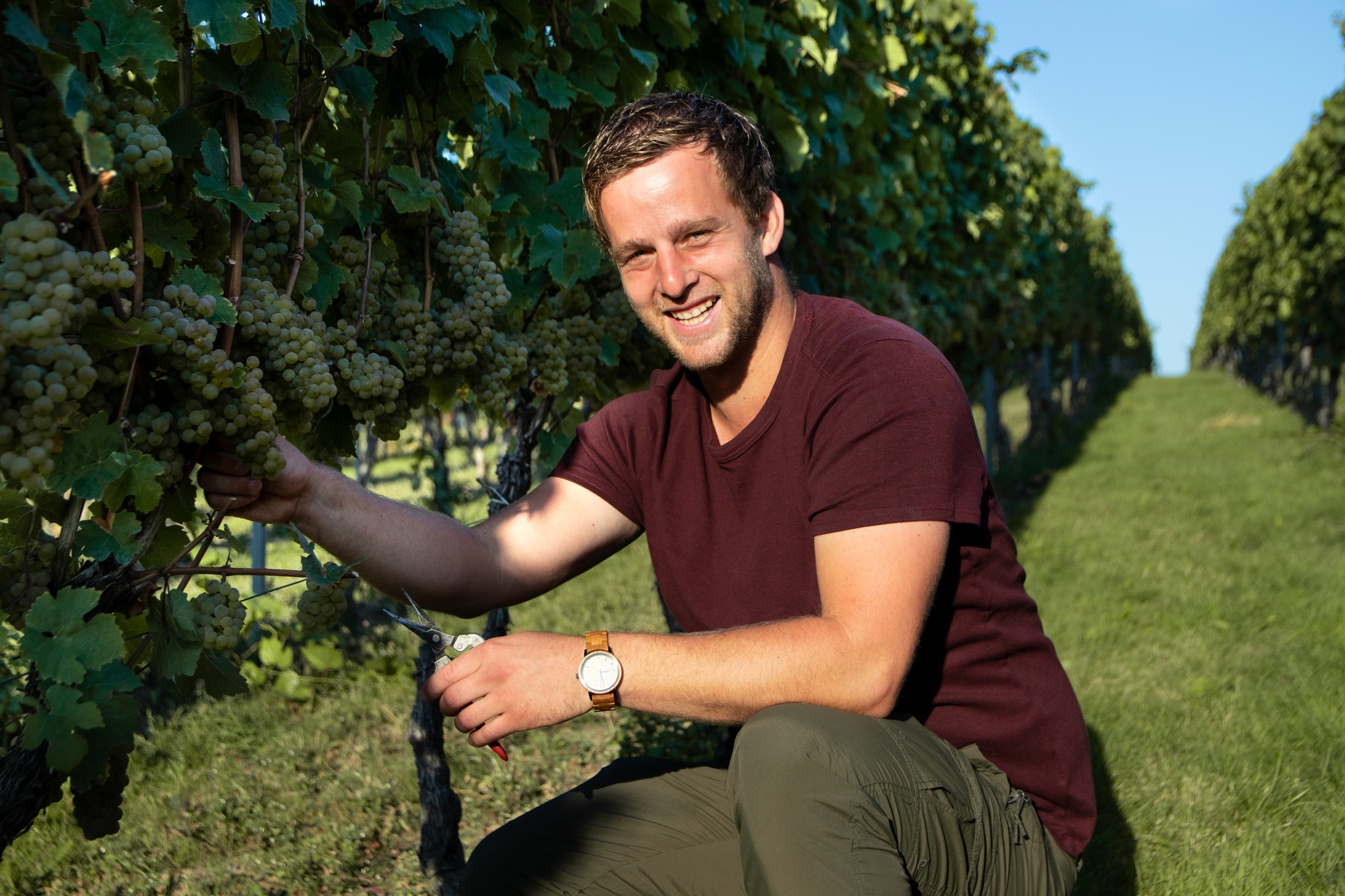
It almost seems like a twist of fate: whilst Gen Z talks with astonishing nonchalance about ‘low alc’, ‘big fruit’ and ‘easy drinking’, whilst sparkling wines (apparently still popular with Gen Z) and, to a lesser extent, wine alternatives are taking over the bedrooms of the urban youth, the very wine category that has been capable of all this for centuries lies fallow: fruit-sweet Rieslings. Wines that make do with seven, eight or nine per cent by volume, that are a drinking experience rather than a workout, that celebrate aromatics rather than alcohol. And yet they’re regarded as relics of past generations (okay, boomers) – until you head to the Moselle and meet a winemaker like Christoph Eifel. Eifel, in his early thirties, with the smile of a man who didn’t choose his profession but found it (admittedly, partly because he grew up in the trade), stands in the vineyard like someone who understands the craft of working steep slopes not as romanticism, but as reality. You can see it in his demeanour: the years of routine involved in harvesting, pruning and inspecting the vines; the confidence in levels of ripeness that can be recognised not in a laboratory, but only in the grapes themselves. A young winemaker who does not set out with heavy-handed ambitions fuelled by wine ideology, but with the conviction that great sweetness is only truly great when it is precise.
This is precisely what his two truly fruit-sweet Rieslings demonstrate; they exemplify the enormous potential this category would hold for the emerging drinking culture, were it finally freed from its niche – particularly the Kabis. The 2023 Riesling Trockenbeerenauslese from the Trittenheimer Apotheke vineyard is a concentrated microcosm: golden in colour, yet not heavy; viscous, yet not greasy; sweet, yet never cloying. Even on the nose, you can sense the vintage’s seriousness: nut, orange zest, dried apricot – no exuberant tropical fruit exoticism, no terroir-driven salty aroma, but rather a clear, taut sweetness. This continues on the palate: a majestic fullness, yet immediately counterbalanced by a dark, precise hint of bitterness that acts as an architectural counterweight. It goes down a treat. And by comparison, the Eifel’s brilliant sweets are still a joke when it comes to price. And long-distance runners, of course.
The 2024 Auslese from Piesporter Goldtröpfchen plays in the same orchestra, but with a different voice. It is brighter, more carefree, more playful. More citrus, a hint of kumquat and lychee, more lightness, a touch of youthfulness that isn’t ingratiating. Here, too, there are orange zest and a subtly placed nutty note, but the finish is more open, more invigorating. The sweetness comes across as a pulsating accent, not as a cloak. For many, this would already be the perfect balance: low in alcohol, high in charm, and yet all too rarely found in the glasses of the under-forties.
For the real drama surrounding fruit-sweet Rieslings lies not in their style, but in how they’re perceived. For too long, they have been pigeonholed as dessert wines, as companions for festive occasions, as museum pieces on the shelves of ageing and old age. Because, for many older drinkers, they are sentimental reminders of wine lists long since vanished. Yet for younger people, they are often simply unknown – having virtually vanished from public view. And yet they suit the present day like hardly any other category: they require no endurance, they do not overwhelm, they do not overburden. They are light, aromatic, long-lasting – and authentically Mosel.
Christoph Eifel demonstrates just how contemporary these wines can be when vinified with precision, purity and without aromatic distractions. No herbal wafts, no shards of slate, no kitschy Botrytis romanticism. Instead, clean lines: fruit, zest, a defining bitterness, an interplay of Mosel slate and radiant acidity. This is exactly what sweet wines that could appeal to Gen Z taste like – if only they were given a chance to try them. The fact that these wines often go unnoticed during the wine crisis is not down to their quality, but because they don’t feature on any trend charts. They are neither natural wine nor Pet Nat, neither orange wine nor ‘zero ABV’. They’re simply good – and these days, that’s almost a disadvantage.
But perhaps their moment will come again. Perhaps a generation that has long since moved on from rigid categories will discover, precisely in these wines, the freedom it seeks. Eifel, who also produces excellent and meticulously crafted dry Rieslings, demonstrates with his 2023 TBA and 2024 Auslese just how brilliant these wines can be – and how easily the market sets itself up for failure; how easy it is to overlook them.