
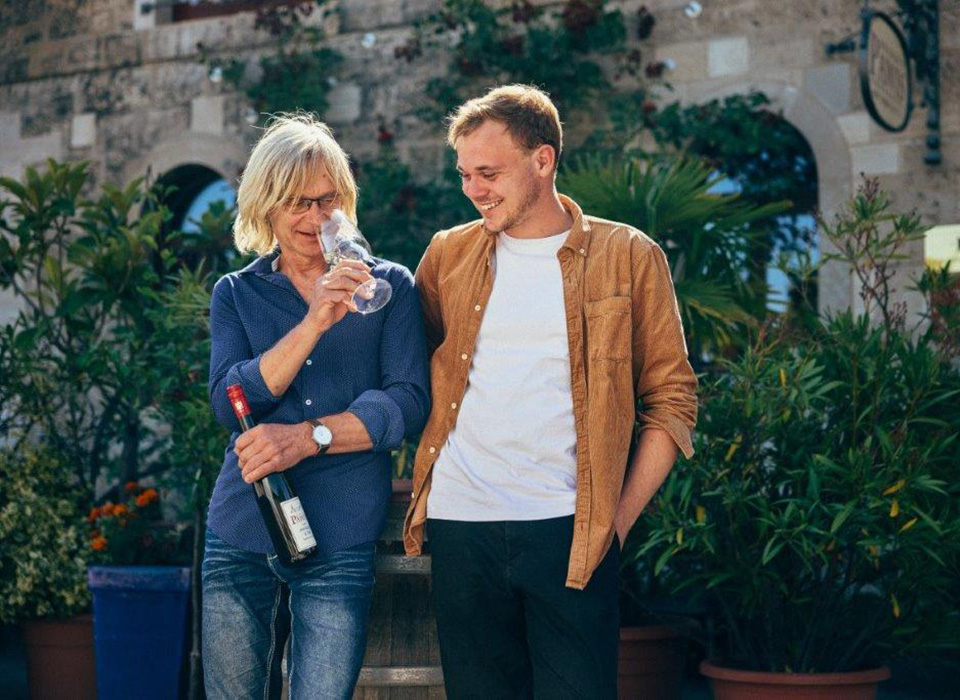
(Manfred Klimek, Bernard Pawis Winery/Photo)
My first trip to the East was twenty-five years ago. Back then, shortly after the fall of the Berlin Wall, there were vines growing in vineyards that had been neglected for decades. Brick walls supported crumbling terraces, and winegrowers spoke of the old days, when viticulture served as a cultural-political pretext. People drank whatever was just about drinkable – with the exception of special wines, which were reserved for the GDR’s Politburo (super socialist). But one thing was immediately apparent: where wine had been grown for centuries, even the unruly forces of communism had been unable to ruin it completely.
In Saxony, north of Dresden, lies a landscape that can hardly be described as anything other than picturesque. Radebeul with its steep slopes, Meissen with its silhouette rising above the Elbe, Pillnitz, where the vines almost grow into the Baroque scenery. Proschwitz Castle, the region’s oldest privately run estate, began early on to produce serious wines from the ashes of the planned economy. The Goldriesling – scarcely known anywhere else – found its last bastion in Meissen, alongside Pinot Blanc and Riesling, which today proudly bear the VDP seal. And then there is Klaus Zimmerling, who in Pillnitz created not only wine but an entire visual language: His wife’s (slightly kitsch) sculptures on the labels, Riesling and Traminer in the glass, which at times shone in noble-sweet splendour and attracted nationwide attention in the noughties. Later, Martin Schwarz joined the scene; formerly a cellar master at Proschwitz, he now has his own distinctive style: Rieslings from granite-soil vineyards, Pinot Noir aged in oak – nothing loud, everything precise.
Dresden itself has long since become not just the backdrop, but also the stage for a new wine culture. In the city’s bars and restaurants, you now find young sommeliers who open Saxon bottles with the same ease as they do great Burgundies. People actually drink Zimmerling or Schwarz alongside Puligny, and the public has learnt that the Elbe region can certainly hold its own when it comes to fine wine-growing.
A little further north-west lies the Saale-Unstrut region, the largest of the East German wine-growing areas. Freyburg and Naumburg, chalky soils, cool nights – it smells of Burgundy when the vintages are kind. Pawis pioneered the region here, buying a monastery estate in Zscheiplitz, building modern cellars and putting Edelacker wines on the menu. Riesling, Pinot Blanc, Pinot Noir – always serious, never pandering. Böhme & Töchter, on the other hand, recently admitted to the VDP, demonstrate that craftsmanship and youthful curiosity go hand in hand: longer maceration periods, spontaneous fermentation, a Chardonnay that combines power and elegance in equal measure. And in between, there’s Hey, at the Steinmeister in Naumburg, who crafts his wines with a steady hand – Pinot Blanc, Riesling, even Zweigelt, which can turn out astonishingly refined in warm years.
And then there’s Leipzig. That’s where I really got to know the Hey wines for the first time. Not in the vineyard, but at Gasthaus Helmut, where a brilliant team of wine lovers crafts the wine list like a manifesto: no dogma, no idle chatter, just glasses that are opened because they simply have to be drunk. A Riesling from Steinmeister followed – slender, cool, subtle in character – and for one evening, the restaurant became a tasting room for East German winemaking. Leipzig has thus become the secret capital – not because vines grow there, but because the bottles are open and there’s someone there to pour them.
Thuringia remains a footnote: small pockets around Bad Sulza, along the Ilm, winegrowers with tenacity and a sense of humour. When it gets warm enough, decent wines find their way into the glass – sometimes even better ones. Here, too, the climate is currently writing new scripts.
The Patke Winery, near Frankfurt an der Oder, ventures furthest to the north-east. A generation ago, no one would have believed that vines would be growing there again today. Johanniter, Kerner, Regent – hardy varieties that, in Brandenburg, used to be seen at most in textbooks. In Pillgram, the grapes are harvested and pressed. A symbol of how climate change is bringing the Mark back into the picture, where wine was once produced centuries ago.
So one must be careful when continuing to speak of the ‘new federal states’. After 35 years, it sounds grotesque, as if the East were to be perpetually placed in quotation marks. In the glass, at any rate, there is nothing new: here, a sense of origin has taken root and held its ground.
And then, as an ironic finale, there’s Rotkäppchen. No, not in Freiburg, as is so often mistakenly claimed, but in Freyburg an der Unstrut. Here, after the fall of the Berlin Wall, not only was a winery saved, but a piece of East German folklore as well. The managers bought the business from the Treuhand; later, it merged to form the Rotkäppchen-Mumm Group – today a market leader, an industrial giant, a symbol. Hundreds of thousands of bottles roll ‘off the production line’ every day; the base wines almost always arrive in Europe by tanker lorry from all over the world, and in Freyburg they are turned into passable sparkling wines. Passable, yes. Never great. But perhaps that is precisely what we must not forget on German Wine Unity Day: unity does not only mean the glory of the steep slopes, but also the indomitable survival of a brand that everyone knows – one of the few genuine East German success stories.
So here we are today. The East is not a footnote, but a chapter. And the further the climate shifts the boundaries, the more weight this chapter will carry. So on Unity Day: a glass of the East. Or better still – a glass of ‘Wine Unity’.