
(Manfred Klimek, Editorial Team)
It’s not quite a thaw yet, but perhaps the first faint crackling of the ice. An article in the latest issue of SPIEGEL. Title: ‘How much alcohol is actually healthy?’ Author Guido Kleinhubbert dares to do what hardly any major media outlet has attempted in the last three years: he breaks free from the spell of WHO rhetoric. No sensationalist headlines about imminent death after a glass of Cabernet, no knee-jerk call for abstinence. Instead: nuance, doubt, context. And that alone is – in this day and age – something of a minor sensation.
For in recent media coverage of wine, there has been little room for nuance. The WHO and the German Nutrition Society had declared wine, across the board, to be a health risk, backed by journalists who made their own abstinence a moral yardstick. People had long since become accustomed to every debate ending with the slogan ‘no safe level’ – a phrase as precise as a smoking ban in the desert.
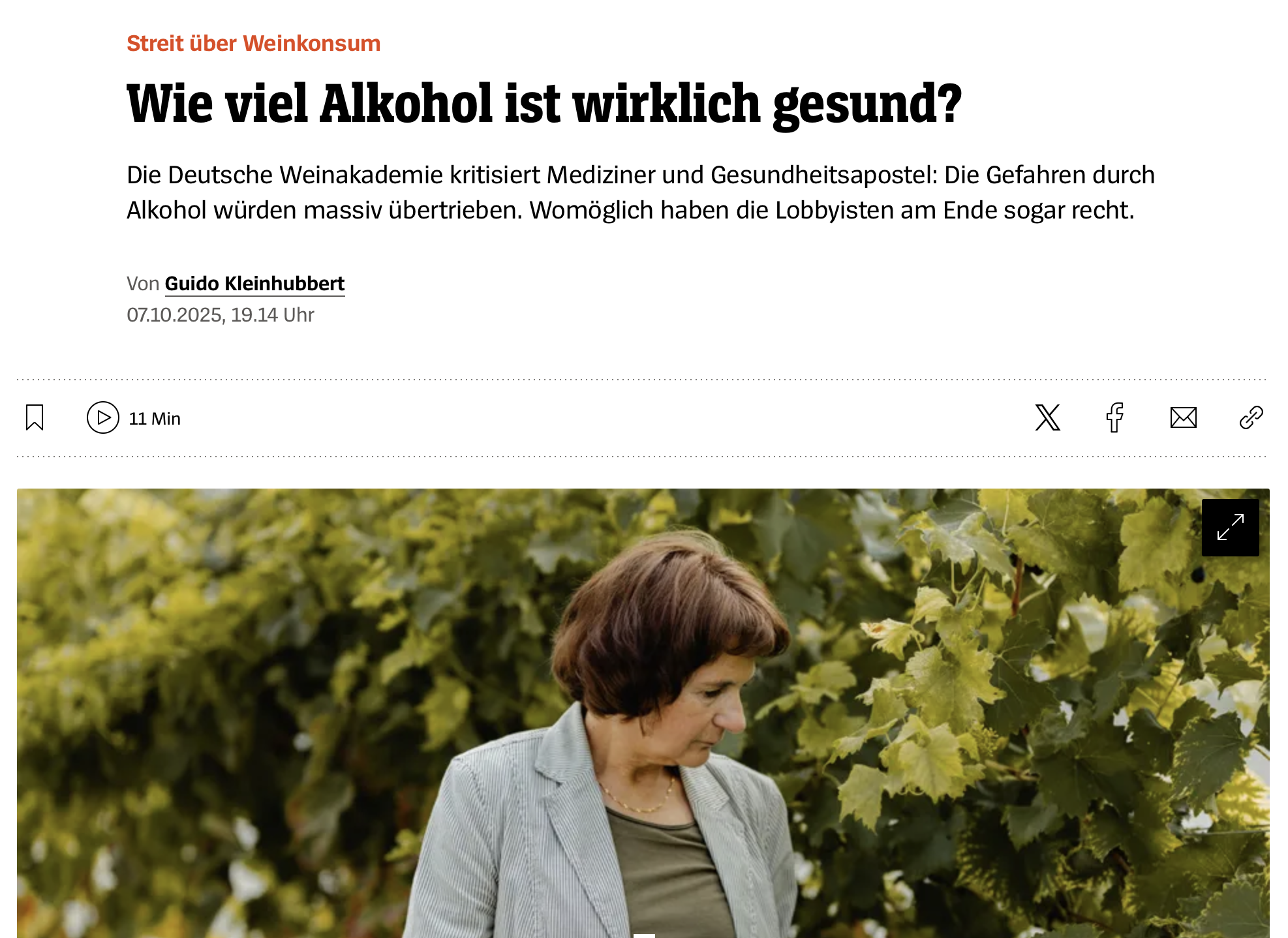
Now, then, *Der Spiegel*. And lo and behold: the article reads like a cautious backtracking. Kleinhubbert portrays the director of the German Wine Academy, Claudia Hammer, not as a lobbyist, but as a voice of reason. She articulates what every serious researcher has long known: that moderate wine consumption is not the same as alcohol abuse, and that there is a wide gap between a cell-damaging toxin and the joy of life – a gap that is worthy of scientific and cultural exploration, yet is rarely explored.
The article quotes scientists who dare to go against the grain – such as nutritionist Nicolai Worm, who points out that wine does not merely contain alcohol, but also polyphenols, i.e. secondary plant compounds that neutralise free radicals and offer cellular protection. Or that many earlier studies were simply inaccurate because they did not take sufficient account of lifestyle, education, physical activity or diet.
The key aspect of Kleinhubbert’s piece, however, is less its content than its tone. For the first time in years, a leading media outlet is discussing wine without raising its voice. The author evidently still knows a world in which wine was regarded not as an addictive substance, but as a social and cultural bond – as a drink for dinner parties, not for hospital statistics. Perhaps that explains why the text exudes a certain gentleness.
Of course, *Der SPIEGEL* also maintains a certain distance. Alcohol is and remains a cell toxin, it is emphasised, and anyone who drinks more than two glasses every evening should not expect a guardian angel. But it sounds less like a judgement than a reminder.
Also intriguing is the implicit self-criticism that resonates between the lines. Kleinhubbert describes the contradictions in the research, the interdependencies between studies, and the moral undertones of the debate – and reminds us that science is not the art of prohibition, but of weighing up the evidence. That a ‘no-safe-level’ thesis may make headlines, but it yields no real insight.
One senses between the lines that this text does not stem from the digital temperance movement, but from that generation which still knows what wine culture tastes like: journalists who learnt in the 1990s and 2000s that enjoyment also means discipline, and that morality does not depend on the size of the bottle.
For us at WINEPARTY, this SPIEGEL article is therefore a sign. Not a victory, not a revolution – but a shift in attitude. The first major media outlets are beginning to question the simplistic narrative of ‘wine = danger’. And this comes just before the next Dry January, when the puritanical trumpets will blare out once more.
Perhaps a new phase is beginning right now: not one of justification, but of serenity. Wine needs no defenders, only fair judges. And if even *Der Spiegel* is starting to write about wine with a clear head again, then that is – with all due respect – a small glass of hope.